

LOUISVILLE, Ky. (WDRB) -- When the NCAA adopted a new college football redshirt rule in 2018, allowing athletes to play in up to four games without burning an entire season of eligibility, most coaches hailed it as a good thing.
It gave players some wiggle room, particularly where injuries are concerned. Gone were the days of a player losing an entire year of eligibility after an early-season injury. Moreover, coaches could use the rule to get young players some limited experience — or even play them late in the year or in bowl games, while keeping four seasons of eligibility intact. (Postseason games no longer count against the four-game limit after a rule change last season.)
But since the transfer portal and NIL have become dominant features of the college basketball landscape, the redshirt rule has swung more into the players' favor. Athletes are "opting out," whether for injury or simply playing time calculations, of seasons for which they have already received some compensation, to preserve that season of competition — and earning power — for later, and potentially elsewhere.
The midseason opt-out is very much a thing, and it may be spreading to other sports as the NCAA considers expanding its football rule to all sports, allowing athletes to play in up to 30% of a team's games while maintaining their ability to redshirt.

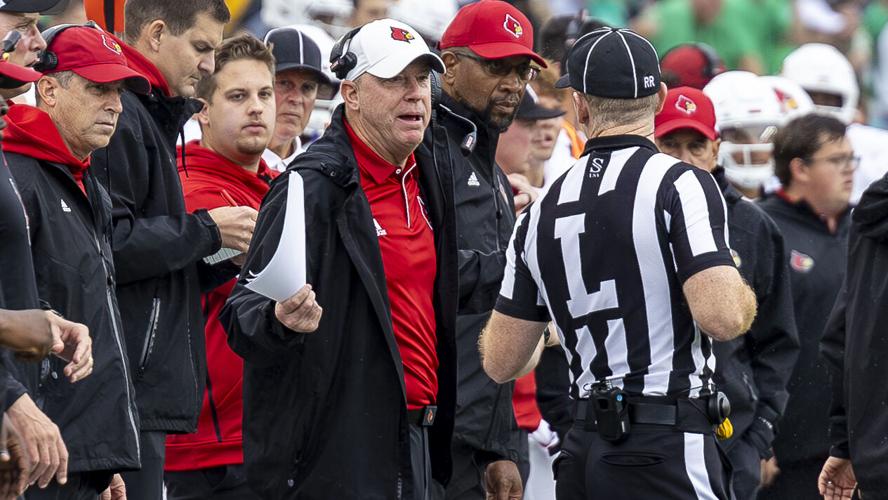
Louisville coach Jeff Brohm makes a point to an official during a 2024 loss at Notre Dame.
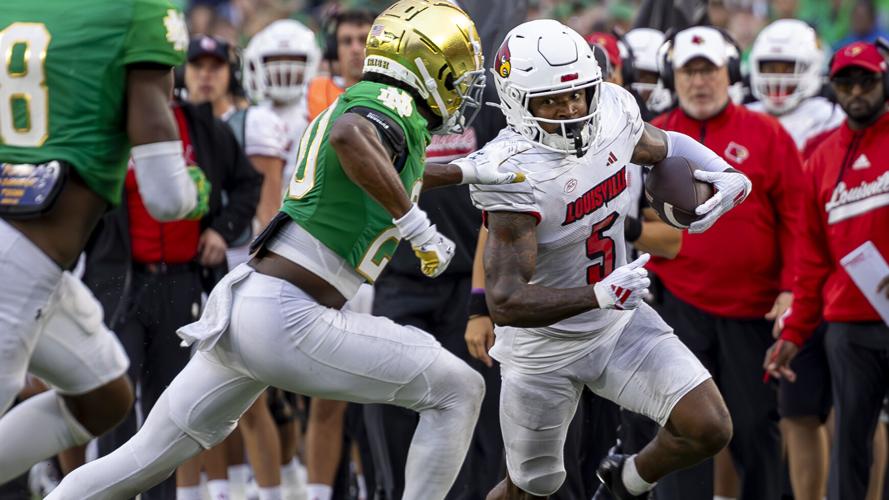
The recent situation of wide receiver Caullin Lacy at Louisville is a good example. Lacy sustained a serious injury — a fractured collarbone — before the season. He healed quickly and made his debut at Notre Dame on Sept. 28, Louisville's fourth game of the season.
Lacy played in the next four games and caught 15 passes for 179 yards. He also returned a kickoff 100 yards in a loss to Miami on Oct. 19. It would be his last game.
After that game, Lacy decided to opt out of the rest of the season, heal up and play his final full season of college football next season, whether at Louisville or somewhere else. His agent said he "intended" to play next season at Louisville and that the parties are "working tirelessly" to make that happen.
For Lacy, who has not been 100% all season, according to his agent, it's a smart move, financially and perhaps from a health standpoint.
Louisville coach Jeff Brohm, who had previously said he was proud of how hard Lacy worked to get back onto the field, said he wasn't happy with the opt-out decision, but in the end, wants to support whatever his players think is best for them.
His response illustrated the balance of what a coach thinks is best for the team and the new reality of being attuned to what his player wants.
"I was not in agreement with the decision. It was not best for our football team," Brohm said. "But I understand where he's coming from, and we definitely want to do what's best for all of our players and we'll always do that. But I do think that we're not as good of a team without him."
NIL and the transfer portal have thrown a new wrinkle into such decisions, which are not always made because of injuries, but sometimes just because of playing time.
Coaches aren't the only ones who can be left unhappy. Some fans aren't thrilled to see players who signed NIL deals they contributed money for leave after a portion of the season. Several Louisville fans took to social media to say so after Lacy's decision.
It's not likely to change the current rule structure.
At Indiana, Donaven McCulley saw himself slip down the depth chart under new coach Curg Cignetti and decided to redshirt.
At Alabama, defensive lineman Jeheim Oatis left the team after playing in four games to maintain eligibility and explore his value as a transfer. Kaleb Brown, a one-time Ohio State receiver — left Iowa earlier this month to preserve a redshirt season.
It is up to schools, or collectives, to structure business agreements with players to take midseason opt-outs into account. Those agreements, however, are not publicly available.
One possible solution would be allowing five full years of eligibility, eliminating the redshirt altogether and thereby removing the incentive to opt out after four games. But no such proposal is yet under consideration.
In the meantime coaches, who once held the upper hand in such situations, are adjusting to players having more say in their own use. And more could be coming with the NCAA is considering expanding the redshirt rule to all sports as part of a wider set of reforms that would eliminate the National Letter of Intent program and allow players more access to agent services.
The world of opt-outs could be growing. And more coaches could be faced with scenarios like the one Brohm is experiencing with Lacy.
(Lacy's replacement, Ahmari Huggins-Bruce, in fact, left Louisville for South Carolina after last season, only to return to Louisville before playing a game for the Gamecocks.)
"We're going to support him (Lacy) whatever he wants us to help him with," Brohm said. "When it came to other guys stepping up, we had to have other guys step up. ... You just have to deal with the blows."
Louisville Football Coverage:
- BOZICH | Computer formulas say Louisville is Top 25 team; Can Cards still show it?
- CRAWFORD | Louisville storms back from 20 down, beats Boston College 31-27
- CRAWFORD | In deep hole at BC, Brohm's halftime message to Louisville: Keep calm
- BOZICH | Snapshot look at Cards, Wildcats, Hoosiers, Toppers as November looms
Copyright 2024 WDRB Media. All Rights Reserved.


