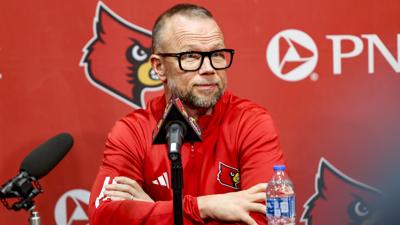

LOS ANGELES, Calif. (WDRB) -- Pat Kelsey is done with injury questions.
After Louisville's 90–70 win at Cal on Tuesday night, he made that clear when Courier Journal reporter Brooks Holton — who made the trip to Berkeley — asked about the late scratch of freshman Mikel Brown Jr., who missed his third straight game.
"This stuff where we gotta do injury reports, which is fine. Part of me says, I guess, it's because of gambling. Is that probably what it is? I have no idea," Kelsey said. "Why are we all of a sudden doing that all of a sudden? It's fine. My whole thing is the injury report will come out at the end of the week. I'm not talking about injuries anymore. If you ask me about how this guy is, the injury report will come out at the end of the week."
When Holton followed up about Kasean Pryor — not to press on details, just to ask if the injury happened in practice or during the previous game — Kelsey held his line.
Louisville | Kentucky | Indiana | Eric Crawford
"I'm not talking about injuries anymore. He's injured."
OK then.
Let me come at this two ways.
First, my personal take: I understand where Kelsey is coming from. I don't gamble on sports. It gets too complicated when trying to cover things fairly. I rarely even bet on horse races anymore. But I know it's a fascination for fans. And it is part of the job. Point spreads. Prop bets. Injury alerts. If I'm not factoring that into my reporting, I'm not doing it fully.
The old-school part of me winces a little when the first question after a big win is about a player's injury status (though in this case, it wasn't). But I've asked that question before. I understand why it matters.
Now, here's the professional reality and the reality of college basketball in 2026.
Holton was doing his job. Plain and simple. If he hadn't asked, fans would've been on him. Probably his bosses, too. At Gannett-owned papers like the Courier Journal, injury reporting isn't optional. It's expected. That means real-time updates, separate stories, pregame scratches, all of it.
Kelsey saying "it's fine" doesn't mean it's fine. He's frustrated. Plenty of coaches are. Conference-mandated injury reports are new and they're not universally embraced.
But let's be clear: This is about gambling. You'd better believe it is.
ACC commissioner Jim Phillips didn't pretend otherwise. When asked why the league now requires injury disclosures before conference games, he called the decision "an important one from a financial standpoint."
That means gambling.
The NCAA has already partnered with Genius Sports to provide official injury and data feeds to sportsbooks for championship events. The ACC hasn't signed a betting partner yet — but it's coming.
This is 2026.
College basketball is part of the machine. The machine runs on engagement. Engagement drives revenue. Revenue funds programs. Programs pay players. Players deal with injuries. And injuries move lines.
This isn't amateur athletics anymore. These players aren't protected by old norms. They're paid, often through university-subsidized funds. Regular students are paying higher fees to help fund those NIL collectives and revenue-sharing pools. Fans are being asked to give more. And in many cases, they're betting more.
You literally could have a kid trying to make enough on DraftKings to offset the tuition hike from the student athletic fee. (I'm kidding. I hope. But college-age men are one of the most aggressive gambling demographics. For better and worse.)
Nobody's asking for HIPAA violations. The Health Insurance Portability and Accountability Act of still applies. But we're not asking for medical charts. We've all accepted "lower leg" for ankle sprain. "Upper body" is fine. Even "unavailable." People get it.
But when you sign up for college sports in 2026, you're not just signing up to coach or play. You're signing up to participate in the product. And injury information is now part of that product.
If these players move on to the NBA, they'll face more detailed injury disclosures, open locker rooms, and a good many other things college coaches might balk at now. That's part of being a pro.
And whether Kelsey likes it or not, that's what these guys are now: paid professionals in a billion-dollar industry.
The crazy thing? We're all on the same side — media, coaches, fans, players. We all want the game to succeed. Coaches, players and fans all want teams to win. But the most successful leagues in the world — the NFL, the NBA — have clear, consistent rules about injury transparency. Not to exploit players, but to protect the integrity of the product.
This isn't about nosiness. It's about the game. And the more open coaches are about injuries — even in vague terms — the more they protect themselves, their players, and the game.
College basketball wanted the big time.
This is it.
Copyright 2025 WDRB Media. All Rights Reserved.


