

LOUISVILLE, Ky. (WDRB) -- When it comes to Kenny Payne's Louisville tenure, the recounting of what went wrong has long been underway. Payne, who was relieved of his coaching duties at Louisville on Wednesday, a day after his team lost in the ACC Tournament, finished his career with a record of 12-52, on an eight-game losing streak.
The depths to which Louisville's program would sink in Payne's two seasons would have been difficult to imagine on the day in March 2022 when he took over as coach, even for the most vocal Payne pessimists.
What exactly went wrong? Payne's inexperience was a known quantity, but his connections around basketball, both college and professional, were impeccable. Magic Johnson hailed his hiring, as did a host of NBA players he had worked with at Kentucky and the New York Knicks. Dick Vitale called it "the right decision," and UK coach John Calipari said Louisville, "could not hire anybody who would do a better job," than Payne.
"He had a proven track record of (recruiting), had a connection to the university, and I thought that was going to be a benefit," Heird said of Payne. "Then from there, you look at some areas that you missed on, and I think they were unknowns for a first-time head coach. Do they have the ability to put a staff together and understand their strengths and weaknesses and put a staff around them that complements their strengths and weaknesses? I've used the term organizational leadership at times. And, you know, I think that's a skill that you don't just wake up and have it. ... As a first-time athletic director, I struggle with it all the time. How do we manage a staff? How do we put staff in appropriate positions to be successful? How do we hold people accountable? How do we set expectations, all those things? ... Kenny had never really been given that opportunity to manage a larger group of people. And I think there was there were times that it was difficult."

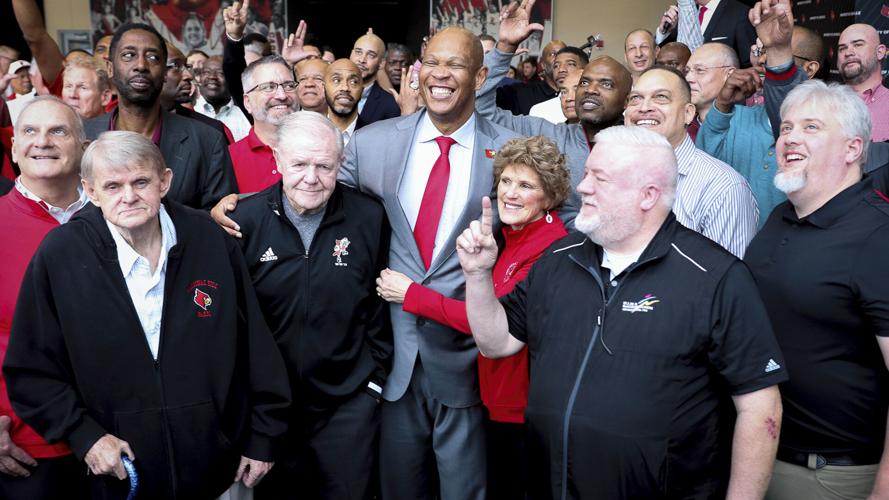
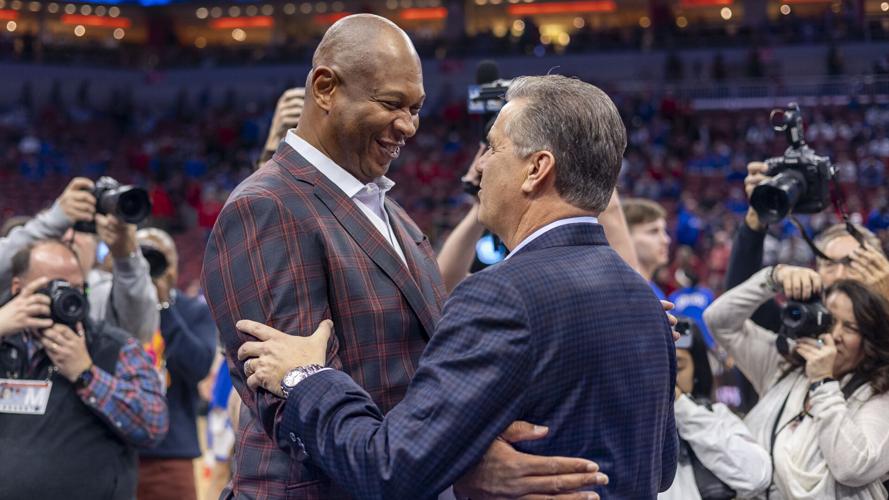
Kenny Payne poses with friends and former players after being named Louisville basketball coach.
Payne hired a former ACC head coach, Danny Manning, as his lead assistant, and figured to start hitting home runs in recruiting as soon as he started swinging.
So what happened? Payne's failure to thrive was, in part, a failure of that same support system that helped him to get the job. It was a failure of experience, of x-and-o basketball acumen, of communication, both within his program and with the legions of fans who follow it or once did. It was a failure of personnel, personality and, perhaps, pedigree, when you look at other coaches who have emerged from the Calipari coaching tree.
Payne, in the end, was slow to jump into the job right after getting it, slow to embrace the importance of transfers, slow to move when his coaching staff wasn’t performing as it needed to, and finally, slow to recognize how dire his situation was as the losses mounted.
The following is a look at what went wrong in Payne’s brief Louisville run:
SUPPORT
This section is not a criticism of the Louisville athletic department or its athletic board or trustees. Nor is it a criticism of fans, who from the exhibition loss to Division II Lenoir-Rhyne in Payne’s opening game to three one-point losses to open his first regular season were given little reason to cheer for Payne and his team. In fact, attendance -- given the negative superlatives posted by the program the past two years -- has been better than it would have been most places.
It's largely an indictment of his coaching staff. In Manning, Payne needed more of a game coach, an x-and-o instructor who could help him adjust to the college game and to making critical decisions at game speed. In six seasons at Wake Forest, Manning had won just 41% of his games and had just one winning season, but he knew the league and had game management experience. It’s not to say that Manning didn’t help, but Payne made basic errors in coaching. He failed to foul in key situations late in games. He could not adjust on the fly. His substitutions were erratic. He allowed long opponent runs early in his career without calling timeouts. And he made those mistakes, apparently, without anyone telling him to do things differently.

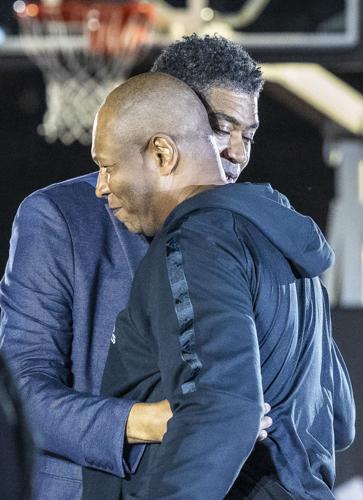
Kenny Payne with Pervis Ellison at Louisville Live in 2022.
In Nolan Smith, Payne signed the son of close friend and fellow U of L alum, Derek Smith, a program hero who played for the 1980 national championship team and died in 1996. Nolan Smith came from Duke, where he was an All-American point guard and starter for the 2010 NCAA Championship team before working on Hall of Fame coach Mike Krzyzewski’s staff, where he spent six years before joining Payne at Louisville.
But Smith was sensitive to criticism, had some contentious social media interactions with fans, and before the 2023-24 season interviewed with a G-League team, the Capital City GoGo. When athletics leadership concluded that Smith had been the source of a leak that resulted in national media reports saying Payne would be fired in December and Smith elevated to the head coaching job, Payne was advised to take the matter up with Smith.
Smith remained on the staff, and what measures Payne may have taken were not known. Similarly, after his first season, Payne declined to shake up his staff after finishing 4-28, even when advised to by Heird.
While Payne’s staff couldn’t save his tenure, his connections around the basketball world seemed of little use. His recruiting connections, many with Nike, were reluctant to help him attract players to Louisville. Pervis Ellison, who ran a successful AAU program that included DJ Wagner (the grandson of Louisville legend Milt Wagner, whom Payne hired to a staff position) chose Kentucky instead of Louisville, as did his AAU teammate Aaron Bradshaw. Both, it seemed, were enmeshed too deeply in Nike’s system to do much else, not that they would have done differently, anyway.
Payne had solid financial backing. Louisville’s collective, the 502Circle, stood ready to help fund any efforts Payne wished to make. But Payne preferred to work through his own group of donors. The 2024 team, a source close to the program told WDRB, was making $1.2 million in NIL money.
But at least six figures in available NIL funding from 502Circle went unused, and at least one major donor pulled back funds that were not appropriated by the program.
PERSONNEL
After taking the job at Louisville, Payne went back to New York for a couple of weeks, and was deliberate in rolling out his coaching staff and other key positions. He also did not dive straight into the transfer portal, and didn’t round out his roster until many top portal prospects were claimed.
While Payne often blamed the "cloud" hanging over Louisville’s program, in the form of feared potential NCAA sanctions -- and those did play a part -- his hesitance to dive into the portal early on wound up hurting his first-year chances..
Payne said he would be picky with the players he recruited into the program, but he was perhaps too picky in his first offseason, and wound up taking Fabio Basili, a guard who was not up to the ACC challenge, and Hercy Miller, a walk-on from Tennessee State whose father is the rapper Master P. Payne did land Tennessee transfer Brandon Huntley-Hatfield, a physically gifted player who came into his own as a junior, but who did little to help the team as a sophomore.

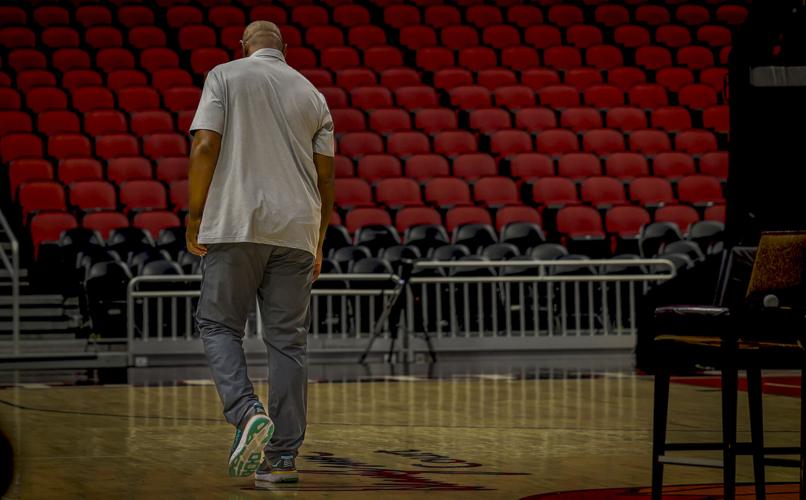
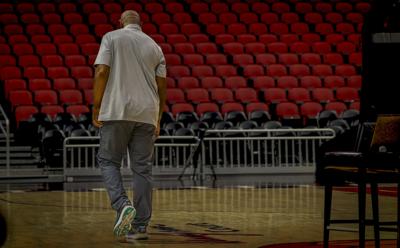
Scenes from the Louisville career of Kenny Payne.
In a show of desperation, Payne added African freshman Emmanuel Okorafor when his first season was going south, and inserted him into the lineup mid-season, though an injury kept him from seeing much action.
Payne’s second recruiting class was a solid one, but there were issues. Trentyn Flowers, the top ranked freshman in the class, left school in August before practice even began, deciding instead to play professionally in Australia. He took with him $90,000 in NIL.
Another five-star freshman, Dennis Evans, was not cleared to continue playing medically in December and left school soon after.
The players who remained were good ones. Freshmen Ty-Laur Johnson, Kaleb Glenn and Curtis Williams were as solid as any freshman group landed by Payne’s predecessor. He also landed transfer guards Tre White from USC and Skyy Clark from Illinois. Even after JJ Traynor was lost early in the season to a shoulder injury, Payne’s second Louisville team had seven players once ranked among the top 100 recruits in the nation.
Other players Payne recruited were head-scratchers. He also added Koron Davis, a little-known junior college guard who never wound up playing for the Cardinals and, before he was dismissed from the team, wound up a problem for Payne and a frustration for Heird. And he signed Danilo Jovanovich, a transfer from Miami who saw double-digit minutes in only six games all season.
For various reasons, this collection of players did not reach the potential their talent would’ve suggested. Moreover, Payne passed on several talented players he wasn’t convinced were good fits for the program. He passed on a WKU guard from Louisville, Dayvion McKnight, who reportedly had an interest in Louisville and wound up a starting point guard at Xavier. He passed on a chance at a talented de-commit from another program when he the player asked for a six-figure payment just to come on the visit.*
In some ways, the biggest blow for Payne was in not landing Wagner or Bradshaw — though his chances to do that may never have been very good.
When all was said and done, Payne brought some good players to Louisville. He also could have brought better ones, and "the best of the best" was the standard he himself set upon taking the job.
COMMUNICATION
As a player, and as an assistant coach, Payne was content to avoid the limelight. In the head coaching job at Louisville, he encountered a position that requires coaches to embrace it.
Payne’s soft-spoken, storytelling style was charming at first. But his reluctance to discuss concrete plans in terms of playing style or recruiting strategy dealt fans out of a key source of excitement. And there were outright mistakes.
His early statements about NIL, while reasonable, created a perception that he was slow to embrace players making money. After a 4-28 first season, when he was asked by a reporter whether he would evaluate changes to his staff, he appeared incredulous and acted as if he didn’t understand the question.
The high point for Payne at Louisville probably was a pair of games in the Empire Classic in New York City. The Cardinals lost 81-80 on a buzzer beater, and a day later had a lead against Indiana until Hoosiers’ coach Mike Woodson went zone and Louisville’s offense went stagnant in a 74-66 loss. Afterward, talking with Bob Valvano on his postgame radio show, Payne correctly pointed out that Woodson had never used a zone at Indiana. But he also used the words, "he tricked me," and fans were beside themselves.
It wouldn’t be the only time his choice of words induced incredulous reactions.
When, early in Payne’s second season, reporters noticed a Louisville player, transfer guard Koron Davis, was not on the bench for games, Payne was asked why and said more than once that Davis "is not in trouble." At the end of the first semester, the program announced that Davis was looking to transfer, but Davis disputed that on social media, prompting a second statement from the program, saying Davis had been dismissed from the team. Davis, who showed up in the KFC Yum! Center stands for games in December and January, clearly wasn’t on the same page as the staff.

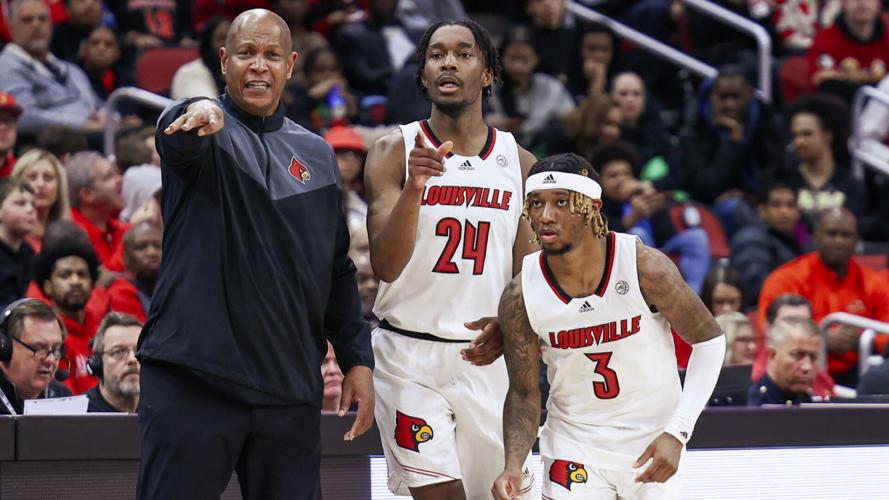
Kenny Payne with his staff during the 2023 ACC Tournament.
Heird, who was out west when the stories about Davis broke, reportedly was unhappy with how the situation was handled and was not happy that Davis was still being allowed to live with the team, a situation he rectified upon returning to town, a source close to the program said.
Heading into a matchup with Kentucky in December, Payne said that while he knew his old mentor, Kentucky coach John Calipari, "wants to beat us down," he would be happy beating Kentucky by even one point. The comment, which he used the year prior, didn’t go over well with an already frustrated fan base.
After a lopsided loss to Kentucky, on the heels of losses to Arkansas State and DePaul, the aforementioned rumors surfaced about Payne being fired, with reports from Matt Norlander of CBS and Jeff Goodman of Stadium saying Payne was soon to be let go with Smith taking his place. Instead, Heird decided to retain Payne and hope that he could improve things over the second half of the season.
Even wins, Payne found a way to hijack positive storylines. After one victory, he told reporters that Johnson had played poorly in the first half and didn’t want to play because the school didn’t have the right compression tights for him to wear.
And after losses, Payne could offer little insight, other than that the team lacked "fight." He intimated after one loss that players should be "willing" other teams to miss shots. Unfortunately for Payne, he was unable to will his players to do that.
In a job that requires clear communication with fans, media, administrators and team, Payne came up lacking in communicating a vision for his program, or a path forward to make it better.
PERSONALITY AND PEDIGREE
As an assistant coach, Payne was an asset to many players as a sounding board, someone who could talk to them about life and basketball. He was a friend. As a head coach, however, a harder edge is required. He at times seemed slow to pull players after mistakes, and to his credit, said he always tried to "coach out of love."
He tried to be candid about what players weren’t doing right when answering reporters’ questions. That, of course, was taken as "throwing players under the bus." But the reality was that he built an inexperienced team, then had trouble getting them to accept his instruction.
That’s the heart of coaching. And by the end of his second season at Louisville, his team barely displayed a heartbeat, despite having comparable talent to the programs they faced. While many factors played into his struggles, his own inability to put players in winning positions is a failure that is on him, no matter what other issues played into it.
Payne came, primarily, from the coaching tree of Calipari. It is a tree that has borne little fruit. Not a single Calipari assistant who has advanced to the Division I coaching ranks has had great success.

Kenny Payne with Kentucky coach John Calipari berfore their teams met on Dec. 21, 2023.
This shouldn’t be taken as a knock on Calipari. But the fact is, his recipe for success works only for coaches with the rare talent of recruiting the very best players in the country. It isn’t built on anything innovative in offense or defense. It’s a system that very successfully shepherds players from high school to the NBA, or in helping high-end transfers make that leap.
You can do the same things Calipari’s Kentucky teams do offensive or defensively, but without Kentucky’s level of talent, it isn’t the same. You can sound the same themes Calipari sounds with his players – toughness, fight, energy – but unless you have a team of future pros, it takes a good bit more than that. The top recent assistants to move on to the head coaching ranks – Tony Barbee, Bruiser Flint, Orlando Antiguia, Josh Pastner and Kenny Payne – have not had significant success in Power 6 college basketball.
The three who coached teams from power conferences – Pastner, Barbee and Payne – have a career mark of 170-241 in those 13 seasons (.414), and in conference play have a winning percentage of just 31.8. Those seasons produced one NCAA Tournament trip and no tournament victories.
It's no mistake that if you watch Payne and Calipari in news conferences, you notice the same themes. But if you watch their teams on the court, you come away with different impressions.
FINAL WORD
Sometimes fans, and some in the media, need a villain. But Payne was not that. He may have been in over his head, but he was not acting maliciously or even in a manner that disregarded the tradition of Louisville basketball. He failed to live up to his goals, and in the position of head coach at Louisville. That’s why he won’t return.
But he also said things that damaged an already fractured relationship with Louisville fans. Asked by WDRB’s Tyler Greever to state his case for a third season, Payne launched into a two-minute deflection.
"For me, I go back to day one," Payne said. "It's unfortunate that we're talking about this right now. When I walked into the program as the new head coach, I talked about I needed everybody on the same page. We sort of forgot that. I talked about how I'm not going to let you blame me. I'm not standing up here by myself. I need all of Louisville with me. We sort of forgot that. I talked about it's going to take time, and I'm going to watch and see who jumped on and off the Titanic. We sort of forgot that. We talked about I gave a specific time. I said three or four years. And I'm good with it. That's what I believed at that time, and that's what I still believe it takes to fix this program. . . . Whether I'm the coach or not, I can look in the mirror and say I gave it everything I had to help this program."
Even those comments, his last as Louisville coach, riled up the fan base.
A great many things went wrong that brought Payne to this point, but in the end, Payne himself wasn’t able to drive the program in a way that would allow a turnaround. He inherited a mess, but his first team should’ve won more than four games, and his second team more than eight. They were less than the sum of their parts, even if their parts did leave something to be desired.
He did inherit a difficult hand. The departure of Mack midseason destabilized the program a year before Payne’s arrival. But it was Payne’s job to act aggressively and immediately to inject the program with talent. Maybe the sanctions facing the program kept him from doing that. But even when that wasn’t’ done, Payne wasn’t able to coax more wins out of his team even against opponents that his team clearly outclassed in talent.
For every coach, in the end, the responsibility rests on his own shoulders.
"I’m not standing up here by myself," Payne said, but when it comes to matters of responsibility, a head coach always does, whether he wants to or not.
If you need more support, you engage the fan base and administration and get it. You get coaches that do what you need. You find players that fit what you want to do. This exercise in determining what went wrong for Payne is not to overlook the fact that often, Payne himself was the problem, whether by his inexperience or reluctance to adjust.
Regardless, his era at Louisville ends with the program as bad off as it was before, its reputation further damage, and the mess he hoped to clean up still burning in full view of a nation in disbelief of where the proud program has fallen.
CORRECTION: An earlier version of this column reported that a collective supporting the University of Louisville had been willing to provide money for a recruit asking for a fee to visit. While the collective did offer funds that were not used, it did not offer funds in the case of that recruit.
Louisville Basketball Coverage:
- WHO'S NEXT? Louisville basketball coaching search Big Board, 1.0
- CRAWFORD | By the numbers: Kenny Payne's tenure in cold, hard stats
- BOZICH | It did not work, but Kenny Payne earned his chance at Louisville
- Kenny Payne fired at Louisville after just 12 wins in 2 tumultuous seasons
Copyright 2024 WDRB Media. All Rights Reserved.


