
LOUISVILLE, Ky. (WDRB) — The leaders of six major college conferences have weighed in against giving another season of eligibility to athletes from the high school class of 2022, warning a Louisville judge that doing so could take roster spots and playing time from other athletes.
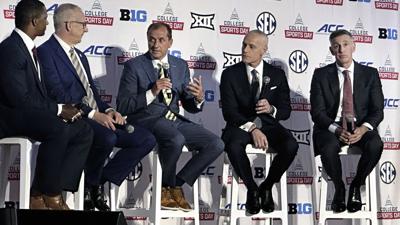
The commissioners of the ACC, SEC, Big Ten, Big 12, Big East and Pac-12 joined the NCAA's argument that allowing athletes who already exhausted four seasons of eligibility to return would create "significant roster instability" across college sports.
Their joint declaration was among documents filed Tuesday in Jefferson Circuit Court, where Judge Brian Edwards is considering a request from 13 athletes seeking another season of NCAA eligibility.
The filing puts some of the most powerful voices in college sports behind an argument attorney Charles Stopher made on the NCAA's behalf at Friday's hearing: Giving something to one group of athletes could mean taking something from another.
But that wasn't the only thing that changed while Edwards was considering the case.
In the four days since the Louisville hearing, courts around the country have continued reaching sharply different conclusions about essentially the same group of athletes — strengthening the NCAA's hand in some places while strengthening the players' in others.
An Ohio appeals court on Monday stayed an injunction that had been one of the players' most significant victories. The NCAA highlighted that decision in its Tuesday filing, calling the recent string of favorable rulings for athletes a "house of cards that has started to collapse."
One day later, a California judge went the other direction, granting a temporary restraining order to 73 athletes seeking to compete during the 2026-27 season.
The California order went beyond another season of eligibility. It temporarily barred the NCAA from using transfer-portal restrictions or certain professional-contract rules to keep those athletes from competing and blocked enforcement of the NCAA's Rule of Restitution against the players and schools involved.
Former Louisville guard Skyy Clark, one of the plaintiffs in the Louisville case, also is covered by the California order.
The Louisville plaintiffs immediately called Edwards' attention to that decision, arguing that courts in Ohio, Tennessee, Georgia and Texas previously rejected jurisdictional arguments similar to those the NCAA is making here. They noted the new California ruling as further support.
The NCAA, meanwhile, pointed Edwards to decisions going the other way, including an Illinois ruling Tuesday denying another athlete's request for a temporary restraining order.
All of that is separate from the most consequential ruling affecting the 2022 class: a class-wide preliminary injunction issued July 31 by U.S. District Judge Charlotte Sweeney in Colorado. That federal order remains in effect and is allowing qualifying Division I athletes who began competing in 2022-23 to play another season while the case proceeds.
The NCAA has appealed Sweeney's ruling to the 10th U.S. Circuit Court of Appeals and asked that it be stayed during the appeal. Sweeney denied the NCAA's request for a stay, and the appeals court has expedited its consideration of the issue.
So for now, the Colorado injunction remains in force. But whether it stays that way remains unsettled.
The result is a legal landscape that has become more complicated, not less, since Edwards heard arguments Friday. Some courts have allowed athletes from the 2022 class to continue playing. Others have refused. One significant player victory has been put on hold by an appellate court, while the broadest ruling of all — the federal injunction from Colorado — remains under appeal.
Edwards said Friday he expected to issue a ruling by the end of this week.
Commissioners warn of consequences
The conference commissioners' involvement could be particularly important as Edwards considers the potential harm to people who aren't plaintiffs in the case.
ACC commissioner Jim Phillips, SEC commissioner Greg Sankey, Big Ten commissioner Tony Petitti, Big 12 commissioner Brett Yormark, Big East commissioner Val Ackerman and Pac-12 commissioner Teresa Gould jointly warned that retroactively extending eligibility could disrupt rosters that already have been constructed for the coming season.
"These student-athletes would potentially take roster spots from individuals to whom the spots were previously promised," they said, singling out incoming athletes as particularly vulnerable.
They said thousands of athletes already have chosen schools based partly on expected roster spots and playing time, and that allowing another group of veteran players to return would create "immediate and significant uncertainty."
The NCAA's filing extends the argument to the new economics of college sports.
It says schools already have made decisions about not only roster spots and playing time but revenue-sharing payments. All three, the NCAA argues, are finite. Returning players could force schools to reconsider who makes a roster, who plays and how much athletes are paid.
The players have framed the fairness question differently.
They graduated from high school in 2022 and entered college while older athletes remained on rosters with additional eligibility granted because of the COVID-19 pandemic. Now, as the 2022 class leaves, athletes entering behind them will compete under a new NCAA model that can permit five seasons of competition within a five-year eligibility period.
Their attorneys have described the class as being "squeezed on both ends."
Can a Kentucky judge decide it?
Before Edwards decides which argument is more persuasive, he also must determine whether a Kentucky court has jurisdiction over the NCAA and the claims of all 13 athletes.
That issue received extensive attention in Tuesday's filings.
The NCAA argues the players' connections to Kentucky aren't enough. It says only five plaintiffs — Levavium Wells II, Donovan Oday, D'Angelo Hutchinson Jr., Fred King and Jabari Mack — allege they most recently attended Kentucky institutions.
More importantly, the NCAA says the legal question isn't where the players attended school or played games. It is whether the NCAA engaged in Kentucky conduct sufficiently connected to the injuries alleged in the lawsuit. It says the players haven't established that connection.
The players counter that the NCAA conducts substantial business in Kentucky and administers its eligibility rules here through its member institutions.
And Tuesday's filing provides a more explicit Kentucky connection for one of the most prominent players in the case.
The plaintiffs say former Missouri basketball player Mark Mitchell is among at least three plaintiffs who have expressed a desire to play another season at a Kentucky school. They argue Kentucky has an interest in his case because Mitchell "desires to play in Kentucky and would be harmed here if he is not allowed to play this season."
Local rosters hang in the balance
The stakes extend well beyond the 13 athletes before Edwards.
At Louisville, North Carolina basketball transfer Seth Trimble is preparing to use the additional season made available by the Colorado injunction. On the football team, defensive players D'Angelo Hutchinson and Jabari Mack are plaintiffs in the Louisville case, while linebacker Kalib Perry also is attempting to return.
At Kentucky, Mitchell could become an impact basketball addition, while linebacker Alex Afari is seeking another football season. At Indiana, defensive end Stephen Daley and linebacker Kellan Wyatt are among players attempting similar returns.
Not all of those athletes depend directly on Edwards' ruling. The Colorado federal injunction provides the broader protection allowing qualifying members of the 2022 class another season, while the Louisville plaintiffs are asking Edwards for additional relief that also addresses obstacles such as transfer restrictions, professional contracts and the NCAA's Rule of Restitution.
But all of these legal points matter. The Colorado injunction has opened the door to another season for thousands of athletes, but the NCAA is still trying to close it on appeal. Meanwhile, cases like the one before Edwards could determine whether some athletes can actually get through that door.
And the calendar isn't waiting for the courts to sort it out.
For Louisville, Kentucky and Indiana, this isn't an abstract legal debate anymore. All three are preparing for seasons with players whose eligibility remains tied to court orders that could still change.
Copyright 2026 WDRB Media. All Rights Reserved.


