
LOUISVILLE, Ky. (WDRB) — Kentucky's season did not end with a mystery. It ended with an explanation.
For a few bright minutes Sunday afternoon, the Wildcats looked like a team ready to push past its limitations. They jumped Iowa State 20-9, made shots, moved the ball and briefly made one of the nation's most aggressive defensive teams look ordinary.
Then Iowa State did what Iowa State does. It climbed into the dribble. It crowded passing lanes. It turned every catch into work and every possession into a test of nerve.
And Kentucky, which had spent much of this season surviving around its flaws, finally ran into a team equipped to drag those flaws into the light and leave them there.
The result was an 82-63 loss in the second round of the NCAA Tournament, one that felt less like a bad afternoon than a hard verdict.
Louisville | Kentucky | Indiana | Eric Crawford
The Wildcats turned it over 20 times. Iowa State turned those mistakes into 25 points. Kentucky led by 12 in the first half and still went to the locker room trailing. Then came the second-half avalanche: 51 points by Iowa State, 63% shooting from the field, 50% from three, and the kind of relentless downhill pressure that makes a game feel like it is being played on a slope.
Kentucky was not merely beaten. It was sped up, tilted, and eventually pulled apart.
That is what makes this loss feel so final, and so revealing.
Mark Pope did not hide from it afterward. In explaining the loss, he explained the season, too.
Kentucky, he said, never really got to be the team it thought it had built.
The Wildcats expected depth. They expected size. They expected to come at opponents "wave after wave after wave." They also knew one area made them uneasy from the start: point guard.
Those worries, Pope said, "came true."
That line lands because it explains so much.
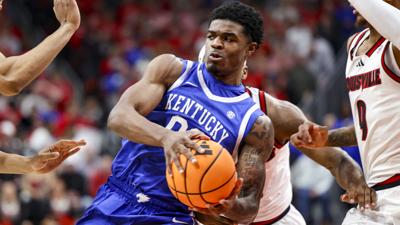
This team spent the year improvising. Denzel Aberdeen, who scored 20 points Sunday, had to become something different from what he came to Kentucky to be. So did others. Roles shifted. Responsibilities changed. The plan gave way to the emergency plan, and then to the one after that.
For long stretches, Kentucky made that work better than many thought it could. There was toughness in that. There was invention in that. There were real moments, real memories, real evidence that Pope's first two years have not been empty.
But March has a way of stripping a team down to its truest outline. And Sunday, that outline was clear.
When Kentucky could play on its terms early, it looked dangerous. When Iowa State turned the game into a series of decisions under duress, Kentucky looked like what it has too often been beneath the effort and the fight: a team without a true floor general, a team asking too many players to do too many things, a team trying to win around a missing piece rather than through a complete design.
Even the most telling detail carried a little cruelty. Iowa State did this without Joshua Jefferson, its best player.
So Kentucky cannot fold this neatly into the folder marked bad luck and move on. Injuries mattered. Roster disruption mattered. But so did construction. So did fit. So did the reality that in the NCAA Tournament, against a disciplined and violent defensive team, your weak spot does not stay hidden for long.
Iowa State found it and kept pressing.
Tamin Lipsey scored 26 points, handed out 10 assists and collected five steals, which is another way of saying he played the position Kentucky needed most and played it brilliantly. He controlled the game while Kentucky chased it. He imposed order while Kentucky slipped into disorder.
In that sense, he was the whole afternoon.
There is still a case for encouragement here. Kentucky won NCAA Tournament games in back-to-back seasons. Pope has plainly re-established energy in the program. Players still talk about the place with affection and conviction. Otega Oweh, in his final game, sounded like someone who had been changed by Kentucky, not diminished by it.
But that is not the standard here, and Pope knows it. He said it himself. At most schools, this would be good. At Kentucky, good is a checkpoint, not a destination.
So the season ends where it had been wobbling all along — not for lack of heart, not for lack of adjustment, not for lack of trying, but because eventually trying to cover a weakness is not the same thing as fixing it.
Kentucky did a lot of standing back up this season, as Pope said.
Sunday, though, it ran into a team that kept knocking it off balance.
And in the end, the Wildcats did not lose because they were surprised.
They lost because the thing they had spent all season managing finally became the only thing that mattered.
Copyright 2026 WDRB Media. All Rights Reserved.


