


LOUISVILLE, Ky. (WDRB) — A Louisville woman said she's been living a nightmare for the past several months as she fights to get back thousands of dollars that vanished after a phone call with what she thought was her bank.
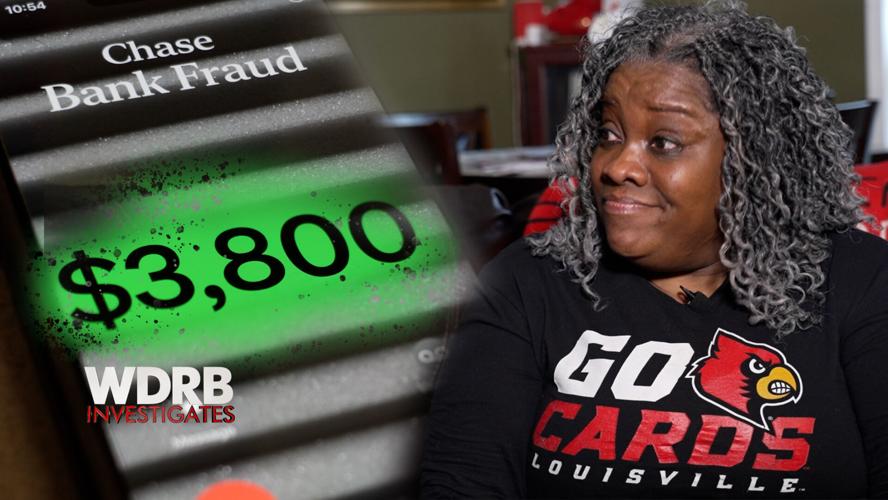
Adrienne Jones-James works from home as a call center employee and said that phone call changed everything.
"I should have just hung up," Jones-James said.
In February, she got worried when her phone kept ringing while she was working. The caller ID said Chase Bank Fraud, so she picked up when she got done with a call.
"I'm a nervous wreck because, I'm like, why are they calling me?" she said. "I answered it, OK, and he said 'Yes, this is Chase Bank Fraud Department. And he said 'You've been scammed.'"
Jones-James said someone tried to get into her Zelle account first but was denied and the scammer on the phone knew that.
"And he said 'I see what they (tried) to take — $1,000 from Zelle,'" Jones-James said. "It was there. He verified that. He said 'You spent money at Walmart.' He verified a whole lot of information out of my account. Now, mind you, I'm falling for this. So I move the money over to the Cash App, and ... $3,800 is what he told me to move. Then the call dropped and I was like 'Oh my God. Oh my God. I just got scammed."
It turns out that phone number claiming to be Chase Bank's Fraud Department wasn't real. It was a spoofed number. Now, four months later, she's still trying to get her money back.
"The scammer was able to call me, name the exact $1,300 Zelle amount that Chase had just denied and use that private internal bank information to convince me they were the real Chase Fraud Department," she said. "They completely manipulated me into believing my savings were actively being drained, instructing me to move my $3,800 into Cash App immediately under my own name to 'protect' it. Because I panicked and thought I was saving my life savings under the bank's guidance, I physically executed the transfer."
Whitney Adkins, with the Better Business Bureau, said cases like this happen all too often.
"The problem is we see folks who are using Cash App without knowing for certain who's on the other end, and that's where the scams can factor in," Adkins said. "It usually ends with the scammer asking the victim to pay for whatever or send cash via Cash App, in this instance."
Adkins reminds people to be cautious when they're told to transfer money.
"No organization — no institution that is trustworthy — is ever going to ask you to do that," she said. "They're not going to say 'Oh, well, just redirect your money here and it'll be safe.' That's a big red flag."
Jones-James said she notified her actual bank, which credited her account but took it out again and said she was at fault. Cash App, meanwhile, said it investigated Jones-James' case and sent her an email that said "We fulfilled your request to send the funds to the recipient."
"Prior to sending this $3,800 P2P payment, Cash App issued a warning notification and this notification was bypassed to complete the payment," the email continued.
Cash App said it followed all procedures and policies to protect customers from potential scams, including displaying a payment warning flagging the transaction as a potential scam. Cash App offered additional tips to prevent others from falling victim to scams:
- If someone claiming to be from customer support contacts you and it feels suspicious, hang up and call the company's number. You can usually find the number on the company's website or Terms of Service.
- Remember that real customer support representatives will never request personal information, especially your password.
- If you don't have an account with the company a scammer claims to be from, don't respond. If they call and something seems wrong, you can let the person know that you'll call them back on the company's official phone number.
Other general safety reminders Cash App provided include:
- To keep your account safe:
- Pay attention to any alerts or notifications from Cash App for suspicious activity.
- Never share your one-time passcodes to log in.
- Only send money to people you know.
- Remember that we'll never ask for sensitive information, like your PIN or login code by phone, email or text.
- If you ever get a suspicious message, take a minute to check if the message is real, especially if it claims to be from your bank, Cash App, or anything related to your money. If an offer sounds too good to be true or a situation feels off, there’s a good chance it’s a scam.
Cash App said its warning features also prevent scams by using AI and machine learning to evaluate hundreds of risk factors, which helps identify potentially suspicious transaction patterns and account behaviors.
Jones-James said she also filed a police report with the Louisville Metro Police Department.
In a statement, LMPD said it's investigation into the matter had concluded.
"Based on the information currently available, no arrests have been made. If new evidence or information is developed in the future, it will be evaluated and a determination will be made regarding whether criminal charges are appropriate. No further details are available at this time," the statement continued.
"We also encourage community members to remain vigilant when receiving unsolicited phone calls, emails, text messages, or other communications requesting personal or financial information. Individuals should verify the legitimacy of such requests directly with their financial institution or the organization involved before providing any sensitive information. Never share passwords, account numbers, security codes, or other personal details without first confirming the request is legitimate. Taking proactive steps, such as enabling account alerts, using multi-factor authentication, and regularly monitoring financial accounts, can help safeguard against fraud and reduce the risk of becoming a victim."
While Jones-James hopes to get the money back, her goal is to share her story in the hopes it prevents this from happening again.
"In the end, I just don't want to see it happen to anybody else," she said.
A spokesperson with Chase Bank provided the following statement:
"These scams are heartbreaking, and the blame for them lies directly with the criminals who perpetrate these crimes. We urge consumers to be cautious of unexpected calls, texts or emails claiming to be from a bank or other trusted institution. When in doubt, hang up and call the number on the back of your card."
Copyright 2026 WDRB Media. All Rights Reserved.