

June Highlights:
- The globe had its second-warmest June on record, driven by global ocean surface temperatures reaching an all-time high for the month.
- Both the Arctic and Antarctic recorded June sea ice extents that ranked among their respective 10 lowest extents on record.
- Global tropical cyclone activity was above average with seven named storms.

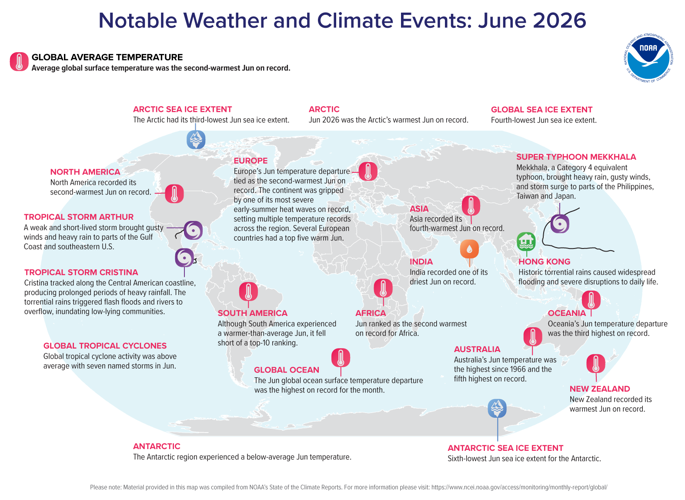
Map of global notable weather and climate events in June 2026.
Temperature
Global surface temperatures in June 2026 were 1.96°F (1.09°C) above the 20th-century average—the second-warmest June on record, trailing only 2024. Notably, all 10 of the warmest Junes in the 1850–2026 record have occurred since 2015. This month also marked the 50th-consecutive June with a global temperature departure above the 20th-century average; the most recent below-average globally-averaged June temperature occurred in 1976. Global ocean temperature was the highest on record for the month, while global land temperatures came in at fourth highest on record.

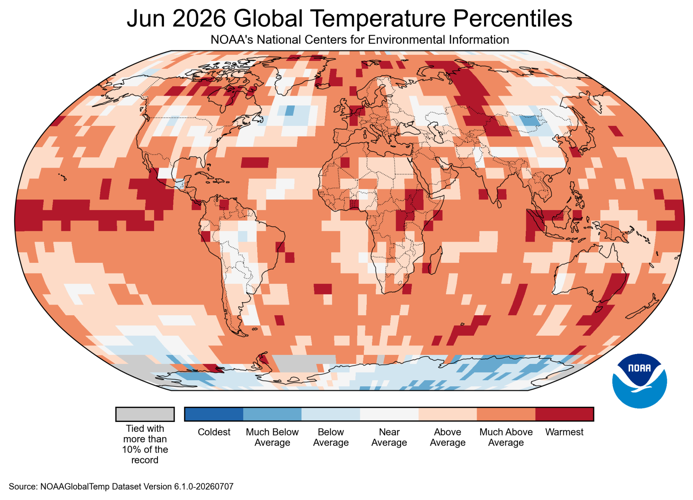
Global Temperature Percentiles for June 2026. Red and orange indicates warmer than average, blue indicates colder than average and gray indicates that it tied with more than 10% of the record.
Widespread, warmer-than-average conditions dominated across much of the globe in June 2026. Notable temperature departures of +3.6°F (+2.0°C) or higher spanned Europe, eastern Australia, parts of Africa, the Arctic, the Weddell Sea, a vast swath of Siberia extending into south-central Asia and along the equator in the eastern and central tropical Pacific Ocean. Furthermore, record-high June temperatures were shattered across the eastern and central tropical Pacific Ocean, as well as portions of Canada, northern South America, Africa, Europe, Asia and across parts of every major ocean basin.
Below-average temperatures were observed across much of Antarctica, as well as portions of South America, Asia, and northwestern Alaska and along its adjacent Arctic waters. Despite these cooler pockets, no land or ocean areas experienced record-cold temperatures for the month of June.
Regionally, several continents and regions recorded a top 10 warm June on record. The Arctic had its warmest June on record, while North America, Europe, and Africa each recorded their second warmest. Oceania observed its third-warmest June, and Asia recorded its fourth warmest. Although South America also experienced above-average June temperatures, it fell short of a top 10 ranking. Meanwhile, Antarctica noted a cooler-than-average month, marking its coolest June since 2021.
Year-to-date
Looking at the year-to-date, the January–June global surface temperature was third highest on record. According to NCEI’s Global Annual Temperature Outlook, it is very likely that 2026 will rank among the five-warmest years on record.
Sea Ice
Global sea ice extent was the fourth smallest for June in the 48-year record, covering 8.78 million square miles, which is 780,000 square miles below the 1991–2020 average. The Arctic had its third-lowest June extent on record, falling 340,000 square miles below average. Meanwhile, the Antarctic sea extent was 440,000 square miles below average and the sixth-smallest June extent.
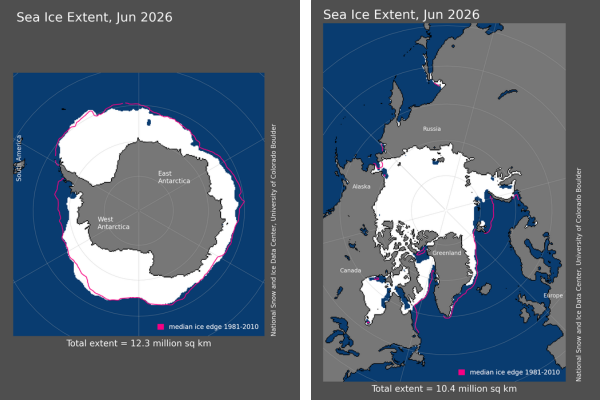
Map of the Antarctic (left) and the Arctic (right) sea ice extent in June 2026.
Tropical Cyclones
Global tropical cyclone activity was above average in June, featuring seven named storms. Of these systems, two reached tropical cyclone strength, with one intensifying into a major tropical cyclone. The storms developed across three primary basins: Atlantic (one), the East Pacific (three), and the West Pacific (three).
In the Atlantic, Tropical Storm (TS) Arthur—a weak and short-lived storm— formed off the coast of Texas, bringing gusty winds and heavy rain to parts of the U.S. Gulf Coast and Southeast.
In the East Pacific, TS Boris and TS Cristina developed within a day of each other off the coasts of Mexico and Central America, respectively, bringing heavy rainfall and windy conditions to both regions. Meanwhile, the West Pacific produced the month’s most notable system: Super Typhoon Mekkhala. Peaking as a Category 4-equivalent typhoon, Mekkhala brought heavy rain, gusty winds, and storm surge to parts of the Philippines, Taiwan and Japan.
No tropical cyclones developed in the North Indian Ocean or any Southern Hemisphere basins during June 2026.
For a more complete summary of climate conditions and events, see our June 2026 Global Climate Report or explore our Climate at a Glance Global Time Series.


