
The Space Weather Prediction Center has issued a Geomagnetic Storm Watch for three consecutive days in a row from today, August 17th, through Friday, August 19th! This is after not just one, but multiple solar flares from the Sun sent out on August 14th and the most recent on August 16th!
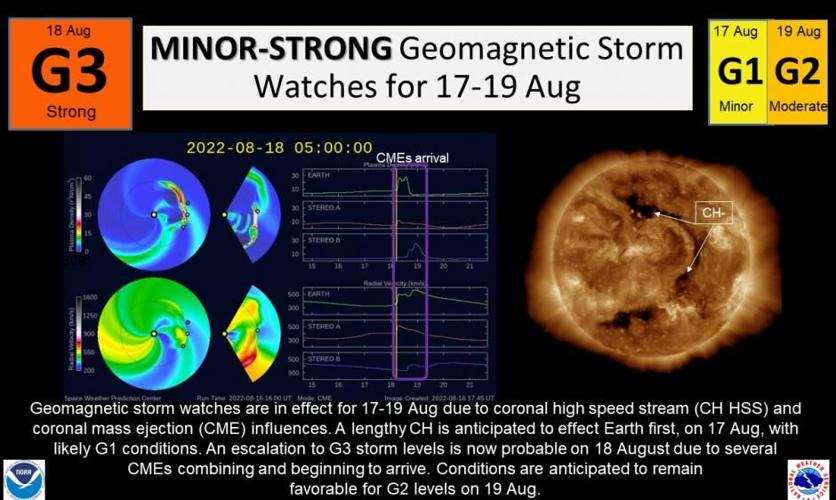
Today's watch is known as a G1 (Minor) Geomagnetic Storm Watch. but will be upgraded to a G3 (Strong) Geomagnetic Storm Watch on Thursday before staying at a G2 (Moderate) Geomagnetic Storm Watch on Friday.

Credit: Space Weather Prediction Center
The scale for Geomagnetic Storms goes from 1 (lowest) to 5 (highest), so Thursday's watch climbs up into the middle of that scale!
"Geomagnetic responses are likely to escalate to G3 (Strong) conditions on 18 Aug due to the arrival at or near Earth of multiple coronal mass ejections (CMEs) that have departed the Sun since 14 Aug. Despite the numerous CMEs, most are expected to have little to no impact at Earth, however, at least four have potential Earth-directed components."
"... model runs indicate combined arrival of some of these CMEs at or in the vicinity of Earth beginning 18 Aug – therefore, the G3 (Strong) storm watch is in effect for that day. Any CME influences are likely to continue on 19 Aug and a G2 (Moderate) storm watch is posted accordingly."
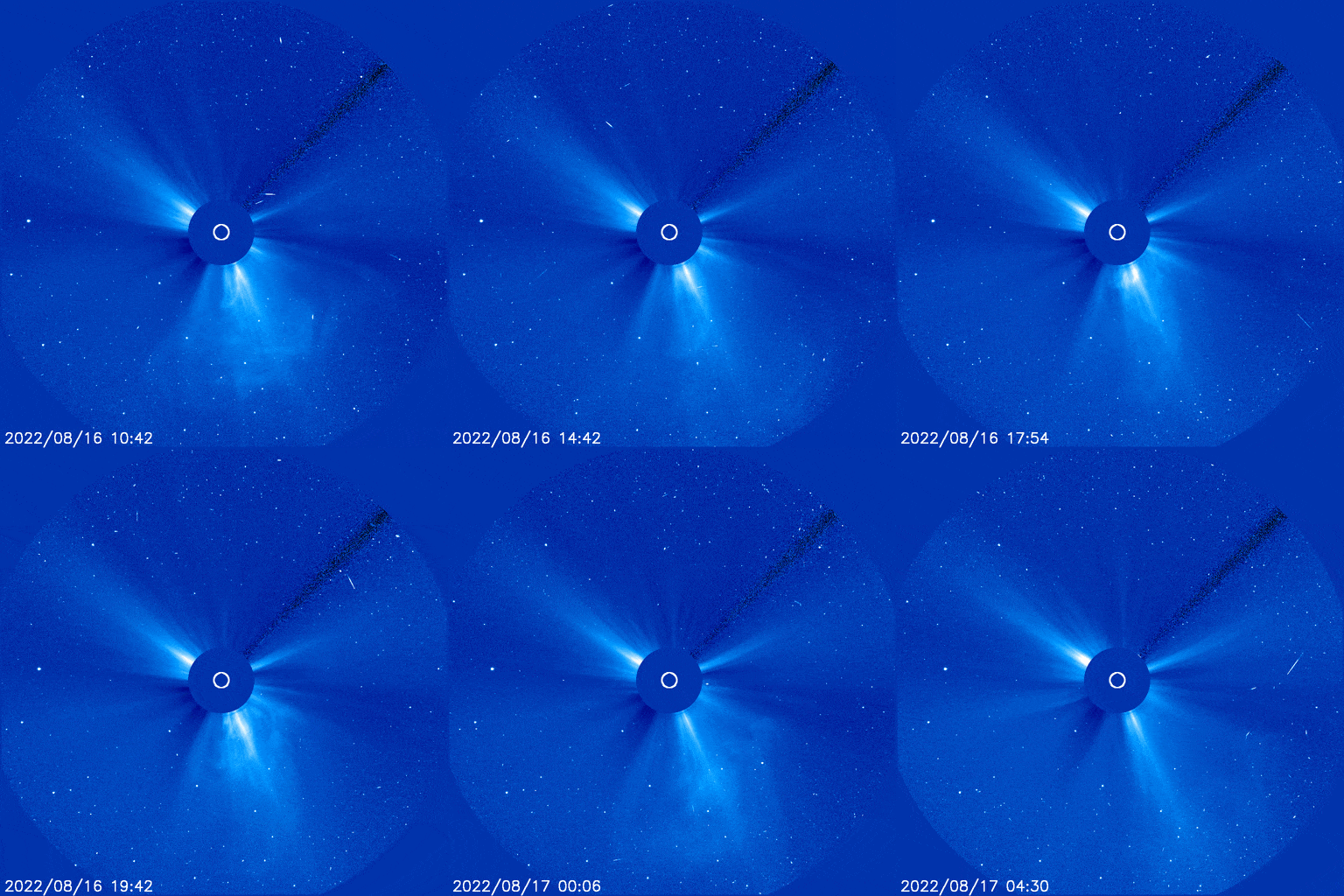
CME's being released from the sun
You can see CME's being released from the sun in the GIF above.
How Does This Affect The Earth?
Solar flares are powerful bursts of radiation. Harmful radiation from a flare cannot pass through Earth’s atmosphere to physically affect humans on the ground, however — when intense enough — they can disturb the atmosphere in the layer where GPS and communications signals travel. Below are the descriptions from the Space Weather Prediction Center of the expected impacts from a G1, G2, and G3 Geomagnetic Storm Watches that we could see over the next 3 days.
Today's G1 impacts...

G1 Level impacts
Thursday's highest level G3 impacts...

G3 Level Impacts
Friday's G2 Impacts...

G2 Level impacts
Areas and locations to our North and the North half of the US (50 degrees Latitude and polar) have the greatest potential to see the impacts from this event through Friday, allowing mainly parts of Canada and potentially areas closer to the Canadian border of seeing the Northern Lights this week, as well as some Northern states in the US.
Odds of Northern Lights In Our Area
The odds of seeing the Northern Lights in our area is extremely small along the horizon. While the chance of seeing it along the horizon isn't zero, the fact is, it's very very low. With our experience in this situation, these usually never show. Don't buy the internet hype!
We've seen these Geomagnetic Storms have big impacts before, even just recently if you have really good memory back in February when a lot of Starlink Satellites came falling back down to Earth because of a Geomagnetic Storm. You can read more about that here.
To see how such space weather may affect Earth, please visit NOAA’s Space Weather Prediction Center https://spaceweather.gov/, the U.S. government’s official source for space weather forecasts, watches, warnings, and alerts. NASA works as the research arm of the nation’s space weather effort. NASA observes the Sun and our space environment constantly with a fleet of spacecraft that study everything from the Sun’s activity to the solar atmosphere, and to the particles and magnetic fields in the space surrounding Earth.