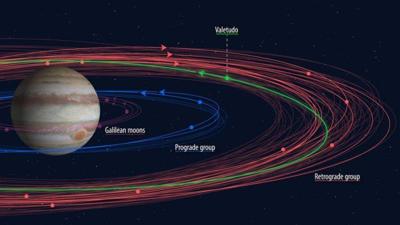

Jupiter has 79 known moons...until now. Now astronomers at the University of British Columbia in Canada are suggesting Jupiter may have more than 600 moons! The only catch is most of those will be tiny - around 800 yards in diameter. That's only eight football fields wide!
Edward Ashton, Matthew Beaudoin, and Brett Gladman (the Canadian astronomers) looked at 60 archived images of Jupiter from 2010. All of those long-exposure images were taken in less than three hours. Studying those and combining them in different ways, the astronomers detected 45 new moons orbiting Jupiter. Even more interesting, they're orbiting backward relative to Jupiter's motion - that's called retrograde. The astronomers found 45 new moons but are suggesting there may be up to 600 because they only looked at one square degree of space around Jupiter. It takes 360 degrees to look all the way around the planet, so there's plenty more space to consider.
According to Sky and Telescope, "The team studied 60 archival 140-second exposures of a field close to Jupiter, all of them taken within a 3-hour period on September 8, 2010, with the 340-megapixel MegaPrime camera at the Canada-France-Hawai‘i Telescope on Mauna Kea. The astronomers digitally combined the images in 126 different ways, one for every possible combination of speed and direction at which a potential Jovian moon might move across the sky."

Image Credit: Carnegie Inst. for Science / Roberto Molar Candanosa via Sky&Telescope
The 45 moons the team discovered are not "official" yet and don't have names. For a moon to be official, the astronomers studying it have to be able to track and prove its orbit which hasn't been done yet for these 45 new finds. In fact there's no plan in the near future to do that. Also the International Astronomical Union currently doesn't name moons smaller than one kilometer, so most of these moons are too small to be named.
Saturn is the planet in our solar system with the most "official" moons - it has 82.
Banner Image Credit: NASA/JPL/DLR