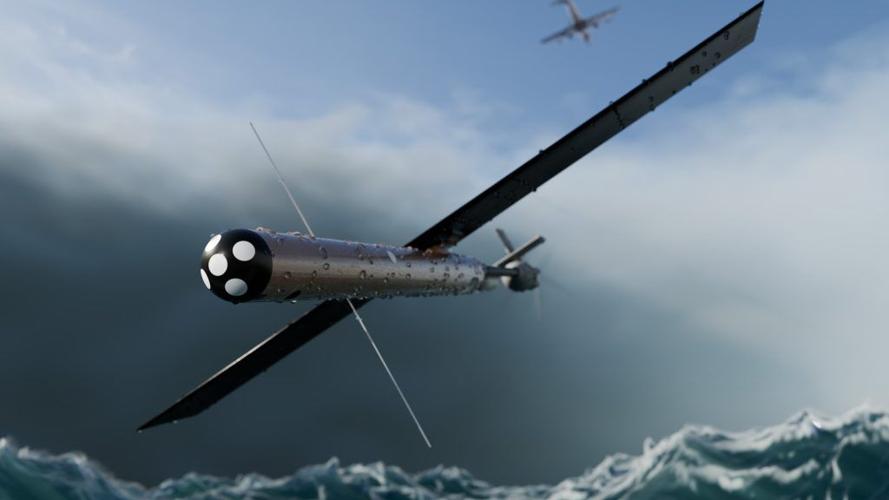


An image representing the S0 flying above the ocean’s surface after being launched from a NOAA Hurricane Hunter P-3 aircraft. Credit: Black Swift Technologies
New drone data improves hurricane intensity forecasts
For the first time, data from a small uncrewed aircraft system (sUAS) – Black SwiftTechnologies’ S0 – will be integrated into NOAA’s hurricane forecast model during the 2026 hurricane season. Scientists from the Cooperative Institute for Marine and Atmospheric Studies (CIMAS) and NOAA’s Atlantic Oceanographic and Meteorological Laboratory (AOML) determined that incorporating sUAS data into NOAA’s Hurricane Analysis and Forecast System (HAFS) can improve hurricane intensity forecast accuracy by 10%.
HAFS is NOAA’s next-generation operational hurricane model that provides forecasters with reliable guidance on hurricane track and intensity. The model substantially benefits from incorporating observations from NOAA’s fleet of hurricane hunter aircraft. However, very few measurements are sampled near the surface during a hurricane, where it is too dangerous for crewed missions to fly. To fill this gap, uncrewed platforms, like the S0, can fly in the notoriously hard-to-access marine boundary layer environments where critical processes control the formation and intensification of hurricanes.
The S0 is released from NOAA’s P-3 hurricane hunter aircraft and adds to the wealth of data collected by the P-3 missions. At only 2.6 lbs, the S0 flight system collects atmospheric observations of pressure, temperature, humidity, and wind in addition to oceanic measurements of waves and sea surface temperature. These novel observations provide a rare window into the processes that govern how heat, momentum, and moisture transfer to and from the ocean and the atmosphere. After extensive testing, evaluation of the data quality, and establishing procedures to transmit the data, forecasters can receive these observations in real-time.
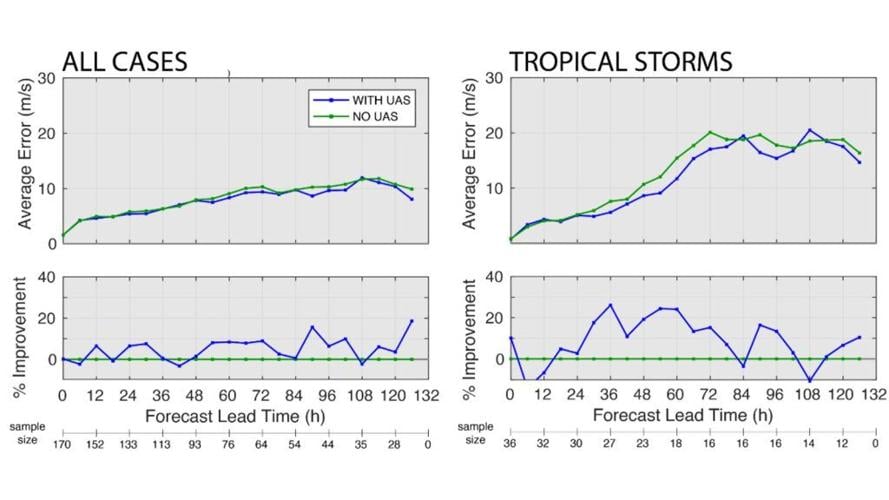
To determine how the S0 data impacts modeling efforts, CIMAS and AOML scientists conducted retrospective HAFS experiments with and without the sUAS data for 10 different tropical cyclones from 2022-2025. The scientists found that the sUAS data improves forecasts, particularly for intensity, which is how strong a tropical cyclone will become. HAFS intensity forecasts improved by about 10% overall when the sUAS data was included, and for tropical storms the improvement was up to 25%. This adds to the benefits of traditional hurricane hunter data, which itself boosts forecast accuracy by up to 20% overall.
“A 10% improvement in maximum wind errors due to the assimilation of Black Swift S0 data is huge. I also love that this S0 data impact study was prioritized so we have numbers to back up our amazing science as S0s are launched this summer!” – Gus Alaka
Continued testing to demonstrate how various technologies impact the models is vital to strategize and identify the most efficient ways to enhance life-saving forecasts. These findings capture the significant improvements that S0 data provide to HAFS, pushing the needle in furthering NOAA’s mission of predicting severe weather to protect life and property.
“Results from this study will help us determine ways to further optimize our models and our sUAS flight-track strategies,” – Sarah Ditchek, CIMAS Associate Scientist.

The graphs show the overall impact of S0 data in HAFS for tropical cyclone maximum sustained 10-m wind speed for (left) all cases and (right) only tropical storms. Errors (top) and improvement (bottom) for forecasts with S0 data (blue line) are compared to forecasts without S0 data (green line).
___
This is a collaborative project between Black Swift Technologies, LLC and NOAA’s Atlantic Oceanographic and Meteorological Laboratory, Aircraft Operations Center, Uncrewed Aircraft Systems Division, Environmental Modeling Center, National Hurricane Center, the University of Miami Cooperative Institute for Marine & Atmospheric Studies, Embry-Riddle Aeronautical University, and the University of Notre Dame. NOAA Office of Marine & Aviation Operations’s Uncrewed Systems Operations Center provided support for Black Swift development and testing.


