Did you know the Hubble telescope, the same one that has been sending back stunning images from space for years, is reporting on planetary weather? NASA says since Hubble's launch in 1990, it's been keeping an eye mainly on the weather of the gaseous outer planets of our solar system. In the last few weeks, NASA has released updates on what Hubble has observed around Jupiter, Saturn, and Uranus which we will break down here.
Think about weather on Earth. Most of what we see is driven by the sun heating the air and ground differently in different locations. Neither of those factors contribute as strongly to weather on the gaseous planets. They don't have the solid surface like we do, and the sunlight doesn't drive as much atmospheric circulation since it's farther away.
JUPITER

SCIENCE: NASA, ESA, STScI, Amy Simon (NASA-GSFC), Michael H. Wong (UC Berkeley)
IMAGE PROCESSING: Joseph DePasquale (STScI)
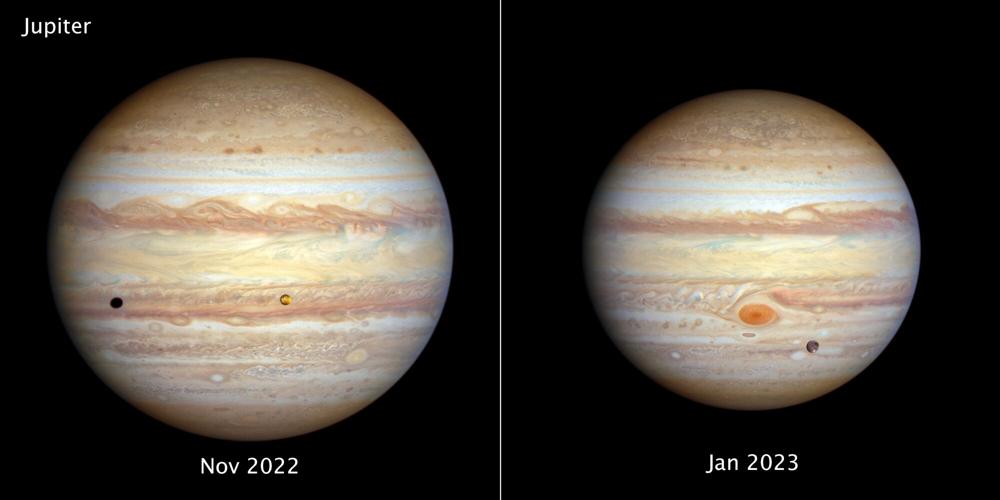
You've probably heard of the "Great Red Spot" - Jupiter's massive storm shown on the right in the image above. "Though this vortex is big enough to swallow Earth, it has actually shrunken to the smallest size it has ever been over observation records dating back 150 years," according to a Hubble statement.
On Jupiter Hubble has observed a string of cyclones and anticyclones lined up near each other. You can see them in the image above; look to the picture on the left and in the upper middle of the planet (for context in our weather forecast, a low pressure is a cyclone and a high pressure is an anticyclone because of how they spin). What's even more interesting about these is they look they have thunderstorms inside them like our cyclones do. The telescope didn't see them in the 90s but has observed these storms in the last decade, as well as being able to see different cloud heights based on "strong color differences." NASA's Hubble site added, "Jupiter's weather is driven from inside-out as more heat percolates up from its interior than it receives from the Sun."
SATURN

SCIENCE: NASA, ESA, Lotfi Ben-Jaffel (IAP & LPL)
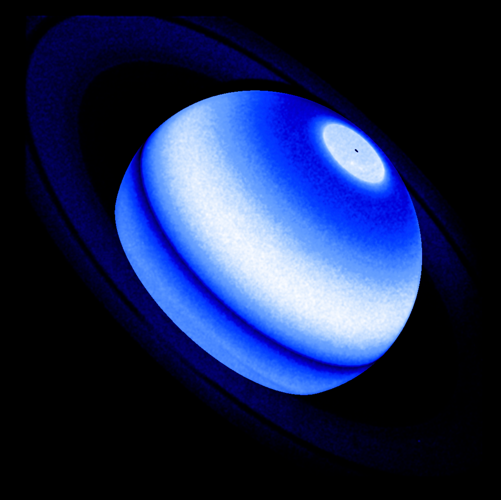
The findings from Saturn are a little different than from Jupiter and Uranus where the Hubble telescope was observing planetary weather so the reports from NASA are tied more directly to the planet's atmosphere. The statement about Saturn discusses how the icy rings around the planet are "raining" on the planet and affecting the weather. In that release, NASA says, "The telltale evidence is an excess of ultraviolet radiation, seen as a spectral line (image above) of hot hydrogen in Saturn's atmosphere. The bump in radiation means that something is contaminating and heating the upper atmosphere from the outside." This is something that has never been observed before in our solar system. The icy rings are raining particles onto the planet which, after observing this for about 40 years, scientists are ready to say is heating Saturn's upper atmosphere. NASA went on to say, "This could be due to the impact of micrometeorites, solar wind particle bombardment, solar ultraviolet radiation, or electromagnetic forces picking up electrically charged dust."
To see this happening, ultraviolet light observations from four old missions to Saturn were pulled together by one scientist. That included the two Voyager probes, the Cassini spacecraft, with additional data from the Hubble and International Ultraviolet Explorer. If the science behind how this discovery happened and the scientist who pulled it all together is interesting to you, you can click here to read more!
URANUS

SCIENCE: NASA, ESA, STScI, Amy Simon (NASA-GSFC), Michael H. Wong (UC Berkeley)
IMAGE PROCESSING: Joseph DePasquale (STScI)
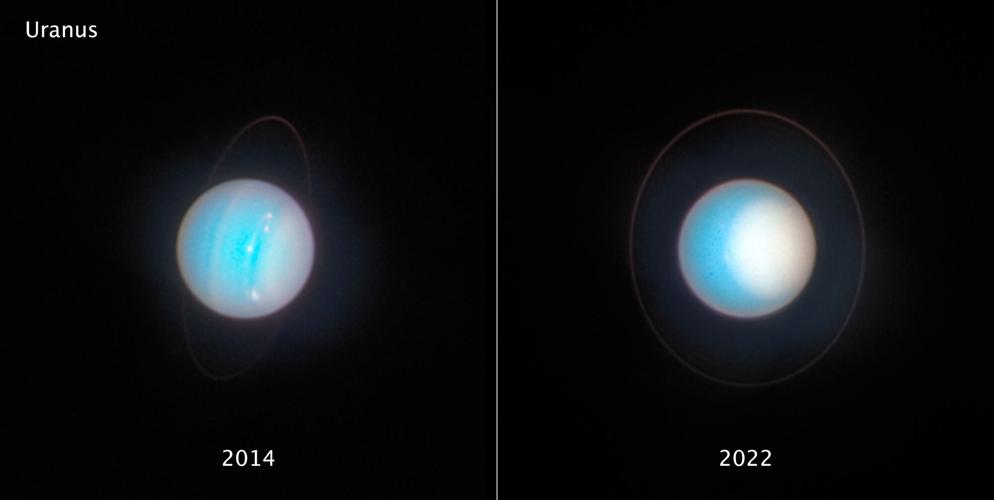
Uranus weather is very different from what we experience because the planet is so different. In addition to its gaseous nature, it's also tilted on its side and takes 84 years to make one trip around the sun. This means the seasons are much longer and large parts of the planet spend decades in or out of sunlight. NASA shared this example in a statement: "When the Voyager 2 spacecraft visited during the 1980s, the planet's south pole was pointed almost directly at the Sun. Hubble's latest view (from November 2022) shows the northern pole now tipping toward the Sun."
The resolution isn't quite as good, but there are several storms visible in the 2014 image above on the left. Those are made of methane ice-crystal clouds which can also be seen as bands stretching out from the storms. When you compare the left and right images, it can seem like we're looking at something totally different, and we are to a certain extent. The 2022 image shows, according to NASA's Hubble site, "Uranus' north pole shows a thickened photochemical haze that looks similar to the smog over (Earth) cities. Several little storms can be seen near the edge of the polar haze boundary. Hubble has been tracking the size and brightness of the north polar cap and it continues to get brighter year after year. Astronomers are disentangling multiple effects—from atmospheric circulation, particle properties, and chemical processes—that control how the atmospheric polar cap changes with the seasons."
Earth isn't the only planet with weather!


