
After a couple of delays last week, the Mars Helicopter (Ingenuity) is scheduled to attempt its first flight Monday morning! Last week NASA announced a problem occurred when they tried to switch Ingenuity from pre-flight mode to flight mode. They needed to reinstall the software and do some other checks to fix that, but it appears to have been fixed.

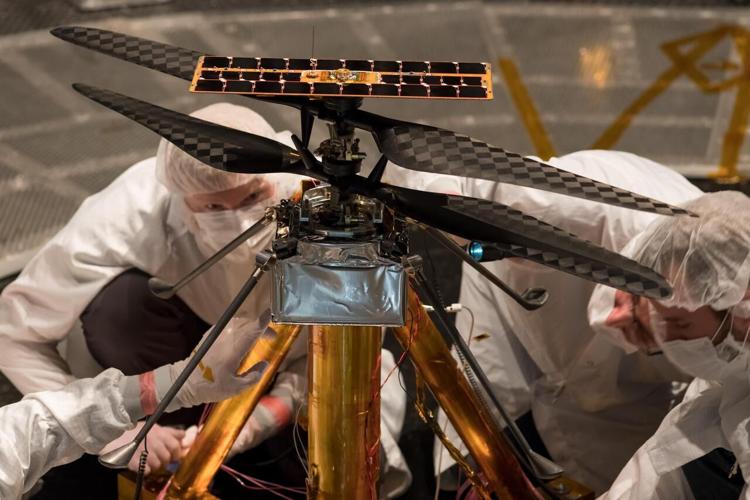
(Engineers working with the helicopter when it was still here on Earth. Image Credit: NASA/JPL-Caltech)
You can click here to watch it; Ingenuity is now scheduled to fly at 6:15 AM Eastern Monday. If all goes according to plan it should rise a few feet above the ground, hover for 20-30 seconds, and land. It's not going careening all over the planet; it's making it's attempt to be the first powered flight on another planet! If this first flight goes well, the team at NASA plans to attempt flights in the future that will go farther and higher.

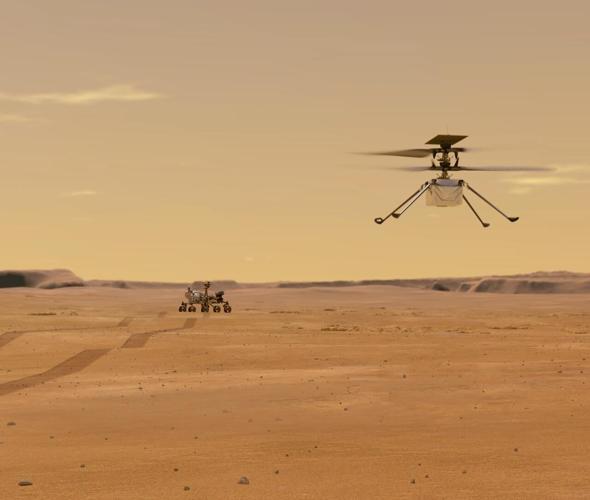
(Artist concept of Ingenuity flying over Mars with Perseverance in the background. Image Credit: NASA/JPL-Caltech)
There has been a build-up to get here. There are the things NASA lists that Ingenuity has already accomplished on the Red Planet in preparation for this historic flight:
- Survive launch, cruise to Mars, and landing on the Red Planet.
- Unlock and unfold from its stowed position underneath the Perseverance rover belly pan.
- Deploy safely to the Martian surface.
- Confirm communications with the rover and flight operators on Earth.
- Keep warm autonomously through the intensely cold Martian night (as low as minus 130 degrees Fahrenheit, or minus 90 degrees Celsius).
- Charge autonomously using its solar panel.
- Confirm the energy and power model over multiple Martian days (monitoring daily power consumption, solar energy, and battery levels).
- Unlock rotor blades.
- Spin up rotor blades for the first time on Mars (to a speed below what would be needed for flight) while still on the surface.
- Spin up rotor blades full-speed for the first time on Mars (to the planned flight speed of ~2400 RPM) while still on the surface.
Now it just needs to lift off, fly, and land successfully!


