NASA's InSight lander has been studying the Martian surface and subsurface since it landed in 2018, but the last two years have brought a new observation. In a statement released last week, NASA announced Insight had heard four meteoroids strike the Martian surface in 2020 and 2021. "Not only do these represent the first impacts detected by the spacecraft’s seismometer since InSight touched down on the Red Planet in 2018, it also marks the first time seismic and acoustic waves from an impact have been detected on Mars," said NASA. In that same statement, NASA shared this audio clip saying "the sound of a meteoroid striking Mars – created from data recorded by NASA’s InSight lander – is like a “bloop” due to a peculiar atmospheric effect. In this audio clip, the sound can be heard three times: when the meteoroid enters the Martian atmosphere, explodes into pieces, and impacts the surface. Credits: NASA/JPL-Caltech/CNES/IPGP"
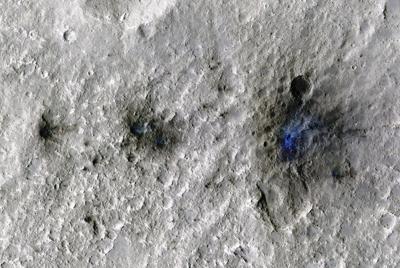
Geeking out about hearing space junk strike another planet? Don't worry, you're not alone. InSight has detected Marsquakes thousands of times before using its seismometer, but this marks the first time a recorded quake on the seismograph can be directly attributed to a meteoroid impact because of the audio. Then NASA sent the Reconnaissance orbiter to fly over the sight where InSight indicated the impact had happened and took these enhanced images showing impact craters.

These craters were formed by a Sept. 5, 2021, meteoroid impact on Mars, the first to be detected by NASA’s InSight. Taken by NASA’s Mars Reconnaissance Orbiter, this enhanced-color image highlights the dust and soil disturbed by the impact in blue in order to make details more visible to the human eye. Credits: NASA/JPL-Caltech/University of Arizona.
This is so exciting because researchers expected more impacts on Mars than what they have been able to observe to this point. NASA shares, "The Red Planet is next to the solar system’s main asteroid belt, which provides an ample supply of space rocks to scar the planet’s surface. Because Mars’ atmosphere is just 1% as thick as Earth’s, more meteoroids pass through it without disintegrating (...) Every meteoroid creates a shock wave as it hits the atmosphere and an explosion as it hits the ground. These events send sound waves through the atmosphere."
Now that they know what it sounds like, researchers hope to be able to detect more impacts in the future. They are also going back through the data InSight has already collected to see where they may have missed a previous impact they could now attribute to a meteoroid. Unfortunately this is the same InSight lander whose solar panels are so covered by dirt that it can't get enough power to stay alive. "...based on the latest power readings, engineers now believe the lander could shut down between October of this year and January 2023."


