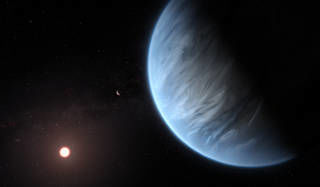
NASA's Hubble Space Telescope discovered a new planet 110 light-years away from Earth with water vapor in its atmosphere. This exoplanet is in the habitable zone from its star, making this discovery the first of it's kind. The image at the top of the page is an artist's rendition of the planet (K2-18b) with its star in the background (Credits: ESA/Hubble, M. Kornmesser). According to NASA, "the habitable zone is the region around a star where temperatures would let liquid water exist on a planet's surface."
K2-18b was actually discovered in 2015 by NASA's Kepler Space Telescope. Astronomers at the Center for Space Exochemistry Data at the University College London in the United Kingdom then used data from the Hubble captured in 2016 and 2017 to analyze how light from the star filtered through the planet's atmosphere. That's when they discovered water vapor in the atmosphere; their findings "also suggest the presence of hydrogen and helium in the atmosphere." The scientists working on this project believe there could also be other elements, including methane and nitrogen, but those were not detectable with current observations.
For comparison our atmosphere here on Earth has anywhere from less than 1% up to 4% water vapor. NASA clarified in a statement, "further studies are required to estimate cloud coverage and the percentage of atmospheric water present." This is the first planet outside our solar system which is in the habitable zone of its star known to have water in its atmosphere.
Does this mean there is life on this planet?
No, not necessarily. The star K2-18b orbits is a small red dwarf star in the constellation Leo; it's smaller, cooler and more active than our Sun. Since this star is more active, radiation may be too harsh for this planet to support life. K2-18b is also eight times the mass of Earth meaning surface gravity is much higher. In the future other telescopes will try to gather more information about K2-18b to determine if it's habitable or if life has existed on the planet.
This discovery is even more remarkable when you consider the Hubble Telescope. It was launched and put into service early 30 years ago and is still showing us things about the universe we didn't know!


