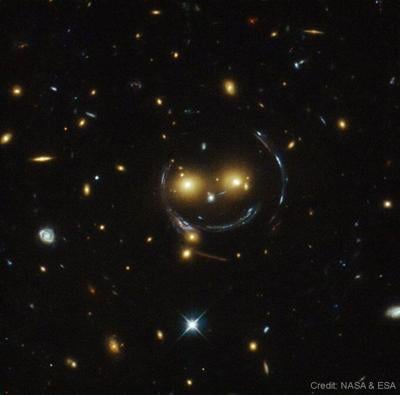

How Gravity Warps Light
Gravity is obviously pretty important. It holds your feet down to Earth so you don’t fly away into space, and (equally important) it keeps your ice cream from floating right out of your cone! We’ve learned a lot about gravity over the past few hundred years, but one of the strangest things we’ve discovered is that most of the gravity in the universe comes from an invisible source called “dark matter.” While our telescopes can’t directly see dark matter, they can help us figure out more about it thanks to a phenomenon called gravitational lensing.
The Gravity of the Situation
Anything that has mass exerts a gravitational pull on all the other stuff that has mass. That’s because mass warps space-time, the underlying fabric of the universe. Things like llamas and doughnuts and even paper clips all warp space-time, but only a tiny bit since they aren’t very massive. Bulkier objects like planets, stars, and black holes warp it a lot because they’re much more massive, but only in their local vicinity since they’re compact. The space-time distortions they create influence how objects move if they pass close by.
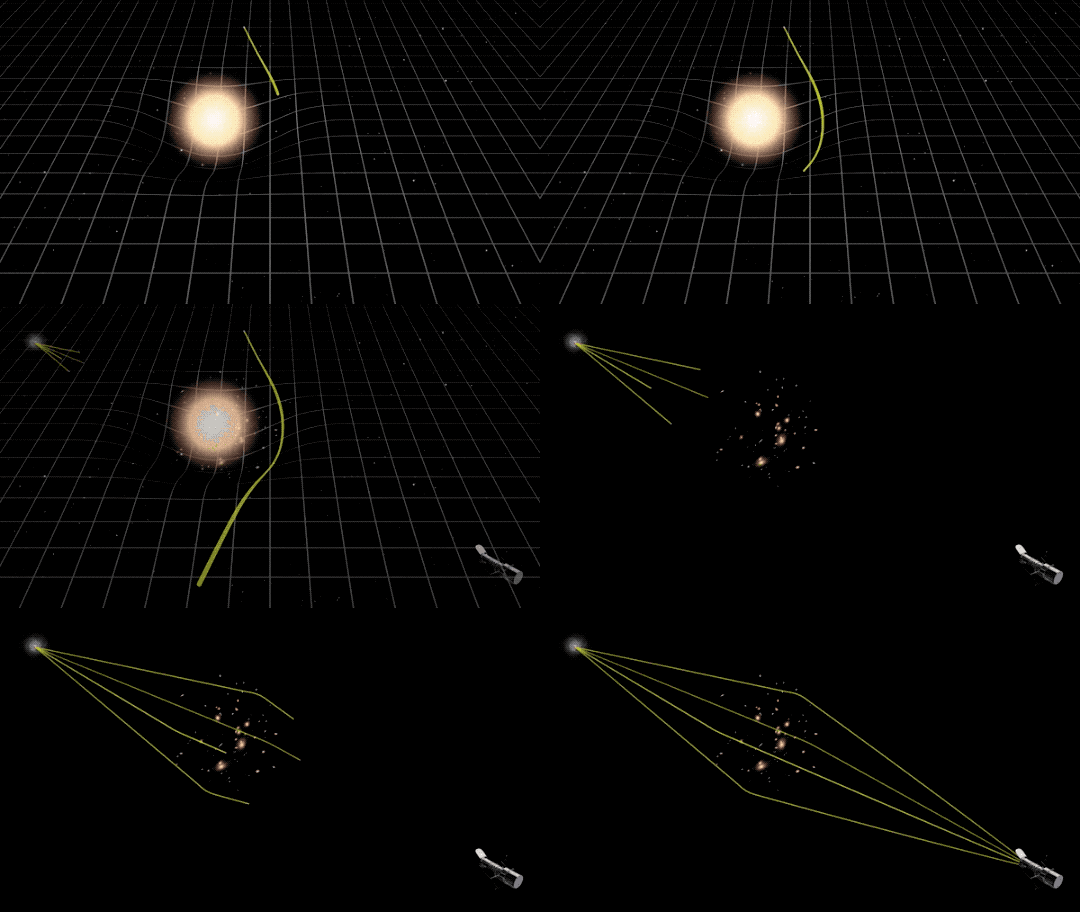
This animation shows the path of light around an object that is warping space-time. The dent acts as a lens. Light from a distant object that passes near the lens will be bent, which can make the object appear brighter and distorted. Credit: NASA, ESA, and Goddard Space Flight Center/K. Jackson
Huge clusters of galaxies are so massive that their gravity produces some fairly bizarre effects. When light passes close to a massive object, space-time is so warped that it curves the path the light must follow. Light that would normally go through the galaxy cluster bends around it, producing intensified – and sometimes multiple – images of the source. This process, called gravitational lensing, turns galaxy clusters into gigantic, intergalactic magnifying glasses that give us a glimpse of cosmic objects that would normally be too distant and faint for even our biggest telescopes to see.
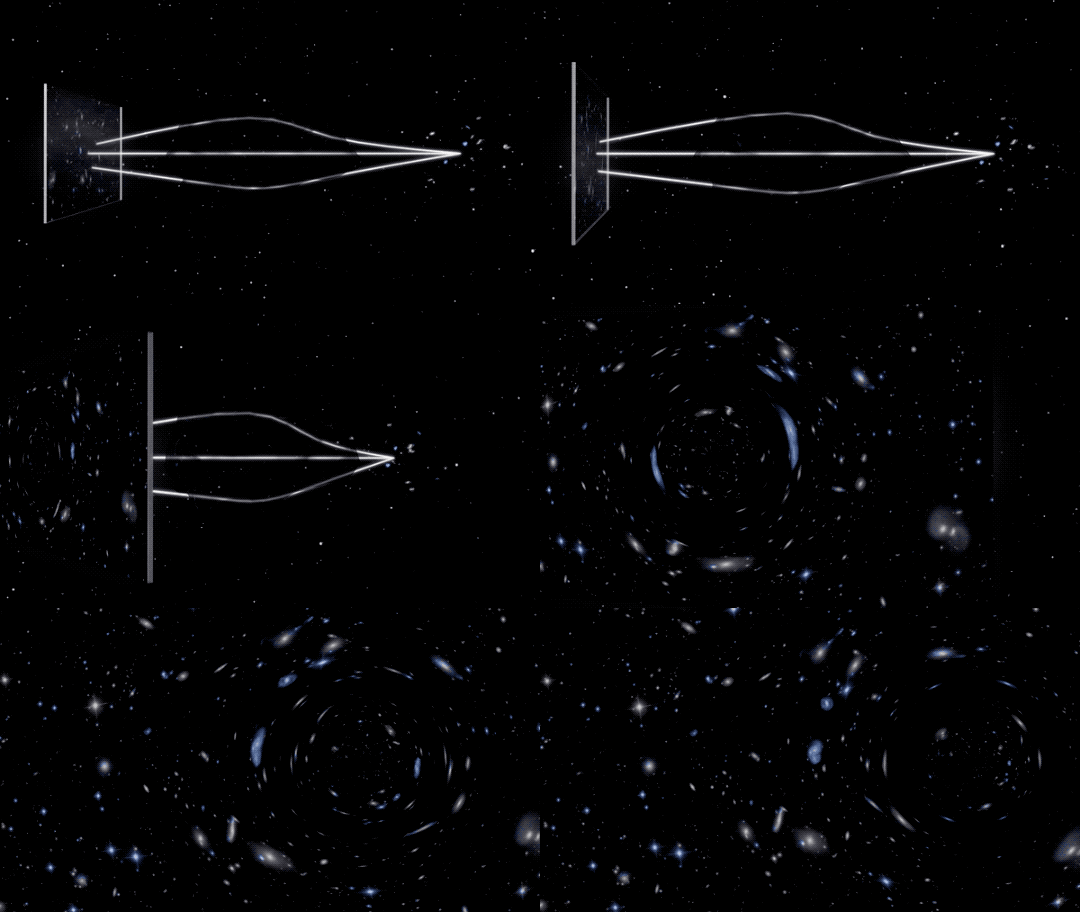
One way to investigate dark matter is by using gravitational lensing. This animation shows light passing through a galaxy cluster, with its path bent by the gravity of the cluster. The amount of bending helps scientists learn about the dark matter present. Credit: NASA's Goddard Space Flight Center Conceptual Image Lab
Hubble “Sees” Dark Matter
Let’s recap – mass warps space-time. The more mass, the stronger the warp, and the bigger its gravitational lensing effects. In fact, by studying “lensed” objects, we can map out the quantity and location of the unseen matter causing the distortion!
Thanks to gravitational lensing, scientists have measured the total mass of many galaxy clusters, which revealed that all the matter they can see isn’t enough to create the warping effects they observe. There’s more gravitational pull than there is visible stuff to do the pulling – a lot more! Scientists have given the invisible stuff that accounts for this difference the name “dark matter.” It’s invisible to our eyes and telescopes, but it can’t hide its gravity!
The mismatch between what we see and what we know must be there may seem strange, but it’s not hard to imagine. You know that people can’t float in mid-air, so what if you saw a person appearing to do just that? You would know right away that there must be wires holding him up, even if you couldn’t see them.
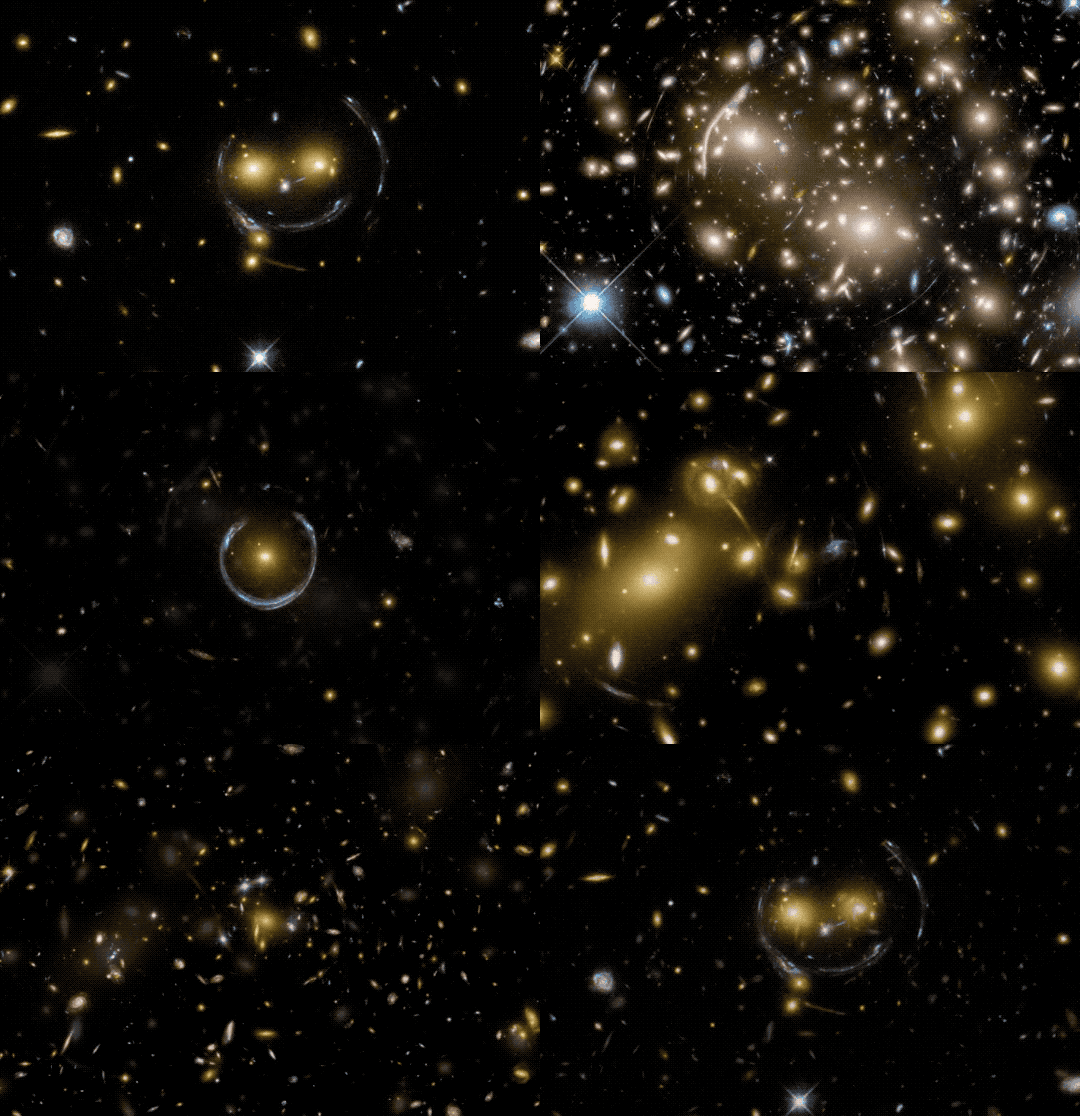
This slideshow highlights five images from the Hubble Space Telescope with strongly lensed galaxies. The path of light from these galaxies bends around the massive objects due to their strong gravity, creating these distorted images. Credit: NASA, ESA, Hubble, J. Lotz, HFF Team, Andrew Fruchter, ERO Team, K. Sharon, and E. Ofek
Our Hubble Space Telescope observations are helping unravel the dark matter mystery. By studying gravitationally lensed galaxy clusters with Hubble, astronomers have figured out how much of the matter in the universe is “normal” and how much is “dark.” Even though normal matter makes up everything from pickles to planets, there’s about five times more dark matter in the universe than all the normal matter combined!
Roman Will Escalate the Search
The upcoming Nancy Grace Roman Space Telescope will take these gravitational lensing observations to the next level. Roman will be sensitive enough to use a much more subtle version of the same effect, called weak gravitational lensing, to see how smaller clumps of dark matter warp the appearance of distant galaxies. By observing lensing effects on this small scale, scientists will be able to fill in more of the gaps in our understanding of dark matter.
Roman’s broad field of view will be at least 100 times larger than Hubble’s, while maintaining the same awesome image quality. It will also be more efficient and take images faster, so Roman’s lensing map will be almost a thousand times larger than Hubble’s. Roman will collect so much data in its first year that it will allow scientists to conduct in-depth studies that would have taken hundreds of years with previous telescopes.
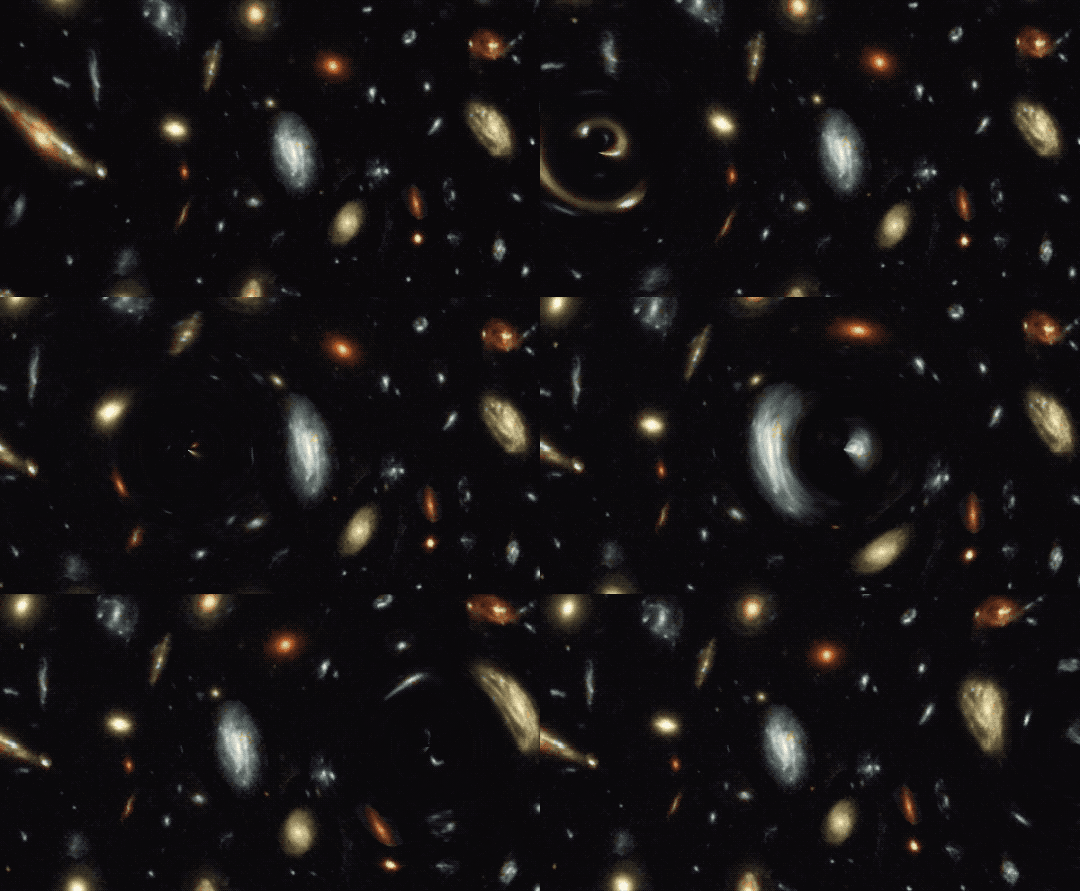
This simulation shows a gravitational lens moving against a background field of galaxies. The object passing between the camera and the background galaxies warps space due to its gravity. The warped space bends the path of the light from the background galaxies, making them appear distorted and brighter. Credit: Frank Summers (STScI)
Roman’s weak gravitational lensing observations will allow us to peer even further back in time than Hubble is capable of seeing. Scientists believe that the universe’s underlying dark matter structure played a major role in the formation and evolution of galaxies by attracting normal matter. Seeing how dark matter was distributed in the universe from its early stages to the present will help scientists unravel how it has evolved over time and possibly provide clues to how it may continue to evolve. We don’t know what the future will hold, but Roman will help us find out.
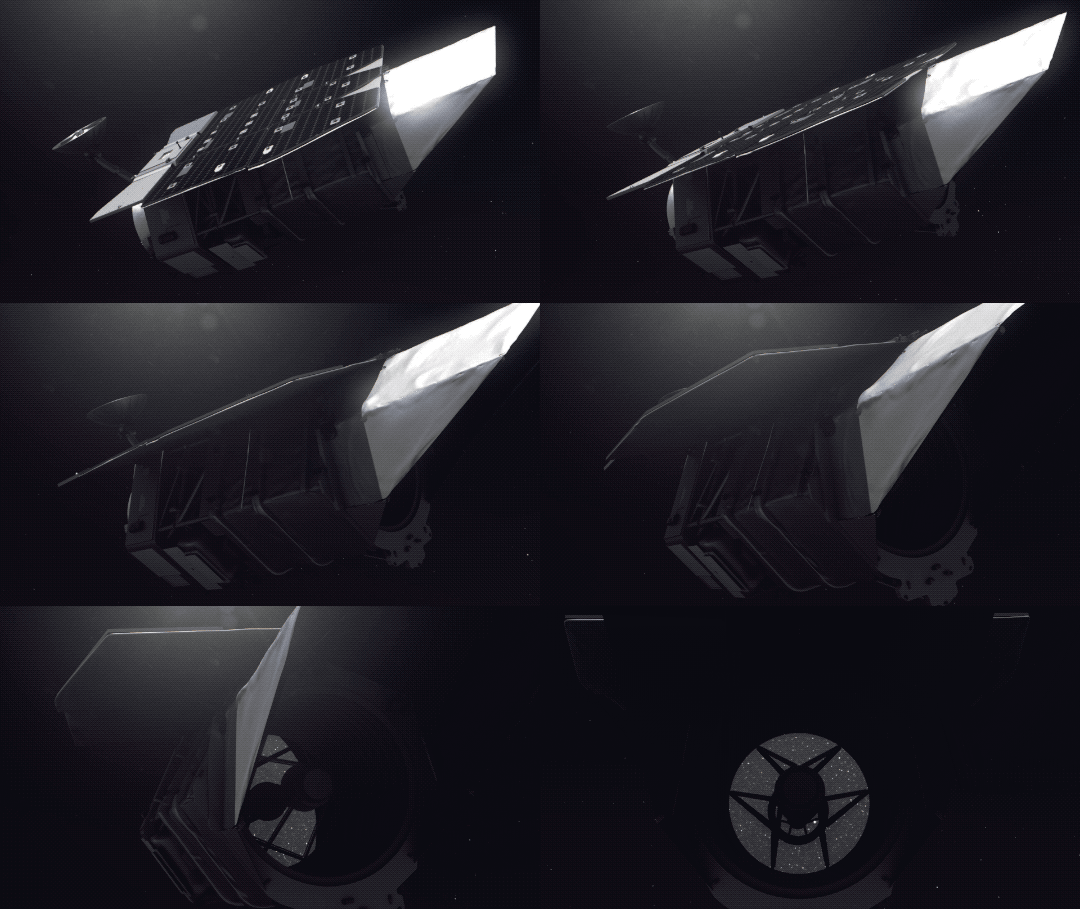
NASA’s Nancy Grace Roman Space Telescope mission, illustrated in this animation, will help uncover some of the biggest mysteries in the cosmos. Credit: NASA's Goddard Space Flight Center/CI Lab


