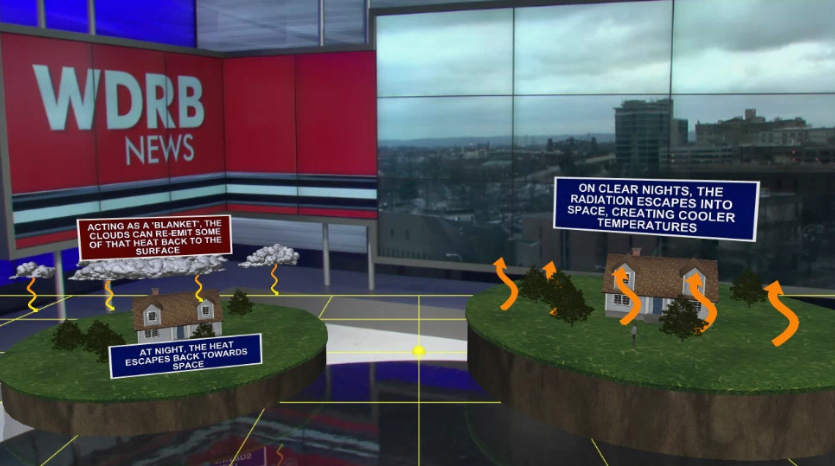
You may hear meteorologists say sometimes of TV the term "radiational cooling" when referring to very cold nighttime and early morning temperatures. We will experience this very aspect of weather tonight as extreme cold settles in to part of our area by tomorrow morning.
What causes air temperature to rise during the daytime?
Everything radiates heat. The ground, for example, emits heat continuously to outer space while receiving energy from the sun. In the daytime, incoming solar energy exceeds the outgoing energy and the temperature of the ground surface rises.
What causes air temperature to fall at night?
At night, as there is no incoming solar energy and the ground continues to radiate away heat, its temperature falls. This night-time cooling is called "radiation cooling".
Under what conditions will air temperature drop most efficiently?
The amount of temperature falls at night-time is related to cloud cover, wind strength and humidity. Maximum cooling occurs under clear skies, light winds and dry conditions (just like tonight).
The effect of cloud on ground temperature is akin to wrapping with a blanket to keep our body warm. Thus, under cloudy conditions the overnight temperature drop is less than that under clear skies.
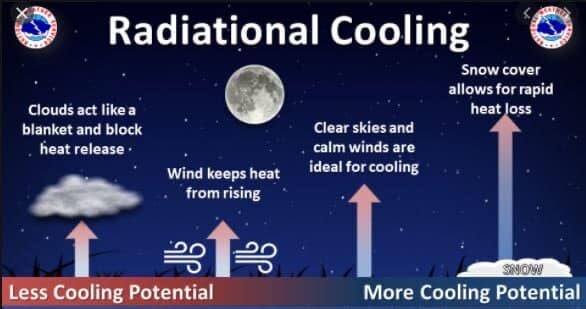
Image: NWS
Light winds tend to confine the cool air locally, preventing it from getting warm by mixing with surrounding air. Moisture in the air keeps the heat on the ground from radiating away. Hence, dry air cools off faster than moist air.
When you have snow on the ground like we do, it makes the surface even colder and can help speed up the process and make radiational cooling even more impactful. Stay warm tonight as single digits and some sub-zero temperatures are possible around our area!