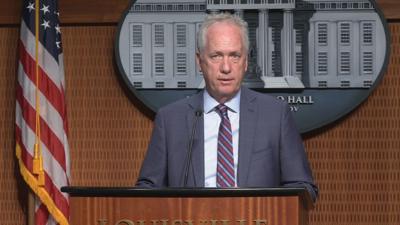
LOUISVILLE, Ky. (WDRB) -- State lawmakers introduced a bill to place new term limits on Louisville’s mayor, a change that would take effect after a new chief executive is elected later this year.
House Bill 314, filed this week by Louisville Republican Reps. Jason Nemes, Kevin Bratcher and Ken Fleming, also would allow the creation of more independent cities in Jefferson County and give the Metro Council the authority to approve settlements that exceed $1 million.
The measure would not change the city’s mayoral races to nonpartisan, a feature of a similar bill in the General Assembly in 2021. Nor does it address the subpoena power of a new civilian review board for police officers.
Under the bill, the next Louisville mayor and succeeding officeholders would be limited to two consecutive terms, although they still could run again after waiting four years. Since the merger of Jefferson County and the old City of Louisville in 2003, the mayor’s tenure has been capped at three straight terms, or 12 years.
Democrat Jerry Abramson served eight years before choosing not to seek a third term. Greg Fischer, also a Democrat, is serving the final year of his third straight term.
“I think that two four-year terms is a good model for an executive that has so much authority,” Bratcher told WDRB News.
In Lexington, for example, the nonpartisan mayor of the combined city-county government can serve three consecutive terms. Indianapolis, which has a merged government, has no term limits for its mayor.
A 2006 survey by the International City/County Management Association found that only 9 percent of cities imposed term limits on their mayors. Of those that did, 54 percent had a two-term limit and 28 percent had a three-term cap.
“I haven't heard a real big outcry from folks that the term needs to be reduced,” said Virginia Woodward, chair of the Louisville Jefferson County Democratic Party. Her initial reaction to the bill, she said, is: “You address terms by voting people out.”
The Jefferson County Republican Party did not immediately respond to phone and email messages seeking comment Thursday.
The merger of Louisville and Jefferson County, approved by voters in 2000, left more than 80 suburban cities in place even after the new merged government took effect in 2003.
HB 314 lets residents of Metro Louisville who live outside the urban services district – and who aren’t already in a suburban city – petition the Metro Council to form a new city. The legislation requires the council to approve such requests if 75 percent of people in the proposed city boundary sign on. The council still could approve a new city if that threshold isn’t met.
The bill also lets the council approve expansion requests by suburban cities if at least three-fourths of the residents in an area to be annexed sign a petition.
Bratcher, who represents parts of southeastern Jefferson County outside the Gene Snyder Freeway, said he hears from constituents who believe they’re not getting the Metro government services they deserve.
“I think that if you're going to have a county full of smaller cities that everybody should have the opportunity to incorporate into a city,” he said. “And I think that there's many parts of the unincorporated parts of Jefferson County that feel like the Metro government is not providing all the promises that they made when they merged.”
Metro Council President David James, a Democrat, said there are aspects of the bill he supports. Those include giving the 26-member council the power to approve settlements and mayoral appointees to agencies, boards and commissions.
But James said Thursday that he opposes the provision allowing new cities.
“We already have 82 or 83,” he said. “To add more to that would really dismantle consolidated local government and really cripple government, quite frankly.”
The bill does not address the subpoena power for the city’s Civilian Review and Accountability Board, which the Metro Council overwhelmingly approved in 2020. The panel and its inspector general were given police oversight after officers shot and killed Breonna Taylor during a raid on her apartment in March 2020.
One version of similar legislation introduced last year would have let the board pursue subpoenas through the Metro Council’s Government Oversight and Accountability Committee, which already has that authority.
Some state legislators were reluctant to give subpoena power to the civilian review board – an appointed, but not elected, entity. Competing attempts at resolving those powers ultimately shelved the bill.
Bratcher said there appears to be “very little interest” in legislation about the civilian review board in this year’s session.
James argued that it does need to be addressed.
“Subpoena power for the civilian review board is still something that needs to happen,” he said. “I would like for our legislature to do that. It would help our city move forward and bring people together.”
Copyright 2022 WDRB Media. All Rights Reserved.


