
LOUISVILLE, Ky. (WDRB) -- Cyndi Scott captured a moment of anguish recently as her son, a fifth-grade student at Camp Taylor Elementary, struggled with his lessons during distance learning at Jefferson County Public Schools.
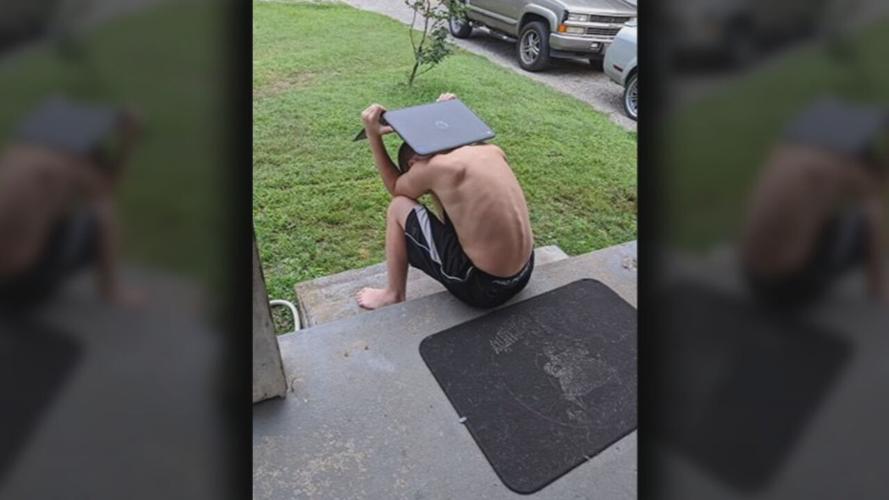
Shirtless, barefoot and seated on his porch with his back to the camera, Jeremy Wolf is crouched with his head down while holding his opened district-provided Chromebook above his head.
That photo, Scott said, sums up her son’s attitude so far about nontraditional instruction at JCPS so far this school year.
“I just want people to see that our children are willing to learn, but our children are getting frustrated, too,” she said Thursday. “My son, he wants to learn. He wants to be in school. He wants to learn everything he can, but he’s getting frustrated.”

Jeremy Wolf shows his frustration with distance learning at Jefferson County Public Schools. Photo provided by his mother, Cyndi Scott.
Students like Jeremy aren’t the only ones exhausted by the district’s distance learning program so far, which will last for at least the first six weeks of the 2020-21 school year because of the local COVID-19 caseload.
After multiple middle- and high-school classes were disrupted by students on the first day of classes Aug. 25, JCPS transitioned instruction from Google Meet to Microsoft Teams.
The new platform came with “a big learning curve” that has left some teachers feeling “really frustrated,” said Tammy Berlin, vice president of the Jefferson County Teachers Association and teaches arts and humanities at Atherton High School.
While Microsoft Teams provides more security features, it lacks some of the functionality of Google Meet that teachers had learned in the weeks leading up to the 2020-21 school year, she said, noting that some JCPS teachers reported working 14- to 18-hour days in hopes of familiarizing themselves with Microsoft Teams during the transition.
Berlin said she had problems getting an interactive slideshow to work during class Thursday. She also wanted to share a video of a theatrical performance so her arts appreciation class could analyze it, but the clip only played on Microsoft Teams without audio.
“I wound up having to share the link with them, and we all sat there while everybody watched it on their own,” Berlin said.
Microsoft has been responsive to JCPS when issues are raised about the Teams program, she said. For instance, after teachers raised concerns about students posting inappropriate content in chat rooms during classes, Microsoft pulled that feature and added security measures to keep that from happening, she said.
“It’s like playing whack-a-mole,” Berlin said. “We’ve got that problem fixed, now here’s something else.”
Berlin said the district has requested breakout rooms in Microsoft Teams, which allows classes to work in small groups during instructional time.
Whether teachers can see every student during classes also depends on whether they’re using Microsoft Teams on a web browser or with the Teams program, she said. Whether the software is the latest version also plays a role in how many people can see viewed in the video conference, she said.
“That’s a real frustration we’re having right now, because it’s hard-wired into teachers that we have to monitor our students during class,” Berlin said. “We want to keep them safe. We want to make sure they’re not doing anything that they shouldn’t be doing.”
Still, Microsoft Teams gives teachers more control over their virtual classes than Google Meet.
Berlin said teachers can now set up waiting rooms to admit students to classes before they start. Teachers can also remove students from classes or mute their microphones with Microsoft Teams, she said.
With Google Meet, students simply needed class codes to enter video conferences. Berlin said some students shared their meeting codes on social media, which allowed others to begin “wreaking havoc on classes.”
Teachers could remove people from those classes, but they could rejoin at least twice more before they could be permanently kicked out of the conference, she said.
“People were coming into the classroom uninvited and sharing inappropriate things, saying inappropriate things, and the teacher didn’t have a way to kick them out of the class,” Berlin said, noting she did not personally experience such problems. “There was no way to mute them or anything like that.”
“It was a safety issue for kids,” she said. “Kids were being exposed to inappropriate things, and we don’t want that to happen to our students or your children in our classrooms. We want our classrooms to be safe and places that are conducive to learning.”
At times, multiple people interrupted virtual classes. Berlin said she heard from one teacher who had eight people disrupting her Google Meet class at the same time.
“She couldn’t kick them out fast enough,” Berlin said.
While some teachers faced major security issues with Google Meet, Berlin said others hope to switch back at some point during distance learning if those problems can be fixed.
“I know that our elementary teachers, a lot of them are saying that they really liked Google Meet because it’s really much more user friendly for students, younger students especially, and their parents than Teams is,” she said.
But for parents like Scott, she’s more concerned about the rigor offered to her son during “NTI 2.0.”
She worries that the hour each day of synchronous instruction and the few assignments he gets daily don’t compare to the instruction he’d be getting if learning inside a classroom.
Her other children – a daughter who is a junior at Central High School and a son who is in the sixth grade at Highland Middle – have gotten more out of their virtual learning experiences, she said.
“I think these elementary school kids need more attention,” Scott said.
JCPS spokesman Mark Hebert said the district issued guidance to teachers at every grade level about the amount of instruction that students should receive each week.
"If a parent has issues, they should contact their child's teacher and/or school leadership," he said in an email to WDRB News.
Scott believes more class time and individual attention will help her son adapt better to distance learning at JCPS. At one point, Jeremy said he was so upset that he wanted to drop out of school, she said.
“I think there’s some new stuff that we could add to this to help some of our children out more so that our children don’t struggle and don’t get frustrated,” Scott said.
“It’s sad. It just broke my heart to see my 9-year-old son say he wants to drop out of school.”
Copyright 2020 WDRB Media. All Rights Reserved.