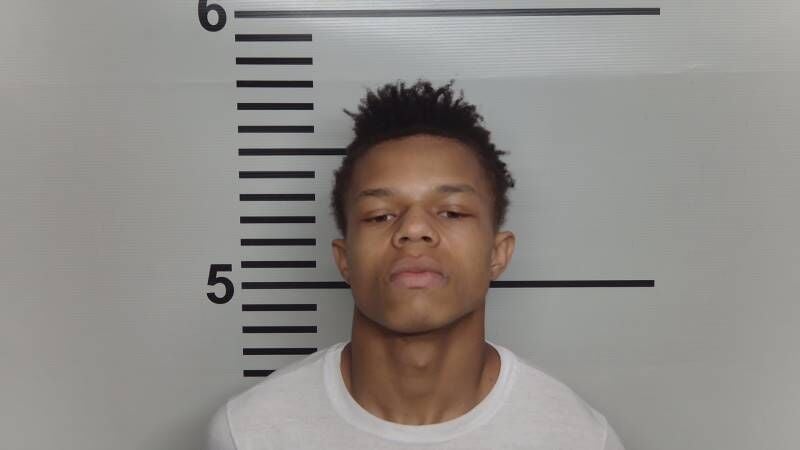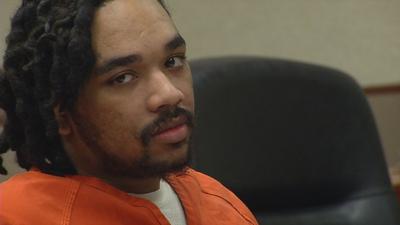
LOUISVILLE, Ky. (WDRB) – Dimitri Harris, who was charged with trying to kill a police officer in 2017, pleaded guilty Tuesday to lesser charges that don't involve the shooting.
Harris maintained that he never shot Officer Brad Shouse and told WDRB News in a previous interview that he believed the officer shot himself during a foot chase. But he accepted a plea agreement to charges of fleeing and evading police and unlawfully having a gun in his apartment.
The plea deal calls for Harris to serve eight years in prison. He entered an Alford plea, meaning he maintains his innocence but acknowledges prosecutors have enough evidence for a jury to find him guilty.
Harris admitted to Jefferson Circuit Court Judge Audra Eckerle that he ran from police, putting officers in danger, and had a gun at his home he was not allowed to own because he is a convicted felon.
Bullets from the gun in Harris' home did not match the shot that hit Shouse during the chase near Kemmons Drive between the Watterson Expressway and Goldsmith Lane in June 2017.
But Assistant Commonwealth’s Attorney Ryane Conroy said body cam video from Shouse and other officers prove Shouse did not shoot himself. WDRB News has previously requested to see the body cam footage, but police have not provided it.
Conroy told a reporter prosecutors "obviously believed we had evidence" that Harris shot Shouse but agreed to a compromise plea, which is common in criminal cases when the evidence is lacking.
Defense attorneys Sarah Clay and Ted Shouse (no relation to the officer) declined to comment after the hearing.
Harris told WDRB in August 2017 he ran from police because he had a warrant for his arrest, but "I never pulled a gun or anything."
"I never had a gun or nothing," Harris said. "I believe (Shouse) shot himself in the foot.”
After that interview, Jefferson Circuit Court Judge McKay Chauvin signed a search warrant allowing Louisville police to comb through WDRB News' newsroom and access computers, notes and unpublished material gathered for the Harris story.
WDRB appealed, arguing the search warrant was "clearly illegal" under a federal law meant to protect journalists' First Amendment rights.
Chauvin told police they would instead need to have a grand jury subpoena WDRB to get the information they wanted, but he defended his actions and said the station needed to work with police.
"They need to get what they need to get," Chauvin said of police at a hearing in September 2017. "And you're not in the business of preventing that to which they are entitled."
Eventually a different Louisville judge rejected efforts from police and the Jefferson Commonwealth's Attorney's office to obtain raw video from the Harris story.
"It is a poor way to build (or reject) a case involving a wounded policeman," Judge Charles Cunningham ruled in January 2018. "Are we to understand that LMPD is now going to depend on reporters to generate crucial evidence of criminal wrongdoing in our community?"
The WDRB interview with Harris took place two months after "the police had already staked out a public position" that Harris shot the officer, Cunningham wrote. "If they didn't already have enough evidence to indict him, and thus really need this footage, why did they say such disparaging things in the first place?"
Commonwealth's Attorney Tom Wine implemented a new policy requiring subpoenas to media outlets to be approved by him or his first assistant.
Copyright 2020 WDRB News. All rights reserved.