

LOUISVILLE, Ky. (WDRB) — A $1.4 billion development set to tower over Louisville's Cherokee Park received final approval Thursday for up to $62 million in tax increment financing incentives from the state.
According to our partners at Louisville Business First, the Kentucky Economic Development Finance Authority voted to approve the plan for One Park at its meeting Thursday. The news is a major win for Jefferson Development Group, the developer of One Park, which has been working on plans for the $1.4 billion project since at least 2014.
The deal will redirect state taxes collected from the activities at One Park — such as state income taxes of employees who work there — from Kentucky's coffers back to that of Jefferson Development Group, developer Kevin Cogan's business entity.
Demolition of the existing buildings between Grinstead Drive and Lexington Road could begin in 2027, according to Louisville Metro councilman Anthony Piagentini.
Jefferson Development Group has pursued the ambitious project since 2016. One Park South was approved in 2019 after almost two years of debate and 11 public meetings about its height and density. Introduced in 2021, One Park North on the north wide of Lexington Road got its rezoning approval in 2023.
In December 2023, Louisville Metro Council signed off on a similar arrangement whereby Cogan's group is eligible to capture up to $114 million in Metro taxes over 30 years following development’s construction. The subsidy requires the developer to make 7% of the estimated 600-700 apartments at One Park affordable, using guidelines for income, family sizes and rents established by the federal government. Under the agreement, the developer to keep 80% of the incremental tax dollars while Metro Council will keep the other 20%.
The state incentives layer on top of Metro's $114 million.
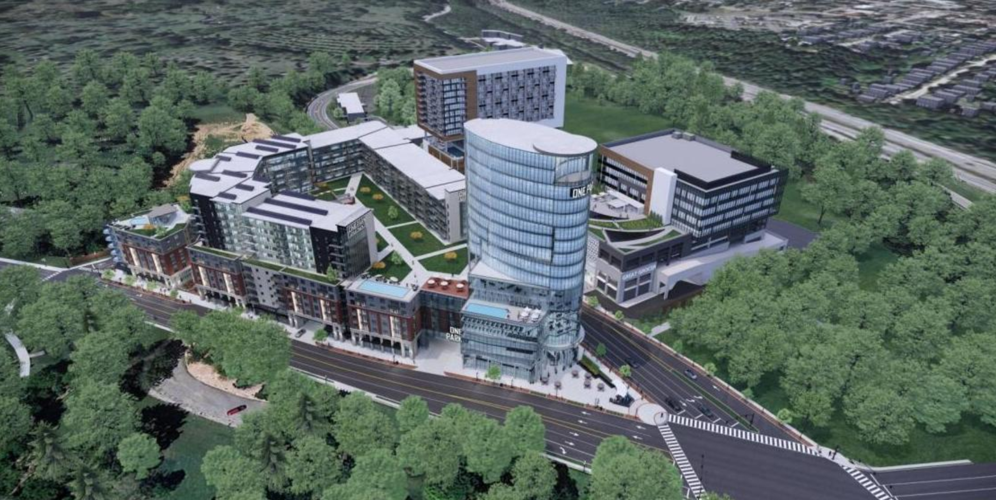
One Park would be one of the biggest developments in Louisville history, a mix of apartments, offices, stores, restaurants and a hotel in various buildings up to 18 stories tall. It's construction would come at a time when Louisville faces a severe shortage of housing that is affordable for low-income households, and policymakers like Mayor Craig Greenberg have said the city needs more affordable units in all neighborhoods.
"One Park is one of the largest, most progressive, interesting, dynamic developments that we’ve had in decades," Piagentini said.
'What type of a city do we want to be?'
While some neighbors think it's too big, One Park is the sort of urbanist development that city planners dream of: a dense, compact, pedestrian-friendly mix of uses built near Louisville's city core and at the foot of one its finest public assets, Cherokee Park.
One Park is "exactly the kind of economic activity that is anticipated and promoted by" Louisville's land use plan, the Metro Planning Commission gushed when approving the original One Park rezoning in 2019. It would replace a hodge-podge of small buildings and parking lots that developed haphazardly over time in the triangle between Grinstead Road, Lexington Road and Etley Avenue.
In all, One Park would have 600-700 apartment units, 200 hotels rooms, a grocery store, restaurant/retail space and common areas such as plazas and terraces, according to the presentation obtained by WDRB. Jefferson Development Group has said One Park is the sort of project seen in faster-growing cities like Nashville.
Former Louisville Metro Councilman Bill Hollander, who voted for the 2019 zoning change needed for the original One Park, said he applauded the development for its density, despite "legitimate" concerns about added traffic.
"Whether you think this would be a good development for the community is one thing. And I do," Hollander said. "Whether you think the taxpayers should pay for it is another thing. And I'm not sure I do."
Metro Councilman Markus Winkler, a Democrat who represents the Springhurst-Anchorage area, supported the TIF deal for One Park, saying it would be "a shame" if the project doesn't materialize.
It's "the sort of development you see in lots of other growing cities," he said.
"What type of a city do we want to be? Do we want to be a city that attracts new people, new business, new opportunity? Or, do we want to be a city that stays the same or shrinks, right? And you either grow or you die," Winkler said. "... Responsible growth — making sure that we're attracting a workforce here, that we're attracting companies here — is what's critical to the success of our city."
TIFs don't always work as planned
One of the few economic development subsidies available to Louisville officials, TIFs have proliferated in recent years, underpinning the financing of the KFC Yum! Center arena, the Omni Louisville downtown hotel and several new apartment complexes.
The idea is that something newly built — such as an arena, a hotel or an apartment complex — results in increased tax revenue. A portion of that new money is then redirected over time back to the developer to help pay for the project.
In theory, cities and states still come out ahead, even if they let the developer share in the gains. But the economic assumptions undergirding TIFs are often questionable, said Greg LeRoy, executive director of Good Jobs First, a Washington organization that researches state and local economic subsidies.
Usually, at least some of the "growth" is illusory because the activity was already happening elsewhere in the same metro area, or would have happened anyway even without the subsidy, he said.
For example, if a company already located in Louisville takes up new office space in One Park, that wouldn't be a net benefit to the city. Even if an out-of-state company relocates to Louisville, that may have happened anyway regardless of the development, LeRoy said.
"If you can safely assume ... that 100% of every business, every tenant, every hotel night, is going to come from afar and wouldn't have happened otherwise except for this one, spiffy building, then you can claim it's all 'incremental' (growth)," LeRoy said. "I would never try to defend that position."
Supporters of TIFs also accept another article of faith: that private developers wouldn't build their projects except for the subsidy.
TIF deals for the Omni and the downtown Marriott built in 2002 left taxpayers with a $5 million tab because tax revenue didn't materialize at the hotels during the COVID-19 pandemic. The TIF for the KFC Yum! Center, which was built in 2010, also didn't produce the new tax revenue that had been projected, causing Louisville taxpayers to contribute more to help the arena meet its debt payments.
However, in the presentation shared with city officials, Jefferson Development Group said the One Park TIF would work differently: The developer — not taxpayers — would be on the hook if tax revenue is less than expected.

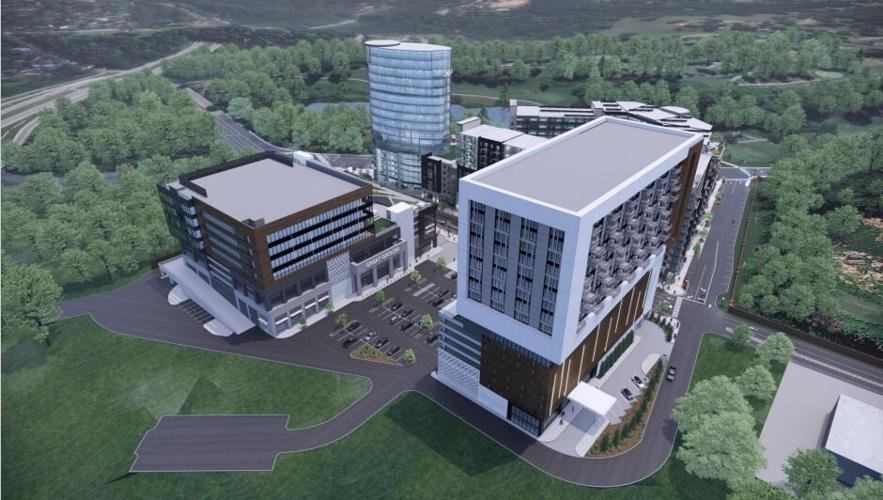
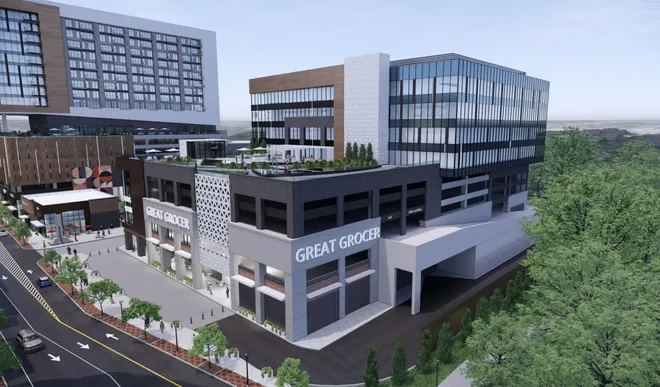
One Park North would include a 10-story residential tower with a grocery store on the ground floor and a 17-story tower for apartments. (WDRB Photo)
How big is the One Park development?
One Park would have roughly 240,000 square feet of commercial office space as part of a broader mix of uses.
Of the new construction office and mixed-use projects currently tracked by Business First's Project Watch map, fewer than a handful are inside the Watterson Expressway.
Louisville's office market has had its share of ups and downs, especially after the work-from-home changes during the COVID-19 pandemic. But real estate executive David Hardy said one thing remains constant: New space always leases well.
Hardy, who has been brokering office properties in Louisville for nearly 40 years, said he believes new tenants will be drawn to One Park.
"Anytime you build a new office product, it's appealing to the tenant, because you're going to have modern amenities and a modern feel that you can't replicate very easily in older inventory," said Hardy, managing director for CBRE's Kentucky operations since 2005. "It's kind of like throwing up a new hotel in a market — everybody goes to the new one."
The lack of new inventory could be a contributing factor to downtown's struggling office market. CBRE's November Downtown Louisville SkyView report showed there is more than 1.5 million square feet of rentable office space available in downtown towers, equating to a 35% direct vacancy rate.
Hardy said a new office construction like One Park could exacerbate those numbers further when tenants in existing office buildings leave for the new development.
But new construction is necessary for Louisville to compete with other cities for jobs and talent, Hardy said, and the market has weathered previous projects.
"If Louisville is going to attract new companies with new workforces and a Fortune 500-type mentality they want to see newer product that meets their vision, needs and accommodates their staff," Hardy said. "I think having something that's interesting and appealing to those types of groups is a plus for Louisville and really a necessity."
Copyright 2026 WDRB Media. All Rights Reserved.