
LOUISVILLE, Ky. (WDRB) – On August 29, 2005, as Hurricane Katrina roared ashore on the Gulf Coast, a senior vice president at Marathon Ashland Petroleum asked a colleague at the company’s Ohio headquarters for a list of states with laws prohibiting businesses from jacking up prices on necessities, like gasoline, during emergencies.
Kentucky is one such state, having adopted a law against emergency “price gouging” in 2004.
In a subsequent email, the Marathon vice president told a colleague to “brace yourself,” adding that Gary Heminger, the company’s then-president and now CEO of Marathon Petroleum, wanted to “take the full move.”
Marathon, the biggest supplier of wholesale gas to Kentucky, would proceed over the next three days to raise the price of regular gas at its terminals in the state by nearly 35 percent, from $1.94 to $2.59 per gallon, according to the Kentucky Attorney General’s Office.
On Aug. 31, as the remnants of the dissipating storm reached Kentucky, the Marathon vice president, Mary Ellen Peters, made a suggestion to her boss, Heminger: “How about going public quickly that we are not trying to profit from the problems (and) will donate 10 or 20 or whatever to the relief efforts.”
The 2005 emails are among confidential records obtained by WDRB News in Kentucky’s decade-old lawsuit against the company, now known as Marathon Petroleum Corp., which is the “dominant” supplier of wholesale gasoline to Kentucky service stations.
The emails were also the subject of a contentious fight in the court case, with lawyers for the state arguing they show the company flaunted Kentucky’s anti-gouging law and spiked prices. Marathon has disputed that interpretation while seeking to keep the emails from public view.
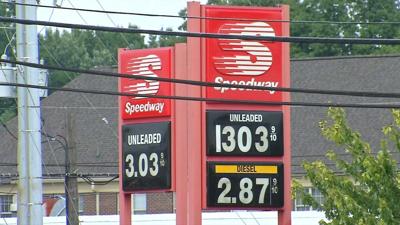
The case centers on Kentucky’s allegation that Marathon, which also owns the Speedway gas station chain, illegally increased gas prices in the wake of Hurricanes Katrina and Rita in 2005, and again in 2011, when the state had a major flood.
Kentucky’s anti-gouging law prohibits businesses from charging prices “grossly in excess” of their previous prices or their costs during a state of emergency declared by the governor. The law is meant to ensure consumers aren’t taken advantage of for necessities like gas, building materials and groceries.
Attorney General Andy Beshear – who inherited the lawsuit filed in 2007 by his predecessor’s predecessor, Greg Stumbo – said he is determined to finally resolve the languishing case, which has taken “far too long” already.
“We believe what we are going to be able to show here is that they were making significant and gross profits off of this time period, where people were suffering,” Beshear said in an interview last week.
Marathon, which has denied the state’s allegations in court, declined to comment for this story. A trial is scheduled for January, though either a settlement or yet another delay is possible.
But even if Beshear, a Democrat who has launched a bid for governor next year, successfully resolves the 11-year-old case, the Republican-controlled state legislature may have knee-capped Beshear’s ability to win penalties from Marathon.
With the support of many Democrats, the General Assembly passed a bill in March that puts a $25,000-per-day cap on penalties for violating the law, among other changes to the statute.
Marathon lobbied for the changes and even sent a company lawyer to testify to the bill’s benefits before a legislative committee in March.
Beshear’s attorneys have suggested in court that Marathon may have misled legislators about how the bill could strengthen the company’s position in the current case, as opposed to the changes applying only to future price-gouging claims.
In court, Beshear has demanded Marathon turn over any communications its lobbyists may have had with lawmakers and with Gov. Matt Bevin or his office about the bill. A spokeswoman for Bevin called the request “just another political stunt from Candidate Beshear.”
Marathon calls lawsuit a “vehicle for self-promotion”
Marathon, based in Findlay, Ohio, is a $35 billion petroleum giant that operates oil refineries – including in Cattletsburg, Ky. – and owns the Speedway chain, including 147 stations in the state.
Kentucky is no stranger to litigation with the company, which is believed to provide a significant portion of the gasoline sold in the commonwealth, regardless of whether the selling station is a Shell, BP or other brand. (Stations with the “Marathon” brand are actually owned by independent business people).
In 2015, five months before his unsuccessful bid for governor, then-Attorney General Jack Conway sued the company for anti-trust violations, alleging Marathon exploits a monopoly on the cleaner-burning reformulated gas, or RFG, required to be sold in Louisville and northern Kentucky.
Conway said consumers in Louisville and northern Kentucky suffer by paying consistently higher prices at the pump than other markets, like St. Louis, where reformulated gas is required.
Beshear said he wants to get the antitrust case, which is unfolding in federal court in Louisville, to trial as soon as next year.
Marathon, for its part, has said it’s been made a punching bag for politically motivated attorneys general. In a 2016 court filing in the price-gouging case, the company said the state has “repeatedly demonstrated its willingness to use this lawsuit as a vehicle for self-promotion.”
Stumbo filed the litigation on the eve of a primary election (in which Stumbo was on a gubernatorial ticket) in 2007, and Conway added the 2011 flooding claims as he was seeking re-election that year, Marathon noted. But after grabbing headlines, Stumbo and Conway did little to advance the cases, the company said.
Marathon fights to keep emails under wraps
The 2005 emails among top Marathon executives show the company was aware of price-gouging laws, “took large price increases anyway,” and then “tried to deflect public anger” over surging gas prices, Beshear’s lawyers told Franklin Circuit Court Judge Thomas Wingate in a confidential filing in June.
While Marathon disputes that characterization, court records show the company has vigorously opposed the state’s attempt to make the emails public, arguing that releasing the documents would compromise the company’s right to a fair trial.
Correspondence in the case shows Marathon worried that Beshear would use the emails – which the company turned over the Attorney General’s office in November -- in a press announcement.
“They (Beshear’s office) want this in the public record in order to misconstrue these documents, which we think their argument in regard to these documents is a misconstruction – is a misinterpretation,” Theresa Canaday, a Louisville lawyer representing Marathon, said during a June 4 court hearing. “That will come out in (the) trial.”
In addition to the emails, Beshear’s office has also sought to make public a deposition of Heminger, Marathon’s chairman and CEO, that Beshear’s lawyers conducted in January in the federal case surrounding Marathon’s alleged monopoly.
Judge Wingate ruled June 6 that the emails and deposition would remain sealed. However, the emails and some confidential legal briefs about their contents were handed to a reporter as part of the public case file at the Franklin County courthouse earlier this month.
The most consequential email may be the one Peters, the Marathon vice president, sent after asking for information about emergency pricing laws on Aug. 29, 2005: “Brace yourself. Basis up 35 on top of 10. GRH (Gary R. Heminger) wants to take the full move.”

Two petroleum industry analysts, each of whom insisted on anonymity, told WDRB the “basis” likely refers the difference between spot – or immediate – prices for gasoline as the storm made landfall, and prices on the futures market. In other words, one of the analysts said, it appeared company officials recognized that the storm sent spot prices surging and took advantage of the opportunity.
But Marathon will likely offer a different interpretation if the case advances to trial.
“The emails actually refer to costs going up, which in turn results … in prices going up,” Marathon attorney Peter Cummins said during a court hearing on March 26.
Beyond that off-hand comment, Marathon hasn’t explained the meaning of the emails in court, and Cummins declined to elaborate to WDRB News.
Beshear and his attorneys also declined to comment on the emails, citing their confidential status.
Critics: Lawmakers helped Marathon with changes
Another looming battle in the case: whether the changes that legislators made to the price-gouging law in March can be used to Marathon’s benefit in the current case.
Lawmakers who championed the bill, SB 160, said the purpose was to clarify vague language in the original law.
“This was a bill that was intended to set very specific parameters as to price gouging so that everybody was crystal clear,” said state Sen. Julie Raque Adams, a Republican from eastern Jefferson County, who co-sponsored the legislation.
Rep. Jerry Miller, a Republican from Eastwood, said the fact that Stumbo’s lawsuit against Marathon is still pending after 11 years showed that changes were needed to make the price-gouging law “worthwhile.”
“What’s the point of having a law which allows somebody to hold a press conference and say, ‘I’m going to do this, and I’m going to do that,’ if it never results in damages or an award that is collected upon by the state?” Miller said in an interview last week.
Critics said the new law, in fact, changes the price-gouging statute in ways that help Marathon and other big businesses.
“This bill protects Marathon; it doesn’t protect the citizens of the commonwealth,” Rep. Jim Wayne, a Louisville Democrat, said on the House floor on March 20.
In addition to capping penalties to $25,000 per day, the bill defined a company’s “costs” to include “anticipated replacement costs,” and added defenses companies can deploy against gouging charges, such as for prices that are “generally consistent with fluctuations” in commodity markets.
While Beshear told WDRB the bill was “close to snuck through” the General Assembly, legislative records show it went through normal processes and garnered a 37-1 vote in the Senate before turning partisan in the House, where it still passed by a comfortable 58-36 margin.
Miller said Marathon wasn’t the only proponent of the bill, which was also backed by the Kentucky Chamber of Commerce and associations representing homebuilders and manufacturers, among others.
Marathon now wants at least four of the bill’s provisions, including the $25,000 per-day cap on damages, to apply to the current case, according to a brief the company filed in May.
Wayne predicted in March that the company was “trying to bypass the courts and come to us” to strengthen its hand in the price-gouging case.
But in an interview last week, Raque Adams said she did not think the bill’s changes could be applied retroactively.
“I was under the impression that this would apply to future questions about price-gouging, and that it would have nothing to do with current litigation,” she said.
Reach reporter Chris Otts at 502-585-0822, cotts@wdrb.com, on Twitter or on Facebook. Copyright 2018 WDRB News. All rights reserved.


