

LOUISVILLE, Ky. (WDRB) -- One year after another, Louisville has recently seen homicides reach into the triple digits. At least 140 people have been killed each year since 2020, according to LMPD data.
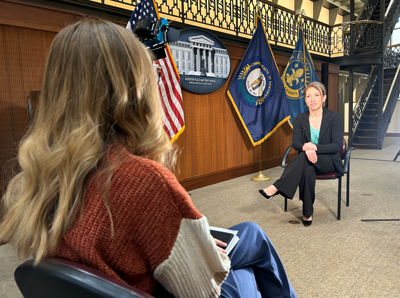
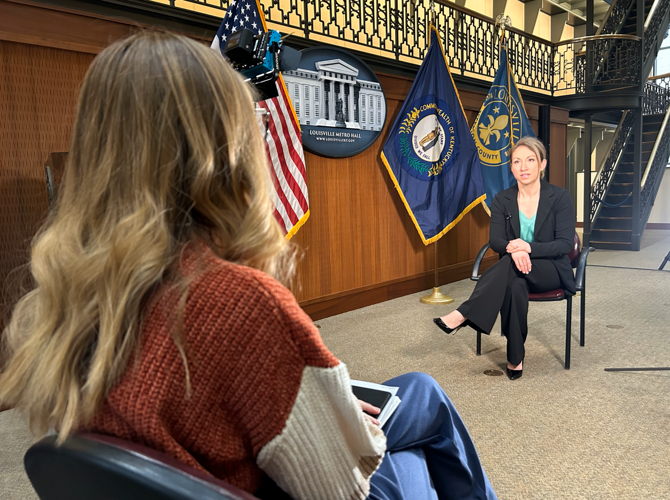
In a move hoping to spark change, the city created a position called executive director of community safety, and stepping in to fill that role is Louisville's own Misty Wright.
"My job is to wake up focused on crime — focus on it all day and then go to sleep focused on it," Wright said.
Raised in Louisville, Wright calls the Derby City home. She's returning to the commonwealth after spending the last several years in Chicago as a federal prosecutor, where she said her work largely focused on gangs and cartels.
"I have focused, over the last 10 years, on how to get agencies who are not beholden to one another to collaborate and cooperate and work together to dismantle organized crime," she said.
She's bringing that background with her to Louisville. Much of her role right now, as she's getting started in the city, is listening and learning with hopes to help create better communication across the board. She said while so many organizations and entities are working try to stop or prevent violence, too many are working as silos.
"My role is centered around not just what will law enforcement be doing or what will OSHN be doing but how can we use all of the resources we have to develop and implement common sense strategies to reduce and eliminate crime and to improve the collaboration, so that those efforts can be compounded into something much more," Wright said.
Community members like Krista Gwynn are glad to hear about plans to get more collaboration. Gwynn lost her son, Christian, in deadly shooting in late 2019. Then, in 2021, her daughter, Victoria, was injured in a shooting at Ballard Park. For years now, she has shared their stories and worked with nonprofits to speak out against violent crime.
"Navada and I, my husband, we have been saying this for the last five years: You can't get nothing done if organizations are trying to one-up each other," Gwynn said Thursday We have one common denominator, and that is to end the gun violence against our youth and against children and people in general. You can't want to run a nonprofit and organization and not want to work with the next nonprofit or organization."
Gwynn said she knows change won't happen overnight but she believes working together will make a difference over time.
"We are tired of losing our children," she said. "So let's unite and become a front in this battle."
Wright is just a few weeks into the job but said there needs to be a focus on programs like Group Violence Intervention, or GVI.
"What I see thus far is that gangs, and other groups, are driving a disproportionate amount of the violence in our city," Wright said. "I think that's absolutely right that we need to be focused on group violence, and that's why things like Group Violence Intervention and community violence intervention programs are really important."
Several months ago, Louisville's GIV provided an update on its impact in the city. GVI managers get referrals from the Department of Juvenile Justice, the Court Designated Worker Program, Louisville Metro Police and Jefferson County Public Schools. They then team up with the Office for Safe and Healthy Neighborhoods (OSHN), which connects those people to mental health resources. At the time, officials said GVI had identified more than 200 high-risk individuals and successfully made contact with about 75%.
Wright said from her work in Chicago, she is familiar with the structure of various types of organized crime and how that impacts the fabric of communities.
"I think it's important that we take that head on and not be afraid to talk about it and not be afraid to address it for what it is," Wright said. "And that is we need to look specifically at group violence and find ways to get dangerous people off the street but to also prevent people from becoming involved and to pull them out of that lifestyle, give them another choice that they can make."
But in a position such as this, how can success be measured? Wright said it can't necessarily just be based on the number of shootings each year.
"Are people's quality of life — are they improved?" she said. "Are there other societal developments that are happening and community developments that are happening? How does the community feel about their police force? Is there trust that's being rebuilt?"
2024 ended with more than 130 people shot and killed in Louisville. At this point in 2025 there have been at least three homicides and more than 10 non-fatal shootings.
"Crime is not a police problem. It's a community problem," Wright said. "So that solution can't be solely police work. It has to include the community and it has to include social services and it has to include resources being given to underserved communities. That's all part of it."
Gwynn said she'd like to see fewer than 100 homicides in the city and, one day, a year without any homicides.
"My son should be here," she said. "I shouldn't be talking to you. I should be raising my children. I should be raising my grandchildren. My son was a statistic but he had a face and he has a name. He has a mother and a father. And until my last breath, I will forever say Christian Lavada Gwynn."
According to Wright, this model has proven to be successful in other cities and she expects to see progress as goals are outlined for the short, mid, and long-term future under her role focused on community safety.
Related Stories:
- Newly appointed LMPD chief Paul Humphrey addresses challenges with officer shortage, transparency
- Leaders say Louisville's Group Violence Intervention Program has reached 156 high-risk individuals
Copyright 2025 WDRB Media. All Rights Reserved.


