


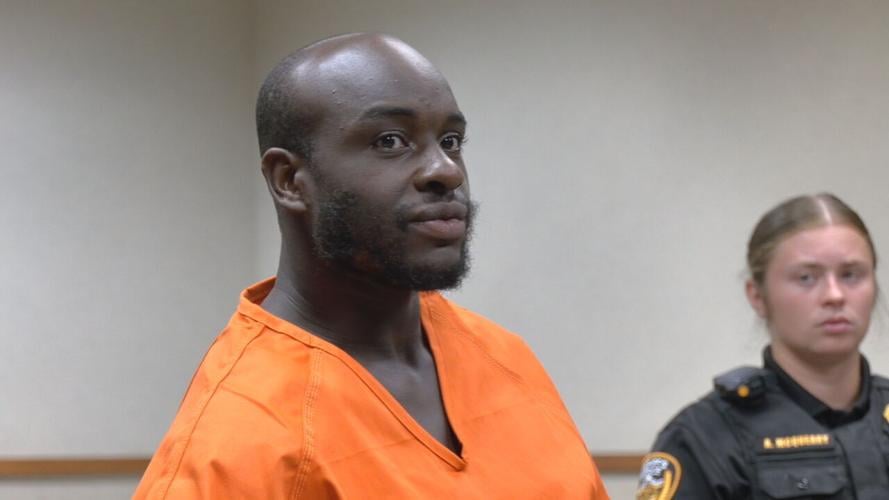
LOUISVILLE, Ky. (WDRB) — A man charged with kidnapping a Louisville family and robbing a bank in St. Matthews last year was found incompetent to stand trial.
According to the order, Armond Langford was found "currently incompetent," though the doctor said there is a "substantial probability" he can be restored to competency in the next year.
Langford will enter "inpatient psychiatric treatment" and will receive further evaluations soon.
On Aug. 8, a Louisville woman was abducted from her home near The Oxmoor Center, along with her two children, before being forced to withdraw $20,000 from a local bank at knifepoint. The suspect, 32-year-old, was arrested later that day and faces multiple charges including robbery, kidnapping and assault.
Jennifer Strong was making breakfast for her children when she heard her back door open twice. Police said Langford entered her home armed with a knife and ordered Strong, her 11-year-old son and her 7-year-old son into a car. Strong sat in the driver's seat with her older son beside her, and Langford sat in the back with her younger son.
With a knife pressed to Strong's throat, Langford demanded she drive to the PNC Bank on Shelbyville Road near Oxmoor Center.
When they got to the bank, Strong said Langford threatened the teller and demanded $20,000. The bank tellers spread the money on the ground. Langford grabbed the cash and fled but was arrested by police a few hours later.
A history of mental illness
When Langford was arrested in August, his criminal history caused many in the public to wonder why he was released in the first place. Court records show Langford pleaded guilty in early 2024, admitting to robbing several Louisville ATMs in 2021. Prosecutors argued against probation.
"Mr. Langford terrorized our community for several months," prosecutor Milja Zgonjanin said at Langford's shock probation hearing July 10, 2024.
Langford was in custody for several years while the case played out, serving time in the jail in downtown Louisville. He also spent time in the Roederer Correctional Complex in Oldham County, where the state deemed his risk level low enough that he was moved to a halfway house.
Before Jefferson Circuit Court Judge Jessica Green granted Langford shock probation, she routinely asked those facilities to report his behavior, according to court records. And both facilities sent letters to Green saying Langford was a model inmate with no disciplinary violations.
Court records show Langford has a history of mental illness and a traumatic brain injury.
"I really need to see if you are going to be accepted into mental health court," Green said at Langford's shock probation hearing. "I'm hopeful that you will be because I believe that that's the structure that you need."
Some current and former judges told WDRB News that Green appeared to go beyond normal practice by checking in on Langford to ensure he wasn't a danger at the time. The judges requested anonymity to speak freely saying they feared for their safety given the threats Green has received because of this case.
Ultimately, Langford was denied admittance to the mental health court program because a state assessment found he wasn't eligible due to a low risk of recidivism.
Jefferson Circuit Court Judge Julie Kaelin, who runs that program, noted Green was doing "everything possible" to keep Langford on the right track, according to an email in the court file.
Retired Judge McKay Chauvin, now the Jefferson County chief court administrator, said judges face difficult decisions in cases like Langford's.
"Every judge knows that every sentencing decision they make, regardless of how thoughtfully and responsibly they make it, still has the potential to end badly," Chauvin said. "Judges also know that if and when that happens, people will be angry and may not recognize or be interested in the difference between a bad decision and a bad result."
Shock probation is meant for first-time offenders and, often, those charged with non-violent offenses. Technically this was Langford's first felony offense, though it was considered violent.
But Green granted Langford five years of shock probation with several conditions, including getting mental health treatment and staying on his medication.
"I don't believe that mentally ill people, just by virtue of your mental illness, need to be in custody," Green said at Langford's shock probation hearing. "But what I do believe is that we all owe it to the community to keep people safe, and if we can keep the community safe while giving you the support that you need, I'm all for it. But you got to do your part, OK? I'll be checking up on you. I'll be checking in."
After the public outcry following Langford's most recent arrest, Green recused herself from the case, saying she and her family received racial and sexual threats. In the order of recusal, Green said her decision to release Langford sparked a "torrent of vicious threats of bodily harm, sexual assault, and death to the undersigned and her family." She said her personal information was posted online, including someone who said people should "surround her house until she quits."
Letters, emails and phone calls flooded her office with "shockingly vile racial animus," Green said. One particular message cited in Green's order said "N***** Judge. Why did we free you? You're (sic) African kings sold you to everyone because you were all so stupid and useless. Animals. Need caged."
Langford's case was randomly assigned to Green's division. It was then moved to another courtroom.
"The aforementioned vitriol notwithstanding, any and all decisions concerning this case would, as is true for any case that comes before this Court, be made based on the relevant facts and applicable law ..." she wrote. "However ... the Court has serious concerns about the extent to which the aforementioned outrage might impact how those decisions will be perceived or, more to the point, misperceived."
Copyright 2026 WDRB Media. All Rights Reserved.


