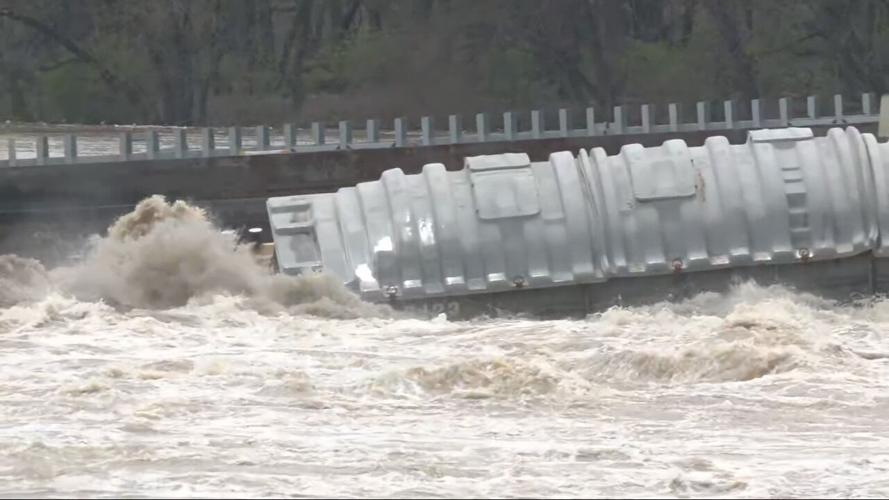
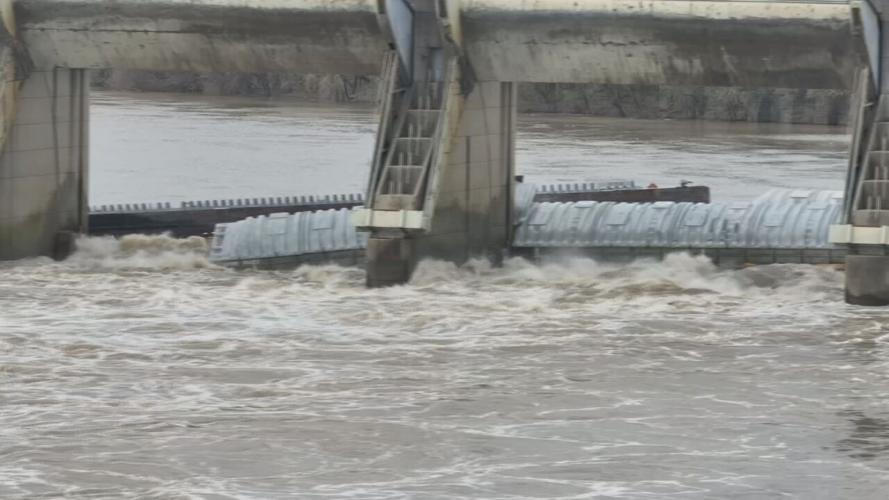
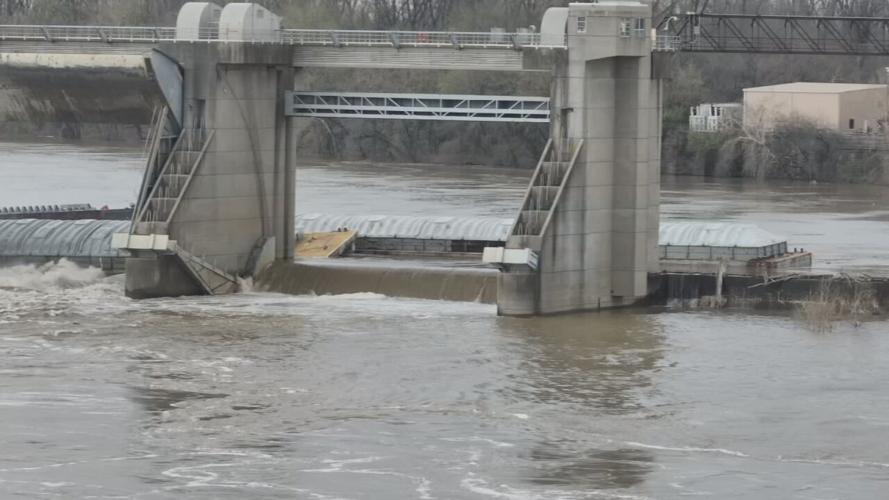
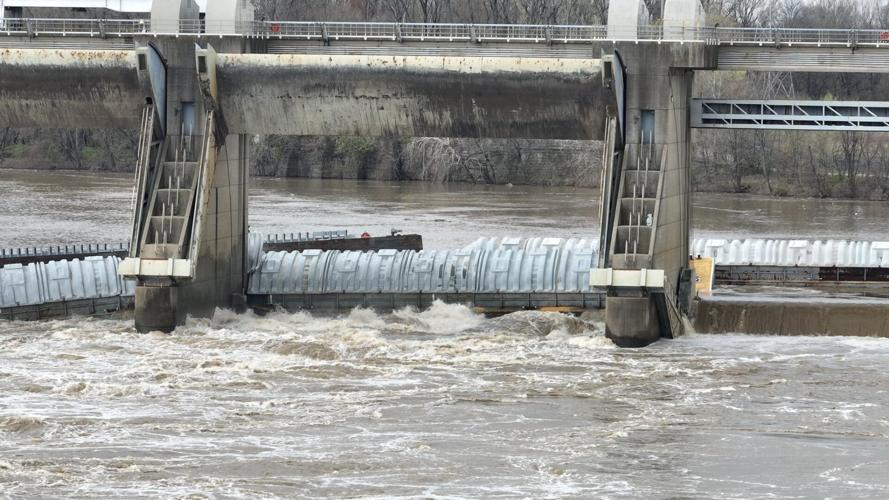
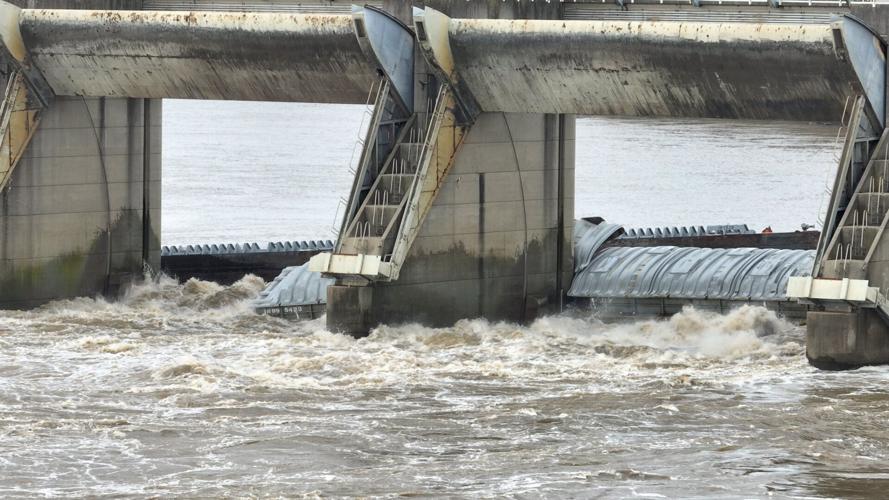
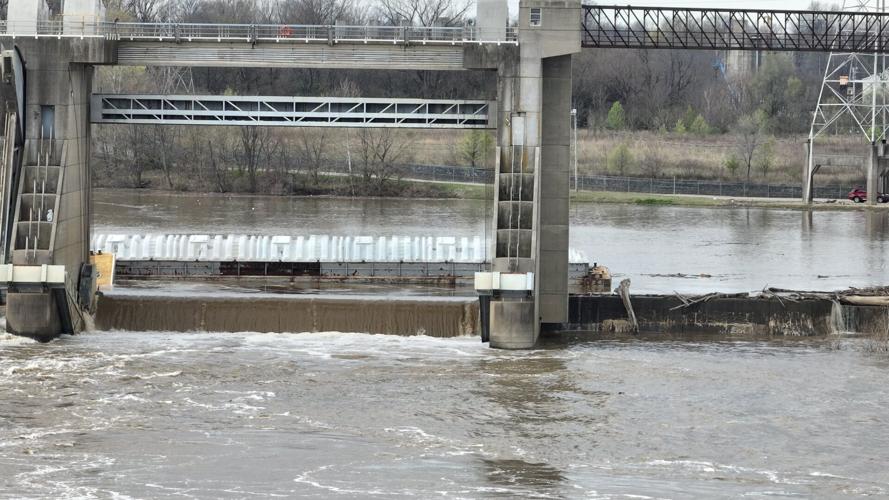


LOUISVILLE, Ky. (WDRB) -- Both the air and the drinking water are safe after a number of barges came loose from a tugboat and got stuck against the McAlpine Locks and Dam Tuesday afternoon.
That was the message from Louisville Mayor Craig Greenberg and other officials Wednesday afternoon.
"More than 80 air quality samples have been taken so far and all tests to date show no evidence of hazards that would post a health risk, though teams are continuously monitoring the situation," Greenberg told reporters at a news conference. "We are also taking water samples on a regular basis. Again, there is no evidence of any leaks at this time."
Greenberg said the incident took place just before 2 a.m. on Tuesday, when a vessel towing 11 barges hit part of a structure at the Portland Canal. As a result, 10 of the 11 barges broke loose and the current pushed three of them against the base of the McApline Dam.
One of those three barges was removed on Wednesday afternoon. Of the two barges that remain stuck against the dam, one contains corn, but the other contains 1,400 tons of methanol.
Methanol, also known as wood alcohol, is a colorless liquid that’s flammable and acutely toxic, according to the National Institutes of Health. It’s used as a solvent for paints and plastics and as an ingredient in a wide variety of products.
John Roberts is CEO of Ingram Barge Company, the company that owns the barges. He pledged to ensure that the barges were moved as quickly as safety enabled.
"Although we were not the operator when this occurred, those are our barges out there on that dam," he said. "And we are gonna be responsible for getting them off in a safe manner. We are committed to doing what it takes to make that right."
"We're gonna do this, and we're gonna do it right, and we're gonna make sure that we don't take a bad incident and make it worse," he added.
He said strong currents were pushing the barges against the dam, and crews were waiting for the water levels to go down.
Roberts said his company had retained he services of T&T Salvage to recover the barges. Kevin Teichman, the CEO of Teichman Group, which owns T&T Salvage, provided an assessment of the damage to the vessels.
"The hopper barge is definitely -- we can see where the side shell has been damaged in one of the double bottoms," Teichman said. "The methanol barge -- we are unable to see any damage on the stern part of it, but we have seen some damage on the double bottoms on it as well."
He declined to speculate on how long salvage operations would take, though he said he did not expect it to take months.
"Normally, before we would lift a barge like this, we would remove the product," he said. "Right now it's just not safe to go on board. We're still seeing some minor changes. We just removed the 13-925 -- one of the other hoppers... so we're able to possibly see a little bit more of what's going on with the methanol barge."
He said he did not believe any mandatory evacuations would be necessary during the salvage process.
Rob Blair of the Kentucky Energy and Environment Cabinet said crews are continuing to check the air and water for contaminants. He said since the accident took place, Louisville Fire has been sampling to nearby air to make sure it is safe to breathe.
"The results have shown no detection of methanol that would be dangerous to humans or the surrounding area," he said.
As for the water quality, he said representatives from his agency were collecting water samples at five separate locations on a three-mile stretch downstream from the accident.
"Those samples are going to a private lab and we are still waiting on the initial results," he said. "However, as we collect those samples, we are also taking in-field measurements for basic water quality parameters, and all of those have come back as normal."
Blair was asked by reporters to speculate about a worst case scenario: a catastrophic release of methanol.
"If we had a catastrophic release -- all of the fluid that is contained on that barge releasing all at once -- we would have some of that that would get dissolved into the water," he said. "But it is also very volatile, so we would have some of that essentially off-gas into the atmosphere. That's why we're monitoring both the surface water as well as the air.
"Based on calculations and the dilution factors in the river, the current of the river, we estimate that within about 15 miles downstream, we would have enough off-gassing and dilution that it would no longer be a major concern."
Within that 15-mile stretch, however, Blair admitted that there would probably be "impacts to aquatic life" in the form of fish kills.
As for whether or not the air in that 15-mile stretch would be safe to breathe, Blair said, "We believe so."
"If that were to happen, the air monitoring as well as the water monitoring would be expanded greatly downstream."
This story may be updated.
Previous stories:
- Crews work to clear 3 remaining barges that got loose on the Ohio River
- Several barges, 1 containing methanol, loose on the Ohio River near Louisville
Copyright 2023 by WDRB Media. All rights reserved.


