


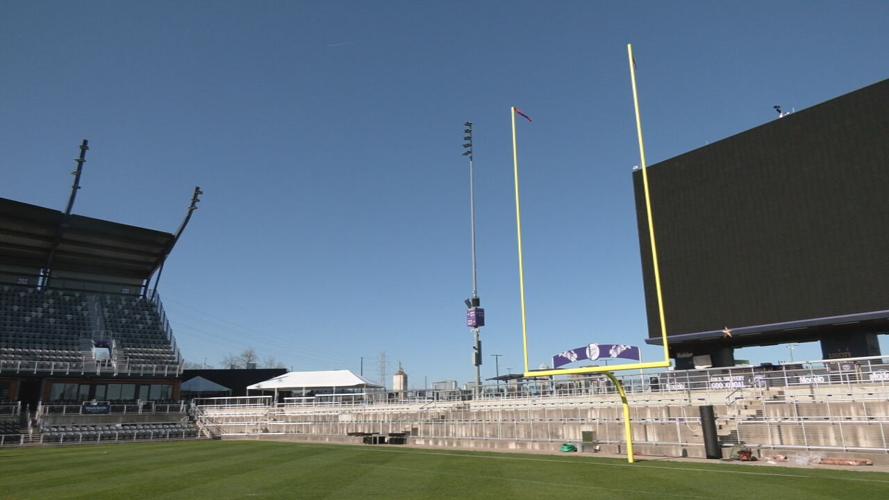
LOUISVILLE, Ky. (WDRB) — What's usually a soccer pitch is quickly becoming a football field at Lynn Family Stadium, where crews are racing to prepare for the Louisville Kings home opener Friday night.
The first goal post went up on the west end of the field Monday night before the second upright was raised early Tuesday.
"We're turning a soccer pitch into a gridiron," said Jonathan Lintner, vice president of marketing and communications for Racing Louisville and Louisville City FC.
In addition to the goal posts, the field flip includes installing TV cables, painting the field, changing signage and rolling out new equipment like a game clock and benches for each team.
The transformation from pitch to gridiron is no stranger to the UFL, however. This season, the Kings are one of six teams across the league playing at soccer-specific stadiums.
Despite the goal switches, paint jobs and equipment logistics required to switch between soccer and football, Lynn Family Stadium was lucky with scheduling between all three teams.
"We wound up really fortunate that there's no soccer games on the same weekend as football games," Lintner said. "So we know the field will have a full week to rest and recuperate, and we certainly hope that gets us to May and June."
The field is the biggest question mark, but Lynn Family Stadium's grounds crew is confident in the careful planning to protect the natural grass surface.
"I think it'll hold up very well for both sport. It'll just be different traffic," said Aaron Fink, grounds director at Lynn Family Stadium. "Soccer is a lot more spread out where football is a little bit more isolated through the middle."
The process of flipping the field will happen before and after each of the five home games scheduled for the Kings. The team will also play five road games over a 10-week regular season. There are no conferences. Instead, all eight teams compete in a single league table, and the top four teams will qualify for the playoffs in late May.
The Kings are one of three new franchises introduced for the 2026 UFL season, alongside the Columbus Aviators and Orlando Storm, becoming the city's first professional football team in decades.
Former Louisville pass rusher Lorenzo Maulding IV and Kentucky running back Benny Snell will make their UFL debuts for the Kings, coached by former Louisville quarterback Chris Redman.
Attracting a new demographic of fans, soccer officials in Louisville are excited for the chance to showcase Lynn Family Stadium in a way that encourages future attendance for other sports.
"If you've not been to the stadium before and seen a soccer game, I'm sure you're going to come here and say 'That would be a pretty cool place to watch a game,'" Lintner said. "I don't care what sport is being played on that field."
To purchase tickets, click here.
New Rules
The spring league will introduce a suite of rules so radical that even fans who normally ignore spring football may tune in simply to see whether they work or whether they break the game entirely.
A four-point field goal from 60 yards. No punts once a team crosses midfield. Only one foot required inbounds on catches. A ban on the quarterback tush push popularized by the Philadelphia Eagles. Shootout-style overtime. Expanded conversion options after touchdowns.
In short: a version of football designed to be louder, faster, higher-scoring and impossible to ignore.
"The UFL exists to innovate," co-owner Mike Repole said in announcing the changes. "If we're not making the game more exciting and fan-focused, we're not doing our job."
1. The four-point field goal: a weapon from deep
The headline rule is also the simplest: kicks from 60 yards or beyond will now be worth four points.
That single change could alter late-game strategy more than anything else the league has done. Teams trailing by eight could tie with a couple of long kicks. Defenses will be forced to guard territory that previously felt safe.
In an NFL context, 60-yard attempts are rare and risky. In the UFL, they could become a legitimate offensive option and a potential significant scoring play with built-in drama every time a team crosses midfield.
2. No punts inside the 50: aggression required
If the four-point kick is the league's flashiest idea, the ban on punting inside the opponent's 50-yard line may be the most transformative.
Once a team reaches the 49-yard line or closer, it must either go for it on fourth down or attempt a field goal. A team sitting exactly on the 50 may still punt — but one yard further and that option disappears. And even penalties or lost yardage that push a team back behind the 50 won't restore the punting option once the ball has been made ready for play inside it.
The message is unmistakable: conservative football is not welcome here.
The rule should produce more fourth-down attempts, shorter fields after turnovers on downs and, potentially, more points. It also guarantees that stalled drives near midfield will still produce meaningful decisions rather than routine punts.
The exception comes in the final two minutes of each half, when punting will again be allowed, a nod to end-of-half strategy.
3. One foot inbounds: college passing game meets pro speed
By adopting the NCAA's one-foot catch rule, the UFL effectively widens the field for quarterbacks and receivers. More sideline completions could mean extended drives, more explosive plays and increased scoring. It also makes the league's passing game visually resemble college football's, but with professional athletes.
From a safety standpoint, it may reduce the need for receivers to drag a second foot while absorbing hits near the boundary.
4. The end of the "Tush Push"
One of the NFL's most debated plays — the quarterback sneak assisted by teammates pushing from behind — will be illegal in the UFL.
The move has been criticized as both unstoppable and aesthetically unappealing. Its removal restores uncertainty to short-yardage situations and may encourage more creative play-calling near the goal line.
5. Overtime becomes a shootout
Rather than extended sudden-death drives, overtime will unfold like a penalty-kick contest — three alternating offensive plays from the five-yard line, with a game on the line and no margin for error. The home team chooses whether to go on offense or defense first. If the tie remains after three attempts each, the shootout continues until someone wins.
6. New conversion math after touchdowns
Scoring a touchdown will no longer lead automatically to a simple extra point. Teams will have four choices:
- 1 point: 33-yard kick
- 2 points: Run or pass from the 2-yard line
- 3 points: Run or pass from the 8-yard line
This system creates real decision-making, especially for teams chasing deficits. A nine-point gap can disappear with a touchdown and a three-point conversion. Late-game scenarios become far less predictable.
7. Red zone penalties: a reset to NFL rules
One quieter change could still affect outcomes. The UFL is restoring the half-the-distance-to-the-goal rule for penalties committed in the red zone, reverting to standard NFL rules. The practical effect: defensive penalties deep in opponent territory become more costly, and offenses gain a small but meaningful edge when they've already done the hard work of reaching the red zone.
8. Kickoffs designed for returns, not touchbacks
The UFL continues refining kickoff rules intended to increase returns while reducing high-speed collisions. The kickoff comes from the 30-yard line, with the coverage team lined up at the receiving team's 45. The receiving team must stack at least nine players in a zone between its own 35 and 40-yard lines.
There are now two touchback spots depending on where the ball lands. Kicks that reach the end zone on the fly are spotted at the 40. But balls that land in the landing zone — between the 20 and the goal line — and then bounce into the end zone come back only to the 20, giving returners a strong incentive to field anything they can.
The structure promotes controlled, high-percentage returns, one of the most exciting but endangered plays in modern football.
Copyright 2026 WDRB Media. All Rights Reserved.


