


LOUISVILLE, Ky. (WDRB) -- The warnings were everywhere, and according to the various posts and reports, Aug. 25 was supposed to be a day that would shut down Louisville. Armed, violent protesters would swarm the city while a caravan of at least 600 cars would clog the city's interstates. But, that's not what happened.
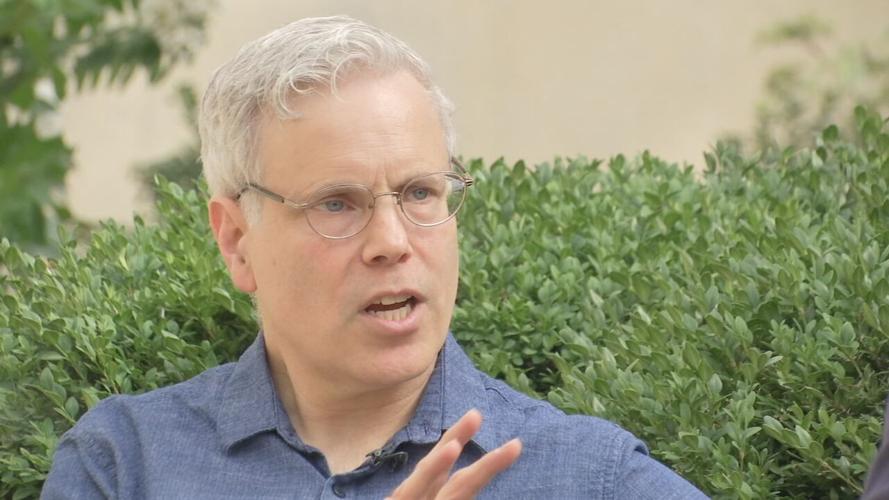
After that day of protest — dubbed Good Trouble Tuesday on Aug. 25 — and another similarly feared protest during the 146th Kentucky Derby, Dan Delaney has had enough. The independent social researcher is doing what he can to address a protest precursor that he considers dangerous.
"This is just something much larger than people seem to want to admit or realize," he said.

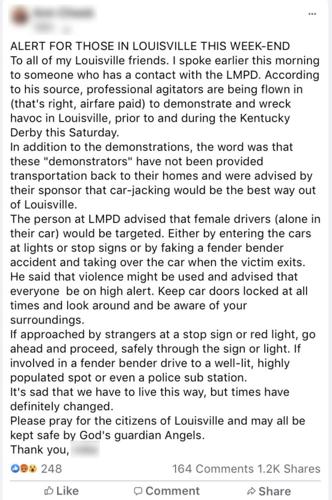
Delaney's problem is the misinformation, potential disinformation and rumors that have been broadcast on social media platforms like Facebook and NextDoor ahead of recent protests, including a post shared hundreds of times before what ended up being a non-violent protest at Churchill Downs.
The post warned of protest agitators that would wreak havoc and carjack women.
"The entire thing was, you know, it would be comical if it wasn't dangerous," Delaney said.
The researcher believes the protest-related rumors are, in some ways, disrupting the city more than many protests themselves. He points to the Aug. 25 protest that ultimately ended with dozens of arrests in a virtually non-violent conclusion. Delaney says some rumors spread on social media reached a "fever pitch" of "fear and panic."
As a result, some schools and businesses closed, and police prepared a massive response.
"It looks as if they were played as much as everyone else," said Delaney.
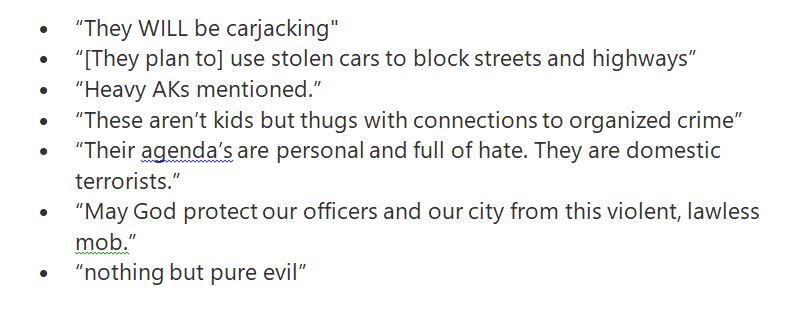
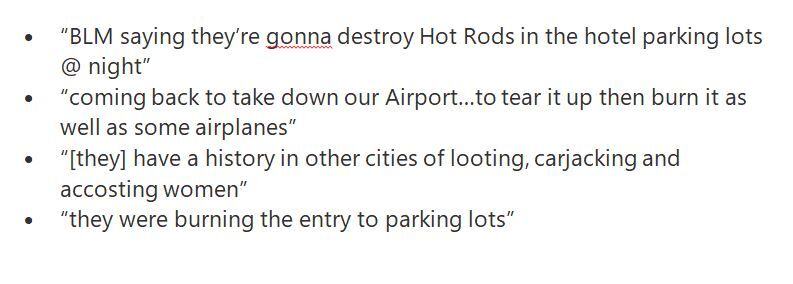
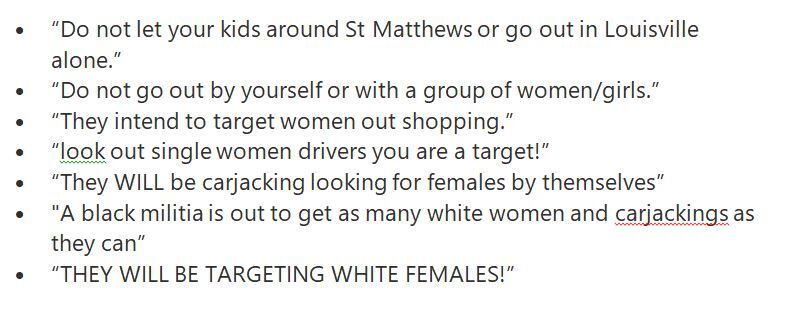
Some of the rumors spread ahead of the Aug. 25 protest. (Source: Dan Delaney)
While Mayor Greg Fischer has repeatedly warned against spreading rumors in periodic press conferences, Delaney has written a letter to the mayor, the Louisville Metro Police Department, and other city leaders tasking them to play a more active role in ferreting out the truth and avoiding "pernicious" misinformation.
"Think of this phenomenon as a 'disinformation bomb' that exploded in Louisville last Tuesday. A disinformation bomb works on a completely different mechanism from a normal bomb. The explosion is not the sudden, rapid spread of its contents after reaching its target," he wrote, in part. "Rather, the explosion is the reaction to the disinformation and rumors once they have reached a critical mass throughout the population. The police reacted exactly as the disinformation bomb intended. They mobilized against a phantom, partially of their own making."
Delaney says he also encourages his friends to think before hitting the share button.
"Generally, you can look at something and see. If it begins with, 'I heard this from a friend who heard it from a reliable source,' that should throw up a red flag," he said, before adding that sharers should also present skepticism when faced with "far-fetched" claims.
In a newsletter last week, Councilman Markus Winkler, D-17, said misinformation is dividing the city. While he acknowledged that some early days of protest left a "terrible scar" on Louisville, he said that doesn't represent most days of protest since.
"We are playing a most dangerous game, and as many fan the flames, they risk igniting an inferno that cannot be extinguished," Winkler wrote, in part.
Delaney, meanwhile, says it's impossible to say whether the rumors are being spread in good faith or maliciously. But, he says law enforcement should give them more investigation and even treat some of the more elaborate ones as they would a fake bomb threat.
"I ask the LMPD to please take the time to fully analyze the way they dealt with last week’s disinformation bomb, and try to devise a better way to deal with one in the future, for Louisville and every other city at risk of this new threat," he wrote in his letter to leaders.
More from Delaney's letter:
To the leaders of Louisville Metro:
Over one week has passed since the day that Louisville was supposed to have been shut down by 600 cars and destroyed by thousands of Black militia. As a social researcher, I have been making observations, talking with people, and collecting as much data as I was able from social media. I want to impress upon you the scope and significance of what happened to the city on August 25. After analyzing the data, I am deeply concerned with what I see, on multiple levels: (1) that the pernicious rumors rose to such a fever pitch of racist rhetoric; (2) that the rumors spread to the general population rather than lingering only in conspiracy theory groups, and that the police played a role in making that happen; (3) that no one addressed the fact that none of the rumors were true and that the entire LMPD had been mobilized on high alert for nothing; and (4) that an outbreak of disinformation and rumors so easily and rapidly brought our city to a state of fear and panic, and that after the day passed without incident, everyone gave a collective shrug and quickly changed the subject rather than confront the gravity of what had happened. We cannot just ignore what happened in Louisville last week. To put it mildly, protesters sitting down on a street or standing around in a park at night should be the least of our worries. So I ask you to please give serious consideration to the following points. And if I have stated any point of fact inaccurately, I am happy to be corrected.(...)If you have found nothing up to this point that compels you to take the threat of disinformation and rumors seriously then consider the economic impact of a disinformation bomb. First, a huge sum of taxpayer money was needlessly wasted by mobilizing the LMPD and KSP for an imaginary crisis. How much did it cost the LMPD, for example, to declare an “All Work-Day”? How much did it cost the state for the KSP to establish a “command center” and to station cars along the interstate? Second, the state of heightened fear over a non-existent threat caused many businesses to needlessly close for the day and many individuals to refrain from going to work. The economic disruption caused by a disinformation bomb, even a mild one like we experienced on the 25th, is nothing to take lightly.As I suggested above, the police should hold their sources accountable for feeding them disinformation, and if they don’t know the sources, they need to start an investigation to identify them. But what if there is no identifiable source? What if the LMPD's reaction was based on hearsay and rumors? Anyone can say anything in the anonymity of social media, no matter how false or how dangerous the potential consequences. Like the old example of shouting fire in a crowded theater, rumors of extreme threats can be posted on social media and result in devastating damage in the real world. But unlike that example, the perpetrators in this case are not in plain sight, and may never be. Which means if investigators don’t want to be continuously chasing after phantoms, they have to figure out a better way to deal with disinformation bombs before they explode. Disinformation and rumors are not going away. They are only going to get worse.What happens the next time viral disinformation leads to a panic? It’s not a question of “if” but of “when.” It will happen again. Now that the architects of last week’s crime know how easy it is to incite a city into a scared frenzy, they will do it again, whether here in Louisville or in another city. And after three or four times of mobilizing the forces based on false threats only to be left sitting in their cars with nothing to respond to, how many more times will it take for the people to stop taking them seriously? How long before law enforcement falls into a “boy who cried wolf” situation? I wish I could offer easy answers, but there are none. I fear that what happened last Tuesday is a minor example of this phenomenon, and that future iterations will only be larger and more dangerous. Again, do not let the way this was handled last Tuesday set a precedent. I ask the LMPD to please take the time to fully analyze the way they dealt with last week’s disinformation bomb, and try to devise a better way to deal with one in the future, for Louisville and every other city at risk of this new threat.Thank you for your consideration.Dan DelaneyDeer Park NeighborhoodLouisville, KY