


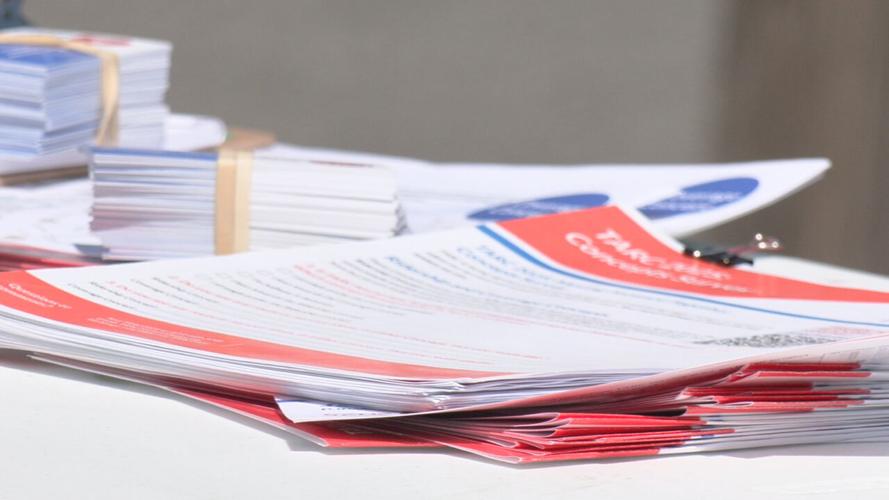
LOUISVILLE, Ky. (WDRB) -- The deadline to submit feedback is quickly approaching for TARC users to weigh in on its future redesign.
The survey to submit feedback on TARC 2025, the redesign project, will close on Sept. 20.
- To fill out TARC's survey, click here.
TARC is redesigning its network to address major financial issues and has been seeking input from the community to help decide what changes to make.
There are three concepts for consideration.
The first two, focused on coverage and ridership, are based on TARC not receiving additional funding to operate and in turn implement a service reduction of up to 50% compared to what was offered earlier this year.
The "coverage" concept prioritizes maintaining existing coverage, which means bus routes will run in more places and be spread out, but wait times will be longer.
The "ridership" concept would have TARC take a look at where concentrations of ridership is highest, and prioritize frequent and reliable services in that area, which means wait times may be shorter, but bus service would be limited in other areas.
TARC Executive Director Ozzy Gibson said its highest ridership numbers are west of 9th Street, meaning there would be fewer routes in the east end of Louisville.
The third concept is what TARC could look like if additional funding was available, and the city's sole public transit system could expand.
TARC's survey will close on Sept. 20.
After this, Gibson said feedback will be presented to its board of directors, and a decision will be made based off the community input.
"Our board is going to have to decide do they lean towards ridership or do they lean towards coverage," said Gibson.
The decision to redesign routes has some frequent riders uneasy.
Darnita Lemon has been a rider since 2019 and said the decline in service has been, "horrifying."
"Gotta wait an hour and a half for a bus, and you miss your doctors appointments, you miss going to work," Lemon said. "You just have no way-- Uber, but who has Uber money?"
Malcom Thomas has been a TARC rider the last three decades.
While he understands the need to change because of financial reasons, he may consider retiring depending on TARC's decision.
Lincoln said on Sundays, it takes him six hours going to and from work at UPS Worldport, where he works a 4 1/2 hour shift.
“I would rather retire than to keep dealing with waiting two to three hours waiting for a bus," Thomas said.
Thomas hopes the decision leans towards the "coverage" option.
"That makes a lot more sense," said Thomas.
TARC expects to lose $30 million in funding, and operate on an $80 to $85 million budget if it does not receive more funding.
"That's going to shrink the service down, you know, 40 or 50%," Gibson said.
When asked about ways to increase revenue, Gibson said there are a few options.
Locally, it may consider a tax increase. It can also increase rates to ride TARC, but Gibson said that runs the risk of losing drivers.
"Right now, the money we make off of rates and stuff like that is $6.5 million. So if we double it, what I'm doing there now, I've created maybe what $12 million, we're really only getting six more, that doesn't get us anywhere," said Gibson. "I'm doubling the price of the people that already have to use me because they don't have to money to buy a car, so you just pass something on to them."
Gibson said $6 million doesn't "move the needle" when talking about adding back routes to the community.
Gibson said he hopes the state can adopt a similar funding formula for public transit as Indiana.
"Indiana, it's kind of based off ridership, how big the city, and how many miles you go. So prime example, every year we get about $1.4 million from Indiana, because we have 20% of our routes over there," Gibson said when explaining the funding formula. "What we unfortunately get out of Kentucky is anywhere from $500,000 to $1.4 million every two years... If Kentucky would adopt a formula like Indiana, we get $7 million a year"
TARC 2025 will conclude next spring, with final proposals released in February or March.
TARC is supported by occupational taxes, 2.2% of Louisville workers paychecks, a combination state funding from Indiana and Kentucky, 15% from fares and 20% from federal government.
To learn more about TARC 2025, click here.
Previous Coverage:
- TARC asking riders for input on transit needs amid financial uncertainty
- TARC to hold several listening sessions for input on proposed route maps
- TARC route reductions will now start at the end of June because of agreement with JCPS
- Deal between TARC and JCPS to restore transportation for some magnet schools in Louisville
- TARC offers free summer ride pass again this year for Louisville's youth
- TARC employees rally in downtown Louisville for more public transportation funding
- Major implications at stake as TARC, JCPS negotiate agreement for drivers
- TARC workers hold May Day rally in downtown Louisville to protest service cuts in agency's budget
- TARC launches mobile ticket app for Louisville bus riders
- TARC service in Louisville could see 'service reductions' to help fix financial troubles
Copyright 2024 WDRB Media. All Rights Reserved.


