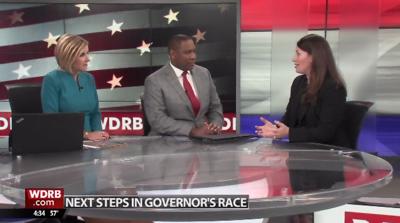
LOUISVILLE, Ky. (WDRB) -- Kentucky Secretary of State Alison Lundergan Grimes was on-hand at the WDRB studios Wednesday afternoon to answer questions about the recent elections and Gov. Matt Bevin's request for a recanvass.
Below is a transcript an interview with Grimes conducted by WDRB's Gilbert Corsey and Elizabeth Woolsey.
CORSEY: Thank you so much for being here.
GRIMES: Well, thank you all for your coverage. Thank you for your excellent work in getting voters out to exceed my expectation of turnout yesterday. But now, what happens next, we have a request from the governor for a recanvass. That will be conducted on Thursday of next week. Other candidates have until Tuesday of next week if they want to be included in that request as well.
WOOLSEY: So the governor's campaign has mentioned multiple voting irregularities as part of the reason they're requesting the recanvass. What can you tell us about this?
GRIMES: Well, as Kentucky's chief election official, I can tell you we monitor up to and on Election Day all calls, complaints and concerns about our election. And we did field very familiar calls and complaints, but nothing that would substantiate anything that would shake a 5,000-vote margin. The Election Integrity Task Force members that I have include everything from FBI, the Department of Homeland Security, the National Guard -- we are unaware of any allegation in our system that would substantiate any claim that we have heard. But again, if those claims exist, they should already be before the State Board of Elections. They should already be before myself. They should be logged. This process of our elections -- it's decentralized, it involves 15,000 precinct electional workers. One would hope, if there was something so substantial to shake 5,000 votes, we would already know about it.
WOOLSEY: Is there a deadline to get that to you -- to get these reports of irregularities to your office.
GRIMES: Well, again, we obviously field calls and complaints up to and on Election Day, but again, if there's any allegation that it needs investigating, we welcome that. We want that to come forward, but I would hope -- especially as it relates to the top office on our ballot -- that we would have already heard, especially something on Election Day, that substantial.
CORSEY: You talked about the scope -- 15,000 precinct workers. The recanvass is going to happen next Thursday, the 14th, but how long do you expect it to take?
GRIMES: It's a process that is fairly streamlined. Under my administration we try to make it transparent. It will typically be concluded that day. It will start at 9 o'clock in the morning. We are checking for transpositional errors. So all of our county board of elections -- 120 county board of elections -- will convene at 9 o'clock in the morning. They will be checking the official results that they are sending my office this Friday, rechecking those to see if there are any errors in what they have sent on the forms to my office, and if there are any changes, we will note them. But in my eight years, we have conducted over 20-plus recanvasses. None have ever altered the outcome of a race.
CORSEY: Do you have that perspective going back in state history? Has a recanvass overturned an election?
GRIMES: Not in my experience. In terms of what I've seen, especially very high-profile races. The presidential preference primary: 1,900 votes that separated Bernie Sanders and Hillary Clinton. While there may have been a change from the unofficial results -- what was officially reported to my office, that will be reported this Friday, no recanvass altered that, or altered the outcome of that election.
WOOLSEY: Governor Bevin by law will not be allowed to ask for a recount, but if he does decide to take this a step further, he can contest the election. So what is that process?
GRIMES: So the process that is set up is two-fold. One, either a recanvass, or two, if he wants to go forward, it's a procedure known as a contest proceeding before the General Assembly. It is made of up of a board -- members of the House, members of the Senate. They will investigate any inquiry that is put forward -- substantiated -- by a candidate or a slate of candidates. Ultimately, they could try to put forth a new election, but this is a process that has not been used since 1899 as it relates to our governor and lieutenant governor. It was used last year as it relates to a Democratic state representative in the western part of the state, in Owensboro. Jim Glenn, a race that came down to one vote, ultimately did not affect the outcome of the race. He was seated, despite allegations from the Republican party.
CORSEY: Thank you for giving us that historical perspective and clearing up the process moving forward.
GRIMES: Thank you. Ask everybody to tune in and we’ll have everything available for Thursday. Thank you all for all your help in getting out the vote.
CORSEY: Thank you for being here.
WOOLSEY: Yes -- thank you for your time today.
Related Stories:
- Bevin formally requests recanvass as Beshear continues to claim victory
- Kentucky education leaders credit teachers for Beshear projected victory
Copyright 2019 WDRB Media. All Rights Reserved.