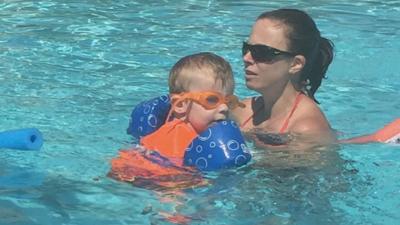


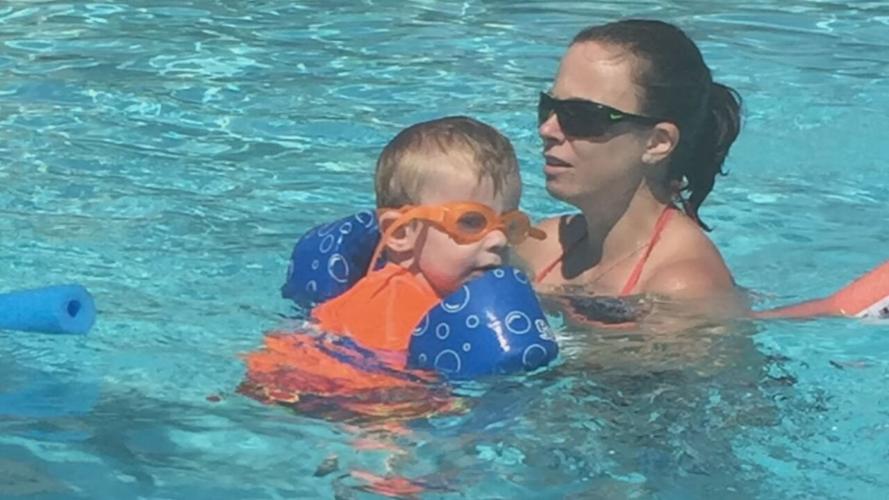
(WDRB/InvestigateTV) — In the decade since her son drown in an apartment pool, Christi Brown has been sounding alarms about the potential culprit – a wearable arm/chest floatie.
But 3-year-old Judah wasn’t wearing the device when he slipped out of mother’s view. She had just removed it moments earlier.
An uncounted number of families share in the Brown family’s tragedy – their toddlers, too, who were accustomed to wearing the floaties, wandered away supervision and drowned without protection.
These devices, critics say, make young children think that they can float or swim even when not wearing one.
Advocates say that it’s long past time for the U.S. Consumer Product Safety Commission to weigh in on these devices, saying that they lack needed safety warnings.
"There’s a warning about everything. And there’s not a warning about this. I mean — we’re talking about the number one cause of death in children" said Genevieve Blasius, a swim school owner who also holds a PhD in neuroscience and biopyschology.
Drowning is the leading cause of death among children age 1 to 4 and CPSC Acting Chairman Peter Feldman said at a public meeting in June that reducing drowning deaths is one of his highest priorities.
"We are not making the progress that America’s children deserve. . . That reality demands something different than what we have always done,” Feldman said at a meeting with experts and advocates for pool safety. “Nothing should be off the table."
Yet the issue of floaties was not mentioned at the meeting, and parents say agency won’t address these types of drowning deaths.
Brown has been trying since 2019 to get the CPSC to take up the cause.
Feldman told InvestigateTV that it’s the job of the U.S. Coast Guard, which tests life jackets and other wearable flotation devices for safety mainly for use on boats.
But the Coast Guard does not test or regulate floaties as swim aids.
This issue exposes a potential problem when a consumer product falls under the jurisdiction of two federal agencies – each tasked with overseeing a specific part of the product and not the safety of the entire product.
For example, the National Transportation Safety Board is charged with regulating car seats but only when they are in a vehicle.
If a car seat handle breaks as a parent carries the child outside of the car, jurisdiction of that then belongs to the CPSC because it’s not in the vehicle.
The CPSC also shares jurisdiction of ATVs, fireworks and gun safes.
The CPSC has issued recalls and/or warnings about different types of flotation products over the years, but it has not for this particular design.
Brown said the CPSC doesn’t even want to discuss these types of floaties.
"I approached them in 2019 about it. . . Every year since then we have tried to approach them, and they still just shut it down faster and faster each year — because they know we’re coming and they know we can ask questions," she said.
A false sense of security leads to tragedy
Judah Brown loved water.
"He would play in the puddles, jump in and splash in them," his mother said. "Knowing that he was incredibly curious about these, we were like, ‘Well, we need to do something about the water.’"
She enrolled Judah in "Mommy and Me" swim lessons. Then, Brown discovered a wearable floatie.
Judah wore the floatie anytime he was near water starting around the age of one, she said.
In September 2016, the Browns went to a cookout at a friend’s apartment complex. Judah had been in the pool, wearing the floatie.
He got out and told his mom he was cold. She took off the floatie, wrapped him in a towel and sat him right next to her. She then scanned the pool to check on her other children.
When she looked back, Judah was gone.
She found him face down in the water, just off the edge of the pool. Paramedics were able to revive him, but he died two days later.
Eventually, Brown began to suspect that the constant use of the floatie created a false sense of security.
"He didn’t know that the device was the thing that was keeping him up and not his own ability,” she said. “It gave him confidence to go to the water anytime he wants to."
Swim experts say the best way for children to learn how to swim is in a horizontal position where they can float on their backs to keep their faces out of the water.
But wearable floaties put a child in a vertical – or upright – position, bobbing up and down like a cork.
"Rather than actually being a learn-to-swim device, it actually ends up being a learn-to-drown device," Brown said. "It’s teaching that body positioning in the water and give you that muscle memory for that position….so if that child does make it to the water without the device on, they’re automatically going to go into that drowning position."
There is no official tally of how many toddler drowning deaths have been tied to wearable floaties. But Brown has heard from dozens of other families who lost a child under similar circumstances.
She set her sights on persuading the CPSC and the Coast Guard to act.
Dual oversight may leave gaps in safety
At the recent CPSC hearing on drowning, Feldman invited representatives from the building industry, the vacation home industry, the YMCA, the parent of a child who died from a pool drain suction injury and others to offer potential solutions to prevent these deaths.
Notably absent, says drowning prevention researcher Acacia Landfield, was anyone talking about the wearable floaties.
In the Teams chat during the meeting, she called it "the elephant in the room."
Nobody acknowledged her comment.
"How can we work together?" Lanfield said in an interview with InvestigateTV. "How can we get the U.S. Coast and CPSC in a room together?"
The problem is, she said, that parents see the Coast Guard-approved stamp on wearable floaties and think that means they’re safe for swimming.
"What we have is products that are being tested and approved for the purposes of open water boating vessels, and they’re being used in a completely different environment," she said.
The Coast Guard declined repeated requests for an interview or comment.
The agency classifies life jackets or wearable floaties in one of four categories based on the likely conditions of the body of water.
Tier I life preservers, for example, are approved of open ocean, rough seas or remote water where rescue may be slow coming and people would be floating in the water for potentially long periods of time, according to the Coast Guard.
Wearable floaties fall under Tier III, which is designed for calm inland waters or sheltered waters and is supposed to keep a conscious person upright.
But the Coast Guard does not test any type of life preserver for purposes of swimming or provide any safety warnings about their use in a pool.
One of the leading manufacturers of wearable floaties is Bestway, which licenses the Puddle Jumper brand.
Bestway spokesman Brannon Smith said its products meets standards set by ANSI, a voluntary standards-making group in the U.S.; CAN, which sets standards in Canada; UL, which is the Coast Guard’s third-party testing laboratory; and ISO, the international standards organization.
“While the Coast Guard approval program is not a pool-specific certification program, the underlying ANSI/CAN/UL 12402 requirements establish in-water performance requirements for buoyancy aids used in sheltered waters. Neither ISO 12402 nor ANSI/CAN/UL 12402 states that such products are prohibited from use in swimming pools or are unsuitable for pool environments,” Smith wrote in an email in response to InvestigateTV questions.
Products used in pools generally fall under the CPSC jurisdiction as aquatic toys. Currently, there are no mandatory safety standards for these specific types of wearable floaties.
A mother’s plea to consumer watchdog goes unheeded
Christi Brown first approached the CPSC in 2019 – three years after Judah’s death.
"The dismissiveness was almost immediate. They didn’t want to talk to us at all — as parents, as advocates, or as water safety professionals," she said. "They wanted to shut down the conversation. They acted like they had been through this before, and that they were not going to go down this road again."
Every year, she continued to press for even just an audience with the CPSC.
"There was a time when I was at a conference and I overheard CPSC representatives talking at a table, saying that they were going to be taking questions after their talk — but they would not take any questions about flotation devices, so the conference leaders needed to make sure that they weren’t going to get any questions on flotation devices," she said.
She said she’s also tried talking with Coast Guard representatives to no avail.
Many – but not all - of these wearable floaties have been approved by the Coast Guard.
And that seal gives parents a false sense of security for swimming pool uses, Brown said.
Parents buy these devices and “they’re going to see this as U.S. Coast Guard approved and they’re going to think, ‘Oh, that’s safe,’" she said. “But they don’t understand what it actually means."
Bestway’s Smith said the warnings on it’s products are clear and that these devices aren’t "a substitute for the development of proper swimming and water rescue skills or vigilant adult supervision. Education around correct usage and limitations is essential."
During an interview with InvestigateTV, Feldman said, "CPSC jurisdiction does not extend to, for example, flotation devices that are regulated by the United States Coast Guard."
But InvestigateTV found dozens of examples from online retailers of wearable floaties that did not have the Coast Guard seal.
Even so, Feldman said the agency continues to monitor the marketplace for problematic products.
"CPSC remains, a cop on the beat when it comes to regulating and making sure that we’re pushing for recalls where appropriate, when you’ve got dangerous and defective, products in the in the aquatic environment," he said.
When asked about parents’ and experts’ concerns about lack of safety warnings, Feldman said, "I think we’re taking a look at all those issues."
The ASTM, which helps set voluntary safety standards for the CPSC, said it is working on standards for buoyancy aids. It did not define what is considered a buoyancy aid or if wearable floaties would fall under that.
Parents say floaties should be considered toys not swim tools
On a July day a decade ago, Jackson Bennett snuck out of his house through an unlatched dog door. His mother Jenny found him in the backyard pool.
Like Judah Brown, 18-month-old Jackson wasn’t wearing the floatie he always wore in the pool.
"Toddlers are simply too young to understand that it’s the device that’s keeping their head above water and not their natural ability," Bennett said. "My concern is with repeated habitual use while swimming in the pool recreationally, the children become more confident and appear more competent with their swimming abilities than they actually are."
Young children learn to be comfortable in the water with a flotation device but don’t understand that it’s the product keeping them afloat, she said.
"Parents are seeing their children have fun in the water as well, and they’re encouraging them to jump in and to swim and to play. But in reality, they’re not really swimming. They’re just floating and bobbing along with their heads above water," she said.
She and other advocates say these types of wearable floaties need to be treated as pool toys and not as a learn-to-swim device.
“They are not teaching children how to swim. They’re teaching them how to float and have fun in the water, which does not equal safety or self-rescue ability for children if they find the water alone,” she said. "And that’s how our toddlers are drowning."
Drowning prevention experts say there must be multiple layers of protection to keep children safe including constant supervision, swim lessons to learn self-rescue and pool fencing, to name a few.
But wearable floaties need to be part of the prevention discussion as well.
"Toddlers are sneaky and they wander,” Bennett said. “That’s how a majority of these drownings are happening."
Full statement from Bestway:
Personal Flotation Devices (PFDs) for children with connected arm and chest flotation components are classified as buoyancy aids designed to provide buoyancy support to the wearer when properly fitted and used as intended. They combine arm floats with a chest panel and a secure back buckle, offering a snug fit that helps prevent the device from slipping off. They are not a substitute for proper swimming instruction for children, and they are intended exclusively for use during supervised water play. They are not intended for any unsupervised water play, as a substitute for proper swimming instruction, or in situations requiring long-term flotation or survival.
We provide users with a range of safety information that accompanies our PFDs with connected arm and chest flotation components, including product labels, fitting and use instructions, care and maintenance information, and supplemental safety literature required as part of the product’s U.S. Coast Guard approval. Devices also include approval markings and consumer-facing informational materials such as the Safe Choice Placard and Child Placard. These materials are intended to help consumers select an appropriate PFD to fit their child’s needs, as well as how to properly fit, use, inspect, and maintain the product in accordance with the applicable requirements for approved recreational PFDs and buoyancy aids.
PFDs for children with connected arm and chest flotation components are buoyancy aids, and they are not a substitute for the development of proper swimming and water rescue skills or vigilant adult supervision. Education around correct usage and limitations is essential. They should always be used in accordance with product warnings and instructions.
We are always open to improvements that help consumers better understand the proper use and safety considerations of our products. As part of our ongoing review process, we evaluate consumer feedback, expert input, and industry best practices when considering any updates to labeling, product design, or marketing materials. We also actively participate in the standards development process for our product categories and support industry efforts to promote the safe and appropriate use of our products.
Our PFDs marketed under the Puddle Jumper brand are evaluated to ANSI/CAN/UL 12402 requirements. ISO 12402 explains that the ISO 12402 series applies to “personal flotation devices (PFDs) for persons engaged in activities, whether in relation to their work or their leisure, in or near water,” and states that “PFDs manufactured, selected, and maintained to this international standard give a reasonable assurance of safety from drowning to a person who is immersed in water.”
ISO 12402-5 specifies safety requirements for buoyancy aids and states that a buoyancy aid provides suitable performance in “sheltered waters,” defined as water protected from significant breaking waves, current, or strong winds where the possibility of being carried away from a place of safety is minimal.
Separately, the U.S. Coast Guard approval program is a boating and vessel-carriage approval framework. The U.S. Coast Guard’s Level 70 approval requirements are based on and incorporate ANSI/CAN/UL 12402 standards by reference. Products seeking Level 70 approval must be evaluated to the applicable ANSI/CAN/UL 12402 requirements, and the required testing and certification are conducted or supervised by a U.S. Coast Guard-recognized laboratory as part of the Coast Guard approval process. While the Coast Guard approval program is not a pool-specific certification program, the underlying ANSI/CAN/UL 12402 requirements establish in-water performance requirements for buoyancy aids used in sheltered waters. Neither ISO 12402 nor ANSI/CAN/UL 12402 states that such products are prohibited from use in swimming pools or are unsuitable for pool environments.
Copyright 2026 Gray Media Group, Inc. All Rights Reserved.


