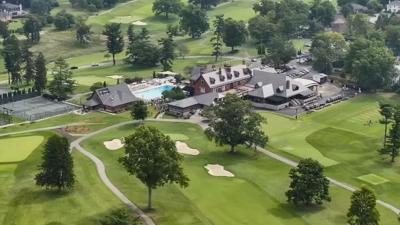

LOUISVILLE, Ky. (WDRB) -- Before it became a golf course, before the stone springhouse overlooked the 10th tee and long before it welcomed the PGA Tour, the land now home to Hurstbourne Country Club and its surrounding neighborhood was a crucial stop in the march of history.
It was here, in 1779, that Major William Linn — one of the founders of Louisville — established one of Kentucky's earliest "stations" along Beargrass Creek, a fortified outpost for settlers, soldiers and westward dreamers.
He was a friend of Louisville's founder, famed explorer George Rogers Clark, and went on an expedition with him in 1780. Just a year later, he was killed en route to a meeting of the new Jefferson County Court.
His burial place and headstone are lost to history, but the spring still runs. And the legacy of Linn's Station — and the generations of political and social figures who resided here — continues to echo through the rolling fairways and historic clubhouse. Just as surely, so do the sufferings and labor of the enslaved people whose hands cleared this land and built its earliest structures.
"The aura of a long and rich history still permeates throughout Hurstbourne," the club's official history notes.
This week, the ISCO Championship becomes the latest chapter — but far from the first.
Col. Richard Clough Anderson, a Revolutionary War patriot wounded at Trenton, taken prisoner at Charleston and aide-de-camp to Lafayette at Yorktown, purchased a tract of this land. On these rolling acres he built Soldier's Retreat, a stone mansion surrounded by outbuildings and — eventually — a family cemetery that still remains, along with a reconstructed version of the home.
Anderson married the sister of Clark. Their son, Robert Anderson, became the Union commander who surrendered Fort Sumter, sparking the Civil War. Erik Larson's The Demon of Unrest has him as a central figure and recounts his upbringing at Hurstbourne.
Two springhouses that still stand on the country club property likely date to the late 1780s.
In 1868, property owners Richard and Pattie Ten Broeck renamed the farm "Hurstbourne" after an English estate owned by Richard's friend, the Duke of Portland. But the most famous resident was a thoroughbred named Ten Broeck, who occupied a stone stable where a garage behind the clubhouse now stands.
The colt's claim to fame was a second-place finish to Aristides in the first Kentucky Derby. Ten Broeck would bounce back to become, at one time, the most famous horse in America — the first ever memorialized with a headstone in Kentucky, and a member of the National Thoroughbred Racing Hall of Fame's inaugural class.
Skip ahead to 1915. The property had changed hands again. Elizabeth Harris, a wealthy Louisville widow, sold it to Alvin T. Hert, head of the American Creosoting Company. His wife, Sallie White Hert, would go on to serve as vice chairman of the Republican National Committee.
Her influence shapes the clubhouse today. In 1928, she hired renowned architect E.T. Hutchings to remodel the home, importing oak paneling and an ornamental ceiling from a 17th-century English manor. That oak-paneled drawing room — 60 feet by 30, with 14-foot ceilings — is now the club's main dining room.
In its day, Hurstbourne was home to trophy rooms, stables, manicured gardens and peacocks strutting the grounds. Mrs. Hert's saddle horse and German shepherd are buried behind the clubhouse.
The golf course itself was built in the 1960s by Chick Adams and renovated in 2005, highlighted by a major bunker improvement program. The primary change for pros this week: The nines have been reversed so the tournament doesn't finish on a par 3, and the first hole has been shortened to a par 4.
And while this is the first visit by the PGA Tour to Hurstbourne, it's far from the first time professionals have walked these fairways. Major champions like Lee Trevino, Bobby Nichols, Mark O'Meara, Fuzzy Zoeller, Tom Kite, Gay Brewer, John Daly and others have played here — many during the heyday of the Foster Brooks Celebrity-Pro event in the 1970s, '80s and '90s.
That event brought musicians and actors in great number — as eclectic a group as Jeopardy! host Alex Trebek and Andy Griffith Show star Don Knotts. Leslie Nielsen joked his way through 18 holes. Louisville basketball coach Denny Crum was a longtime member. Bob Knight played here. So did Pee Wee Reese, Gov. Happy Chandler, Johnny Bench and former President Gerald Ford.
In 1977, at age 74, Bob Hope made a hole-in-one on the par-3 16th — as 4,000 people cheered.
All of which is to say: the old course has seen some things.
But for a place with so much history, this weekend's event brings something rare.
Something new.
Quick Sips
- Get a scouting report on the setup at Hurstbourne from players who came off the course following Wednesday's practice rounds by clicking here.
- For more tournament information, including how to watch and parking and ticket information, click here.
The Last Drop
"If you watch a game, it's fun. If you play it, it's recreation. If you work at it, it's golf."
-- Bob Hope
Copyright 2025 WDRB Media. All Rights Reserved.


