
LOUISVILLE, Ky. (WDRB) — Muhammad Ali died 10 years ago this week.
That sentence still looks strange on the page.
Muhammad Ali died.
The mind understands it. The memory still rebels.
Ali had long ago become one of those people who seemed to exist outside the normal rules. Presidents came and went. Athletes aged and retired. Buildings rose and fell. Yet somehow, Muhammad Ali remained, diminished by Parkinson's but never reduced by it, still smiling, still pointing, still drawing crowds wherever he appeared.
Then one June evening in 2016, the news arrived. And Louisville waited.
Not just for the funeral. Not just for the memorial service. For Ali's return.
Because that's what he always did. He came home.
He came home after winning Olympic gold in Rome.
He came home after becoming heavyweight champion of the world.
He came home after being stripped of his title.
He came home after the "Rumble in the Jungle" and the "Thrilla in Manila."
He came home after the applause and after the criticism.
No matter how large the world became, Louisville remained part of the map. A hometown can frustrate you. It can wound you. It can fail you. But it remains your hometown.
And Louisville remained Muhammad Ali's.
The week of his funeral, the city became something different. The world arrived — not metaphorically, literally. Journalists with cameras and microphones from places most of us had never visited. Visitors speaking languages most of us could not identify. World leaders and religious leaders, celebrities and curious travelers, people who simply wanted to be present when history passed by.
Then came the procession.
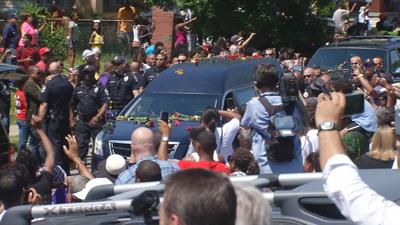
I watched much of it on the news set at WDRB. Even through a camera lens it was moving. Traffic stopped on the interstate and people got out of their cars. Children ran alongside the hearse throwing jabs into the summer air. Grown men reached out to touch the vehicles as they passed. Flowers covered the route, and rose petals waited at Cave Hill Cemetery.
Muhammad Ali belonged to the world. But for one unforgettable week in June of 2016, the world belonged to Louisville.
The city was not mourning so much as accompanying him. Walking with him. Escorting him home.
Years earlier, Ali's daughter Hana told a story about a recurring dream her father once described. He was running down Broadway in Louisville while crowds lined the street cheering his name. Then suddenly he lifted into the air and flew away.
Maybe dreams are just dreams. But when Ali's procession rolled up Broadway one final time, it was hard not to think of it.
The memorial service inside the Yum! Center was full of voices — Billy Crystal, Bill Clinton, Lonnie Ali, Kevin Cosby. But it was John Ramsey, one of Ali's closest friends, who captured something essential about the man.
This week, Ramsey reminded me of a story he told that day. Ali had gone looking for a boxer who had just lost an Olympic match. While everyone else celebrated the winner, Ali sought out the loser, lifted his spirits and reminded him not to quit.
That was Ali.
The world's most famous man, searching for the person everybody else overlooked.
The heavyweight champion noticing the defeated fighter.
The celebrity looking past the spotlight.
That story has stayed with me because it explains something Louisville sometimes forgets. Ali's greatness wasn't really about boxing. The punches made him famous. The kindness made him beloved.
Today, ten years later, there is a temptation to measure Ali only by the size of his fame — the Olympic gold, the championships, the torch in Atlanta, the murals and statues and the museum. But those things are monuments.
They are not the man.
The man was the kid whose bicycle got stolen. The teenager who dreamed impossible dreams. The Louisvillian who kept coming home.
And perhaps his final gift to Louisville was one last homecoming.
For one week, the world looked at this city through Muhammad Ali's eyes.
And what it saw was not our arguments or our divisions or our shortcomings.
It saw people. It saw kindness. It saw possibility. It saw Louisville, a place capable of producing someone whose influence reached every corner of the globe.
Louisville has had famous days. It has had triumphant days. It has had heartbreaking days. But it has never had another week quite like that one. And it probably never will.
Muhammad Ali belonged to the world.
But for one unforgettable week in June of 2016, the world belonged to Louisville.
Copyright 2026 WDRB Media. All Rights Reserved. For a longer discussion of the week surrounding Ali's death in Louisville, watch a discussion between Crawford and Ramsey on MetroTV's YouTube page here.


