


LOUISVILLE, Ky. (WDRB) — If your neighbor told you he planned to spend $30 million more than he made next year, you would not ask for details. You would ask for his keys.
If your local hardware store announced it would lose $30 million next year, you would start wondering where to buy nails.
If your dentist did it, you'd find another dentist.
In business, some might call that behavior insanity. In college athletics, they call it a strategy.
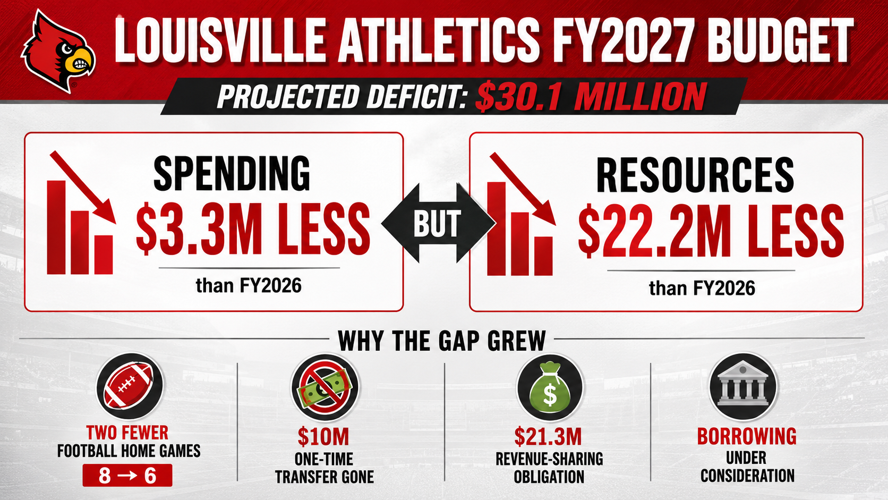
Louisville athletics approved a budget Thursday that projects a deficit of roughly $30 million. And here's the strange thing.
Nobody in the room seemed particularly surprised.
Nobody pounded the table. Nobody demanded a balanced budget. Nobody called for an emergency meeting.
Because everybody already knows the secret.
The entire industry is standing in the same puddle.
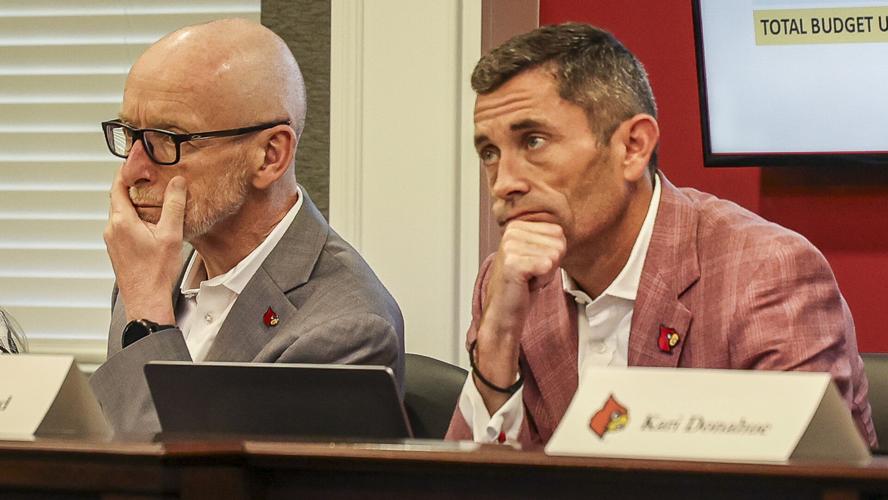
Josh Heird has been the athletics director at Louisville long enough to know what his job used to look like. He said Thursday that it looks nothing like that anymore.
"You don't really know what your job's going to entail when you wake up on any day of the week," he said. "It really is changing that much."
That is the environment in which Heird presented a $30 million deficit -- $179.4 million in spending to $149.3 in revenue -- to the Louisville Athletic Association board Thursday, and received approval without anyone treating it as a crisis.

It is not that nobody cares. It is that everybody understands.
College athletics has become a business where the solution to losing money is often to spend more of it. Spend on coaches. Spend on players. Spend on facilities. And then spend more, because your rivals just did.
But Heird's argument — and it is a coherent one — is that Louisville is not being reckless. It is being rational.
"You have two choices," he said. "You can either continue to try to be in the game and play in the game, or you can say we're not going to."
Choose the exit, he said, and Louisville stops recruiting top players. Winning declines. Attendance declines. Donations decline. Television value declines. And then the department has less money and fewer ways to make more. And it isn’t the only one. Downtown businesses suffer. Arena revenues lag.
So you stay. And you spend. And you borrow.
The presentation Thursday noted that Louisville is exploring "external financing options" — increasing its line of credit to cover the gap. The budget also identified $7.6 million in potential upside: a playoff run, a Top 25 finish, a major concert at L&N Stadium.
Think about that last one for a second.
One of the strategies for solving modern college athletics is hoping somebody books a really good concert.
That is not a criticism. That is a description of where the industry has arrived.
In the old days, athletic directors spent their time worrying about ticket sales. Now they talk about nonprofit affiliates and lines of credit and cash flow and Cardinal Ventures, Louisville's new external entity — which Heird described as still in the "blocking and tackling" stage of becoming operational. The cavalry, in other words, is not coming yet.
Heird said his message to staff has become a simple two-word instruction: Evolve or die.
"If you are not comfortable in the uncomfortable," he told them, "college athletics is not the place for you right now."
That is true of the people working in it. It is also true of the institutions funding it.
The sport has constructed a trap, and rationality is what keeps you inside it. Louisville isn't behaving irrationally. Louisville is behaving exactly the way the system incentivizes it to behave.
The truth is that Louisville's budget is no longer really a Louisville story. It is an American college sports story. The Cardinals just happen to be polite enough to show the math.
Most schools are staring at the same problem.
Some are just using smaller fonts.
Copyright 2026 WDRB Media. All Rights Reserved.


