


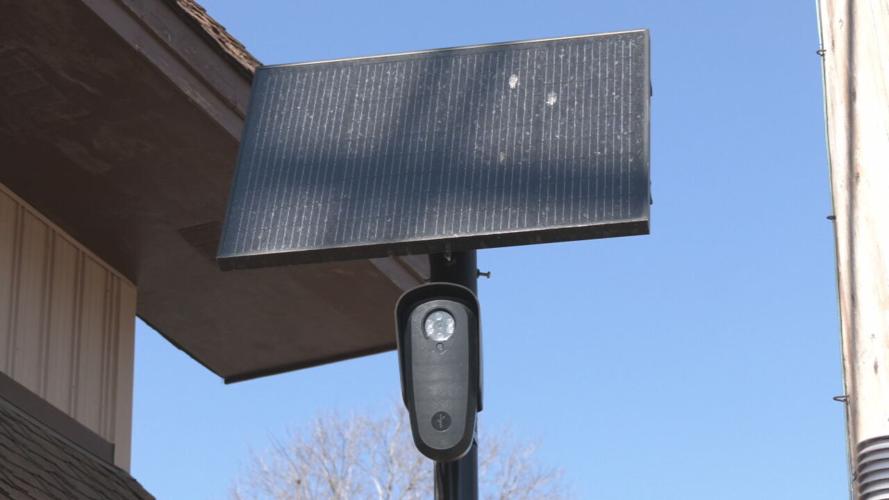
LOUISVILLE, Ky. (WDRB) — Louisville Metro Police won't say where many of city's license plate reader cameras are located. But on Third Street near Cardinal Boulevard, one is hiding in plain sight.
For some residents, that secrecy is the point — and the problem.
"I don’t like being tracked where I go," said a University of Louisville student. "I feel like that’s an invasion of my privacy."
While documenting one of the cameras, a WDRB news crew noticed a laminated information sheet with a QR code attached nearby. That trail led to the DeFlock website, and eventually to Destiny Kelly, with Kentucky DeFlock, which is pushing to remove Flock cameras.
"We believe that the cameras are a violation of our Fourth Amendment right under the Constitution," Kelly said.
Kelly said she’s already helped scale back camera use in her home county, working with the national DeFlock organization to challenge deployments city by city.
"We beat it in every other city in the (Henry) county because of the unconstitutionality and the risk associated with it," she said.
DeFlock’s volunteers are building what they call a public transparency map, crowdsourcing camera locations even when agencies won’t release them. The group said it has mapped more than 110,000 license-plate reader cameras nationwide, including hundreds across Louisville and southern Indiana.
"So if you see a camera, you can tag that," Kelly said. "And even without the city allowing transparency, the people can create transparency themselves."
A quick spot check of the DeFlock map in Louisville shows camera entries near Cardinal Boulevard and Dixie Highway.
Back in February, LMPD did release how many Flock cameras are located in each Metro Council district and police division, but it did not disclose exact placement. At the time, Deputy Chief Emily McKinley defended keeping specific locations private, saying placement is driven by crime trends and infrastructure needs.
"A lot of the locations are chosen based on violent crime statistics, auto theft hotspots and major roadways — including interstate on- and off-ramps — as well as the infrastructure needed to install a camera," McKinley said in February.
Other Kentucky cities have taken a different approach. Lexington has released camera locations, along with a map showing violent-crime data. Kelly argues Louisville taxpayers deserve the same level of transparency.
"In a city with a history of accountability and transparency issues, Owensboro is transparent. Lexington is transparent. Georgetown is transparent. Eminence is transparent," Kelly said. "But they’re keeping it a secret, and you can’t gain public trust that way."
The Kentucky Attorney General has sided with LMPD on withholding the locations of certain cameras.
Copyright 2026 WDRB Media. All Rights Reserved.