

LOUISVILLE, Ky. (WDRB) – So much has happened in the decade since Louisville cut down the nets in the Georgia Dome to celebrate the third NCAA championship in program history – much of it not for the better.
Louisville fans can recite the litany of dysfunction and disappointment that has followed, things that can’t be erased, because they fractured longtime relationships with figures who feature prominently in the university’s athletic history.
So on Saturday, with some members of the 2013 team gathered to remember that run, it was a makeshift moment of NCAA necessity in the KFC Yum! Center. Everyone knows that sad and sordid story.
Yet the largest crowd of a forgettable 2023 season gathered to remember a moment none of them will ever forget.
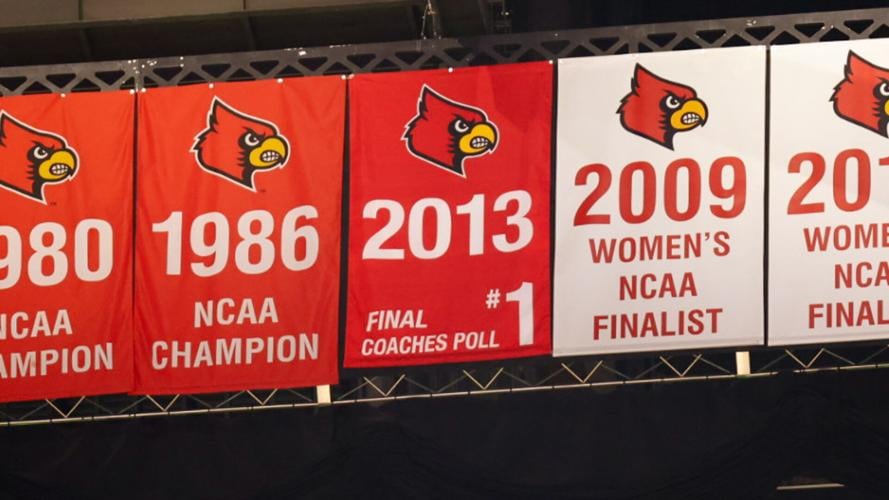
Louisville hung a new 2013 banner that is a study in typography. The NCAA approved the language, “2013 Final Coaches’ Poll #1.” It just so happens that “2013” and “#1” are in large print, while the words “Final coaches poll” are smaller and more difficult to make out.

The 2013 banner hung in the KFC Yum! Center rafters by the University of Louisville.
“It feels like yesterday,” point guard and captain Peyton Siva told the crowd. “In front of 74,000 people, a sea full of red, that we were in Atlanta, cutting down those nets.”
A much smaller crowd, but pretty distinguished, including Louisville mayor Craig Greenberg (who had hung Louisville's real 2013 NCAA championship banner on Metro Hall earlier in the week) gathered beforehand in former Louisville equipment manager Vinny Tatum’s place in the Whiskey Row Lofts. Rick Pitino spoke with the players from the team via FaceTime.
“He just wanted to say hi and congratulate us and tell us he loves us,” Siva said. “He’s a wonderful coach and we all love him and it was great to see him on the screen and have him give us some love.”
Others chiming in via video were Gorgui Dieng, who had to miss the event because of an illness in his family, and Russ Smith, who is playing in Europe.
“Being at Vinny’s was awesome,” Siva said. “He had a lot of posters on his wall that took us down memory lane. Being back with the guys, reminiscing with them about the times we played. That season seems like yesterday. There were so many memories. . . . We were watching the Michigan and just seeing some of those plays -- guys giving me mess about Trey Burke and the infamous block foul and just laughing about it. It's just great memories, man. Definitely, just looking back on it, we really did something special.”
Luke Hancock not only was winning Final Four Most Outstanding Player, but dealing with the impending loss of his father at the same time. He fought to have his records and award restored, suing the NCAA and earning a settlement. He thinks the university, one day, could have some success in a similar effort.
But for now, he says, he’s made peace with the way things are.
“Nobody had any help to win those game when we won a national championship,” Hancock said. “You know, whatever happened, happened. But it didn't help us win any games. So, to get some recognition is really nice. I'm so happy for the crew for and for all these guys. It's been a roller coaster, but we've kind of gotten on the other end of letting everybody else's opinion or people that don't matter – it’s not really affecting us anymore, or myself at least.”
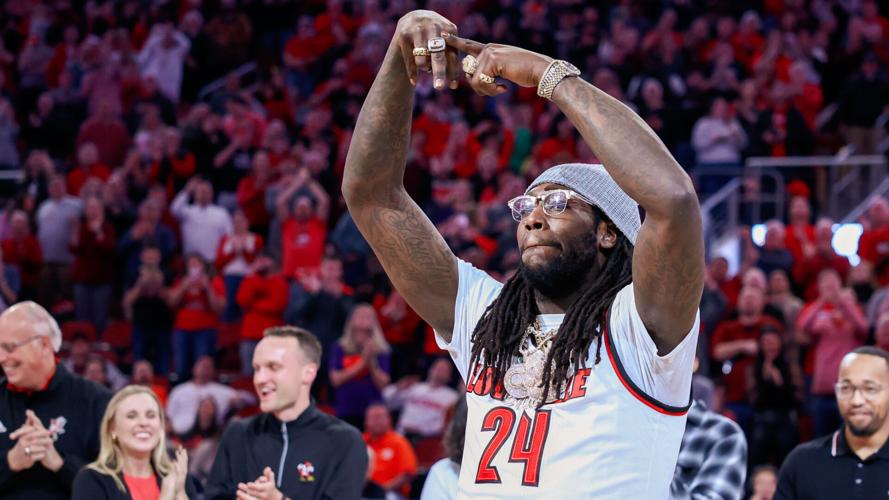
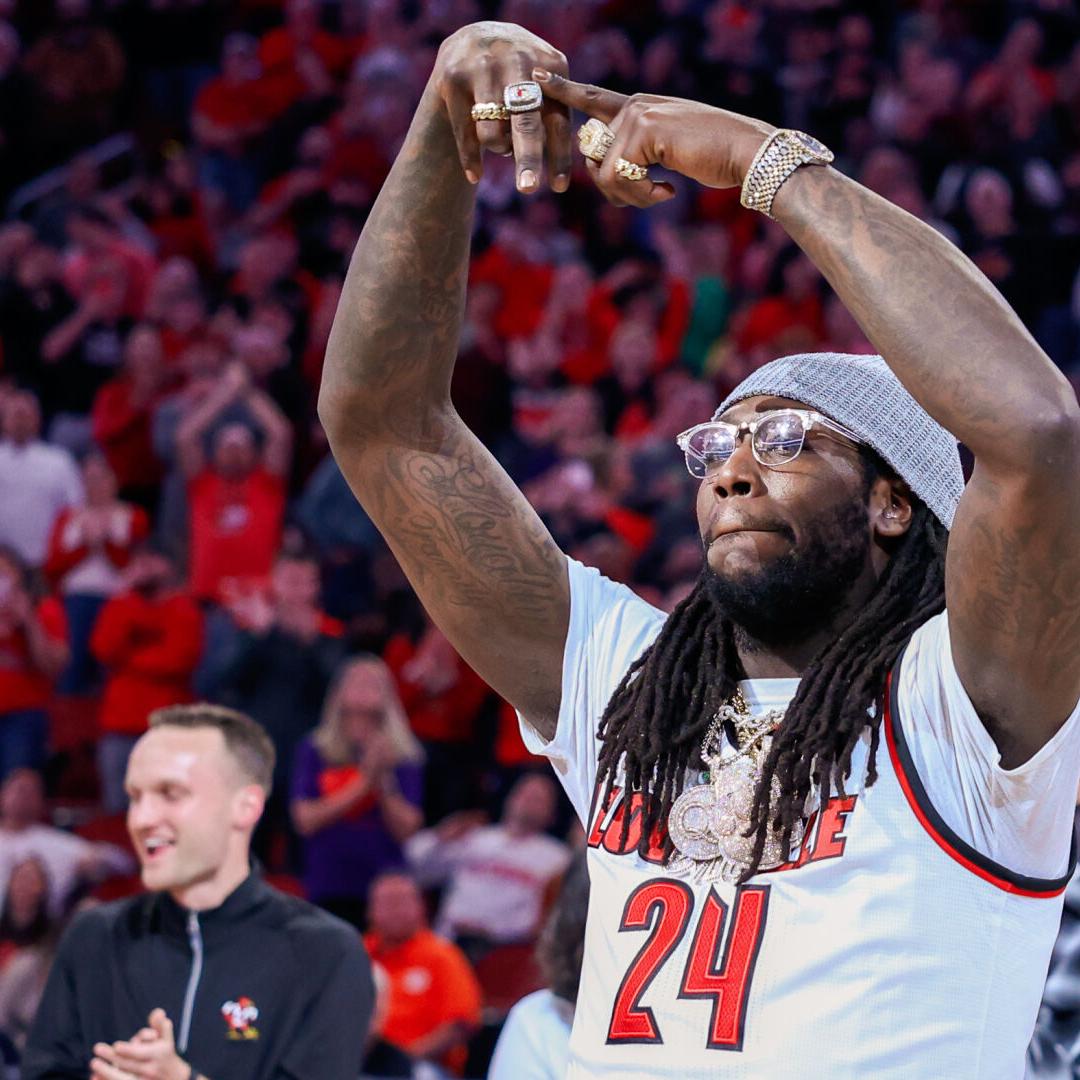
Montrezl Harrell made a point to flash his championship ring from 2013 at every opportunity. Still active in the NBA, he spent the All-Star break with his former teammates.
“Hopefully we’re still fighting to get back what was rightfully won by us,” he said. “We’re going to keep pushing for that. We know what happened. And we know what we did. And we’re going to keep standing on that. Nobody was in that gym but us. I don’t care about something that’s hanging in the rafters, man, because at the end of the day, I’ve still got it.”
Harrell held up his 2013 championship ring.
“I don’t know what they’re talking about,” he said. “I told you, we was in there fighting for it. Y’all keep going. I could talk about this all night.”
What I remember most about that team is the stories.
Russ Smith, a guy nobody wanted, a guy coach Rick Pitino didn’t want half the time during his early Louisville days, becoming an All-American, putting himself in the rafters at the KFC Yum! Center, and taking the team with him. Ridiculous. Russdiculous.
Peyton Siva, who as a high school student had driven the streets of Seattle to rescue his dad from a downward spiral and what his dad said was certain suicide.
Hancock, who shared tearful conversations with Pitino about his dying dad, then somehow found the will to make four consecutive 3-pointers to create moments he’d carry for the rest of his life.
Gorgui Dieng, who came to Louisville not fully understanding the English language or the concept of an offensive foul, getting index cards with vocabulary words from Pitino and being drilled on them every week. Some of Dieng’s interviews during the Final Four are among the most memorable I can remember in my career.
He talked about his father teaching him about the importance of money, not for security, but for the ability to give it away. Dieng has given it away, leveraging his decade-long NBA career into building hospitals in his native Senegal.
Chane Behanan, who came from a rough background, becoming the backbone of Louisville’s Final Four success. Without his rebounding performances over two games, the championship never would’ve come to Louisville.
Harrell, whose monstrous lob dunk from Siva remains the single highlight sure to awaken a KFC Yum! Center crowd.
Kevin Ware, who became the focal point of a nation after his gruesome leg injury in the regional final against Duke. I’ll never forget walking into the Louisville practice facility after returning from Indianapolis and the regional final to see NBC’s Matt Lauer setting up for an interview in the team’s press room.
Stephen Van Treese, another guy Pitino thought he didn’t need, but who transferred back at the first opportunity and became indispensable.
Tim Henderson, who single-handedly turned back Wichita State. He was there Saturday with his wife and four children, and he couldn’t stop smiling.
Through all of that season, I was meeting regularly with Pitino to work on a book. It had nothing to do with that season, but we had to scramble after the championship to include stories from the championship. Many of them Pitino faxed to me, scrawled out on notebook paper from somewhere in the Caribbean. I still have the faxes.
“After 2012, we knew we were going to make a run in 2013,” Van Treese said. “We were focused and ready to roll. It’s been such a fun day seeing everyone and just reminiscing and everything. I feel like an old man. But I also feel like I could get out there on the court and run around right now.”
And probably get a half-dozen rebounds and a couple of put-backs.
The thing that made that team special was that it was not built around a single individual star. It was built around a core of really good basketball players, with unique talents but common determination. They couldn’t defend one-on-one. They had to tailor their defense to the opponent’s attack, often switching from man-to-man to zone principles multiple times in a single opponent possession.
They weren’t a great offensive team to start the season. Hancock was coming off a shoulder injury and couldn’t even lift his arm without warming up for an hour. But by the time the NCAA Tournament rolled around, they were the most efficient offensive team in the country.
Pitino, one of the game’s great coaches, was at the top of his game. He devised the defense, made a key switch with Kevin Ware that brought his game into focus until the injury. And once Ware was injured, the team kept adjusting, adapting, and winning.
In short, they were not the kind of team you would’ve bought if you were setting out to put a team together. Maybe a few of them, but they were a team that had to be always connected or the whole was going to fall apart. They were held together by round-the-clock Russ Smith contributions to the team text chain and good, old-fashioned fear, of a head coach who had a vision.
Even today, Van Treese said, “We have a great text chain going.”
If nothing else, the power of the memory of that season and its enduring value to Louisville fans was on display Saturday night. Into the darkest season in school history, they lit up their old arena once again.
POSTSCRIPT
Let’s talk about the stripper thing. Ten years (and more) later. It happened. Of course. The amount of money involved was vastly overplayed in the original reporting. But the fact that it was sordid, that there was sex involved, that some recruits felt coerced into the situation, those things were worthy of punishment.
“Indefensible,” was the word Louisville athletic director Josh Heird made sure to use, when referring to those actions, apart from the school’s desire to honor that team’s accomplishments.
At the same time, there is no confirmation in any of the NCAA record that any individual employee in a position of leadership at the university – aside from the troubled individual who threw the parties – knew about strippers or prostitution and failed to act.
Personally, I was always bothered by two elements of Katina Powell’s story. One, that there were sometimes when her parties were pre-empted because Pitino kept players too long – as was the case with recruit Earl Clark. If they were such an integral part of the visits, and if Pitino was ordering them, why would he blow them up like that? Secondly, she complained about being paid late on multiple occasions. If you’re a high level coaching staff running things high-dollar and highly improper operation, wouldn’t you make sure you paid the bills on time?
We may never know the whole story.
We do know, however, that some players knew and failed to tell Pitino, out of fear that he’d suspend players and derail the whole season.
I talked to some players from the 2013 a year ago for a separate project.
“If he would have known . . . he would have tripped out,” Smith told me. “If he would have known that, yeah, like everybody would've probably been fired on the spot. ... If he would've known something like that, everybody would have been would have been punished, like, immediately out. I don't know how it was supposed to be handled, but, looking back, as a 19-year-old, if he would have known something like that was going on, he would have torn the roof apart."

“If coach would have known, that was the last day of those guys, whoever make it happen,” Deing told me. “I'm going to be straight up with you. Like if coach ... I was at (the Kentucky Derby) and I went see coach where he was. He asked me millions of questions. How did I get in? Who gave me the tickets? How this, how that? Like, coach, you know, my host family, they got it. (Laughs). You know? I'm not stupid. But that's how careful he was with us. Yeah. So, if somebody can just ask you all those questions for one Derby ticket, imagine, like having strippers, or money. ... There is no way it happens. Me, personally, I don't think coach know or was aware of anything of that. Anything. Think about, you miss, you didn't go to study hall or you didn't do your homework, you will miss a game and going to get suspended. So how are you having all that stuff like that go? It doesn't make sense to me. People ask me did coach know about this situation? No, he did not. Right? This man got too much integrity and too much pride to let stupid (expletive) like that jeopardize his career."
Hancock said during his court fight, and told me, that the NCAA’s handling of the situation, its smearing of every player on that team with the same brush, whether he took part in the parties in question or not, would have had a more negative impact on him personally if not for Pitino’s continued defense of the team and messages of support. And he said it did a disservice to a majority of players on Louisville’s championship team.
“There are certain things that you keep from a head coach,” Hancock said. “. . . I just know for a fact that if he knew that that stuff was going on, and that there were you know, stripper parties, money's flying and recruits are in there, there is zero chance coach would have let that go on. Zero. He was too far along in his career to let something as stupid as that happen if he could stop it.”
When it was hearing Louisville’s case on the sex-for-recruit violations, the NCAA’s committee on infractions determined that one way in which Pitino failed to create an atmosphere of compliance was in creating an atmosphere where players resisted telling him what was going on out of fear of his response.
Years later, a new process set up by the NCAA, the Independent Accountability Resolution Process, rejected that reasoning. It also rejected the “red flag” reasoning, saying that there are things that a responsible coach should not be expected to know, particularly if others are working to conceal it from him.
That process, now, has been abandoned, and the NCAA has begun, especially with regard to Name, Image and Likeness payments, to assume the authority to impose sanctions for violations that it merely determines look like violations, without regard for empirical proof.
This team’s legacy will be forever intertwined with this ugly chapter. But the university and its athletic leadership should not be burdened with the baseless assumption that it somehow knew those activities were going on and condoned them. To the contrary, they cooperated with the NCAA’s process, accepted its judgement, and even this weekend, did nothing without NCAA permission – even when the NCAA has refused to impose similar justice on offenses just as serious elsewhere.
Pitino had no public comment on this 10th anniversary of Louisville’s now-vacated championship. But after the IARP ruled in his favor in a subsequent NCAA recruiting matter – over which he was fired at Louisville – he did say this about the 2013 team.
“You don't take championships away,” Pitino said last November. “You can't rewrite history. We won the championship. No, we did not use steroids. We did not steal signs. We did not do anything illegal to gain an advantage in the game of basketball. We beat Michigan with great defense, an outstanding, well-coached Michigan team. We beat Wichita State, an outstanding, well-coached team with a hard-work ethic. Great defense, unselfish offense, and my players should be commended. They are champions. You can't take that away from them.”
No, you can’t.
Copyright 2023 WDRB Media. All Rights Reserved.


