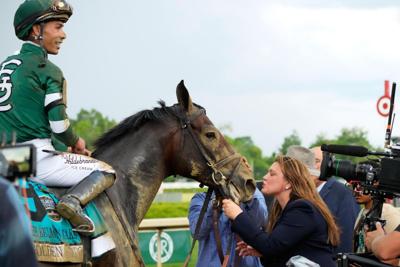



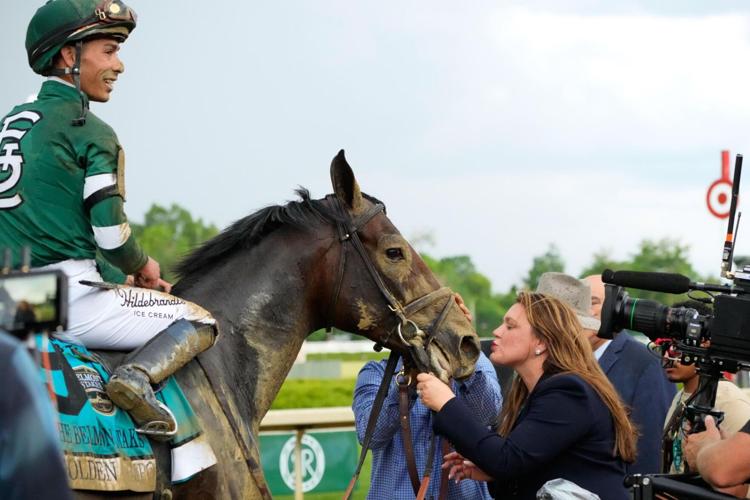
LOUISVILLE, Ky. (WDRB) — They didn't call Golden Tempo a fluke. They just treated him like one.
The Kentucky Derby winner arrived at Saratoga on Saturday carrying roses, a gold trophy and apparently very little respect.
He was the fourth betting choice in the Belmont Stakes.
The favorite was Renegade, the horse he had already beaten at Churchill Downs. Two others, Bill Mott’s Chief Wallabee and Chad Brown’s Emerging Market, also went off at shorter odds.
There are two ways to look at that.
One is that horseplayers are intelligent, discerning students of the game. The other is that they occasionally suffer from the memory span of a mayfly.
Golden Tempo went off at 6-1 in a nine-horse field. That wasn’t a betting line. It was a challenge. Prove it again.
Horse racing does this sometimes. It crowns a king, then immediately begins searching for reasons the crown doesn't fit.
It was easy to fix a narrative in the Derby. The pace collapsed. The trip was perfect. The favorite had trouble. The track favored closers. The moon was in Aquarius.
Anything but the simplest explanation.
Which was, it turns out, that Golden Tempo is a really good horse, with an uncommonly good trainer, and a top-of-his game rider in Jose Ortiz.
On Saturday they won the Belmont Stakes the same way they won the Kentucky Derby: moving late and leaving no doubt.
The difference was that this time Golden Tempo wasn't rescuing a race from a pace meltdown. The fractions were honest, not suicidal. The race unfolded cleanly. The excuses never showed up.
Only Golden Tempo did. Again.
And so did DeVaux, who captured the $500,000 Woody Stephens Stakes earlier in the day with Englishman, who matched a track record. A few hours later, her Derby winner paid $14 to win the Belmont.
The Kentucky Derby made her historic. The Belmont made her impossible to ignore.
Horse racing produces Derby winners every year. It does not produce years like this very often. By sunset DeVaux owned the racetrack.
Not with volume or theatrics. But with judgment.
Every significant decision she made this spring was validated. She developed Golden Tempo patiently. She resisted the temptation to rush him. She skipped the Preakness. She brought him to Saratoga fresh.
And she added blinkers.
That last move might have been the most revealing. Golden Tempo looked different before the race. Not nervous or distracted. He looked ready, as if somebody had turned up the wattage.
He bounced through the paddock. He carried himself like a horse who had somewhere important to be.
The blinkers did not make him faster. They made him more himself.
Afterward, DeVaux talked about his growth. Not just physically. Mentally.
“He broke a lot more alertly,” she said. “He did come out of the gate and get a little lost, took a bit of a right-hand turn, but showed a lot more speed out of the gate, which all signs were pointing that he was going to put himself more in the race, especially with a slower pace than we had in the Derby. So, you know, he's taken a lot of steps forward physically and mentally, and it really showed today.”
That has been the hidden story of his season.
Five weeks ago, he won the Kentucky Derby while still looking like a colt becoming a racehorse.
Saturday he looked like a racehorse becoming a champion. Had the race gone another quarter mile, as it has for most of its history, the victory would’ve been even more visually impressive.
Her only pre-race instructions for Ortiz were, “Good luck.” He got his colt into the fray quicker, then followed his Derby playbook; that is, he watched for Renegade, and moved with him at the head of the stretch. The only difference this time was that instead of circling widest in the field, Ortiz edged inside of Renegade.
“Jose found himself at the back of the pack, but he was going to be wide if he didn't tuck in, which I was pleased with that,,” DeVaux said. “Jose just rode him super confidently. He knew he had a lot of horse under him, and at the top of the stretch, he had him in a position to make that run. Golden Tempo did the rest.”
Perhaps the most poignant thing about the performance was its setting. The Belmont Stakes has been run at Saratoga for three years now, but this one felt different – even if Golden Tempo became the second straight Derby winner (and second ever) to take the third jewel of the Triple Crown after skipping the second.
The scene was cinematic. The rain arrived. The crowd leaned forward. And as Golden Tempo surged past Commandment in the stretch, a rainbow appeared over the racetrack.
Sometimes sportswriters invent symbolism. This time nature handled it.
DeVaux was born in Saratoga Springs. Now she has won the Belmont Stakes there. The hometown girl trained the best horse in the race and watched him prove it in front of her hometown.
The script was almost embarrassingly perfect. Then again, so has been her year.
Six weeks ago, Golden Tempo was a promising colt most racing fans could not have picked out of a lineup. Five weeks ago, he won the Kentucky Derby. Saturday he won the Belmont Stakes.
And somewhere along the way, the conversation changed.
The question is no longer whether Golden Tempo deserved to win the Derby. The question is who is supposed to beat him now?
For the moment, he is the champion 3-year-old in America.
And Cherie DeVaux is the story of the sport.
Copyright 2026 WDRB Media. All Rights Reserved.


