
LOUISVILLE, Ky. (WDRB) -- For my first decade in journalism, I never had to cover a losing team. The first college coach I ever covered was Bruce Pearl, and, like the song says, all he did was win, win, win, no matter what with the USI Screaming Eagles. The women's coach, Chancellor Dugan, did the same. I covered Indiana in the heyday of Calbert Cheaney.
When my newspaper, the late Evansville Press, went out of business, I moved to the morning Courier & Press to cover the University of Evansville, and that team went to the NCAA Tournament under Jim Crews.
I didn't have to learn to cover a losing season until I came back home to cover the University of Louisville and found myself chronicling Denny Crum's final season for The Courier-Journal. But even that year was more about what was happening off the court than on it.
My first real experience, then, covering garden-variety, plain-old stink-it-up losing seasons was with Louisville football in 2008-09. By then, I'd had nearly two decades of experience, but it still was an eye-opener. Nobody is happy. Everything you write is parsed. The athletic director stopped talking to me for a year. Rick Pitino held a one-man intervention with me at Starbucks off Central Avenue.
"Tom wants to know if you have something against him?"
"Not at all. Tom is great. But the football program is circling the drain."
Losing, you see, is hard. The idea of losing is one thing. Louisville basketball hires a first-year coach and you write or say, "Things are going to be tough for a little bit." And people nod their heads.
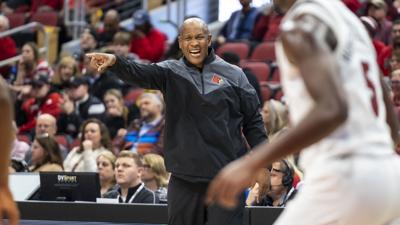
Before Kenny Payne was introduced as coach, I wrote, "Upon the news of his hiring, none other than Magic Johnson Tweeted his congratulations and commended U of L on the hire. But while Payne may have Magic in his corner, he doesn't have it in his pocket. He can't wave a wand and fix a program that little resembles the one he played for. And, in fact, the job today is far more difficult than it was four years ago, when he felt he was ready for the job but got only a cursory glance from the school, and perhaps even less from its fan base. There may have been fewer than 5,000 fans in the KFC Yum! Center for the Cardinals' last home game. The talent level has fallen, and so has the teamwork."
The idea of losing is one thing, the details are something else. Lose three straight one-point games to start the season and the dumpster is on fire.
Get your fire suit. It's going to be a long season.
Louisville has lost three straight, and that was the easy part of the schedule. The last one gave the whole trilogy a fictional feel. After playing uninspired basketball for 32 minutes, Louisville reeled in Appalachian State and had a chance to win on its last possession. It had plenty of time to get up a shot, just under 12 seconds.
Ell Ellis dribbled out 10 seconds of that out at the top, then drove into the line, got whacked across the face but still converted a layup at the buzzer, and the team shot off the bench in celebration, making a B-line for Master P in a courtside seat (not toward the bench, what was up with that?)
Then, they noticed the refs headed to the scorer's table. In one of those things that only happens to programs that are down on their luck, the ball left Ellis' hands a split-second too late. No basket. One-point loss.
It will not be a news flash for Louisville fans to hear that they are going to see more of this kind of thing.
There are inexplicable parts of this. How Louisville's players can come out flat when the program is seeking its first win leads to more questions than answers.
While most of my friends in the media are focused on some obvious mistakes in the game's final 30 seconds (why not foul sooner?), many of my questions deal more with what happened in the first 32 minutes. How do you come out so flat? Why can't you defend straight-line drives? How does your best player wind up with zero points or rebounds but five fouls?
Why is only one of your big men consistently getting any kind of post position, and why aren't guards looking for him more?
How come so many possessions don't get the ball into the paint?
Where are basic things like proper defensive stance, running the floor hard, block outs?
I've been in the business long enough, too, to know this: Often, simple basketball issues are linked to other issues that have nothing to do with the game. And, goodness knows, this group of players has every excuse in the book — rightfully — given what this program has put them through the past two years.
Whatever the reason, it seems to me that players haven't bought in. It also seems to me that a great many fans haven't bought in. Maybe 10,000 showed up for Louisville's season-opener against Bellarmine. Maybe half that for the Cardinals' exhibitions.
"Yeah, won't be no more 6,000 people at the game," Darrell Griffith told me when Payne was hired.
Except that's exactly what it is. This is what Louisville basketball is right now: a program that draws poorly, that just escaped the NCAA shadow, whose talent level has dipped and that is badly in need of a shot of adrenaline. This is not the program that hangs in the rafters in the arena. It is the program of empty seats and last-second losses.
Changing that, restoring what has been lost, is no small job, and it is Payne's task. How he goes about doing that is the story of this basketball season.
"If you watch us practice, you'll understand what we're dealing with," Payne said Tuesday night. "You can't play games and expect to win and have bad practices."
The problem, of course, is that fans and reporters can't watch practice. The challenge of telling the story of this season is that we don't have great access to many of the inner workings. The locker room closed when David Padgett departed as acting head coach — after decades of being open — and hasn't reopened. There's no opportunity to talk to players, except in a news conference setting or at preseason media days.
Rick Pitino liked the locker room being open because he wanted losses to hurt. He wanted players to have to answer questions after losses. (Occasionally, he closed it after particularly disappointing losses but usually out of his own anger, not any desire to protect anybody.) He once marched the whole team back in from the bus to sit in the locker room while I asked questions after the first road loss of his Louisville career. That was a fun locker room.
What gets lost, sometimes, is that these are all human beings with lives of their own. They aren't robots in uniforms. Coaches aren't cardboard cutouts at a grocery store. Yet, if there's little access to them or their struggles even amid a season like this, they grow to be two-dimensional, and the reality of them is just the numbers on the stat sheet.
Some of the humanity is lost. Frankly, it's a lot easier to rip a guy on radio or TV or in print if you haven't stood beside him at his locker after he just lost a third-straight game by one point.
That's the struggle of a losing season. It's easy to talk about scores and why didn't a team foul here and why did the coach do this or that? In the absence of players talking about it more, we're all going to substitute our own thoughts. Right?
Of course, I'm not in the public relations business. I can't tell coaches or programs how to manage expectations or how to deal with the public when things are going bad. If I were Louisville, I'd throw everything open, locker room, practices, you name it.
If a player isn't going to work hard in practice, let him try it with a bunch of fans looking on. I used to hate it when teachers would say, "show your work." They do that for a reason. They don't just want to see your answer, they want to see how you got to the answer.
I guess, in the end, that's the challenge of covering a losing season. The goal is to show their work, and that's not something organizations usually want you to be able to do, even when they are winning and sometimes especially when they are winning.
The easy way is to rip everybody all the time when a team loses. That's the path to a following, I guess. Find someone to blame and start banging that drum and let the page views flow.
I've never been any good at that. I've seen teams left for dead wind up in the national championship game. I'd have bet money that you could close the book on Louisville football after the loss to Boston College.
My best advice, if anyone wants it, is to pace yourself. It's going to be a long season in more ways than one. But the most important story of this difficult basketball season for Louisville may not be what transpires on the court but in the response of its fan base, the resilience of its coaching staff and in the culture that results from those.
Copyright 2022 WDRB Media. All Rights Reserved.