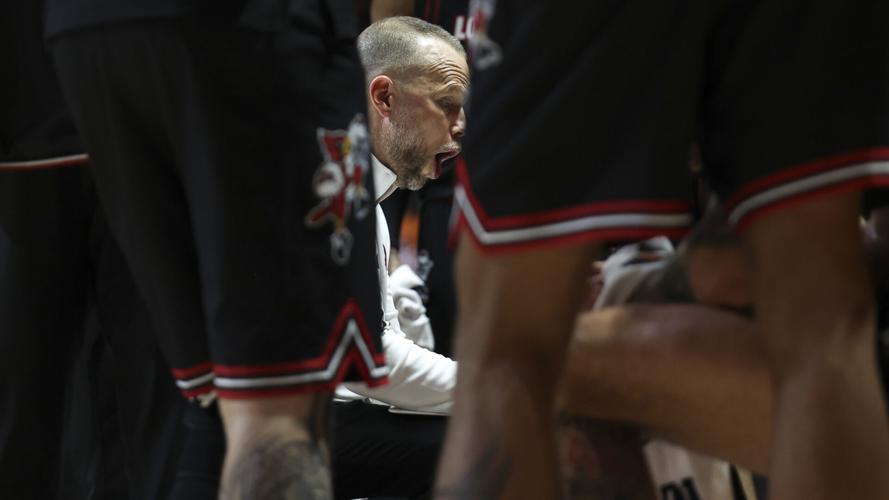

KNOXVILLE, Tenn. (WDRB) -- Pat Kelsey sounded like a guy trying not to sound alarmed Tuesday night. He sounded, in fact, like someone who had seen something he didn't quite trust or wasn't ready to say out loud.
Asked whether Tennessee simply overwhelmed his team physically in an 83-62 victory, Kelsey didn't seem ready to concede the point.
"I don't know about that," he said. "I mean, we were ready for the fight and we've got tough kids. We've got a tough team. You guys have seen us play for a long time. We've got gritty, tough dudes that fight. I don't know. It's hard after the game sometimes without watching the tape."
Watching the tape again — and again — is what coaches do. But there's a good chance Kelsey will see what a lot of us saw the first time or have seen before, when Louisville was matched against a team long and physical enough to take away its preferred offensive options.
Louisville | Kentucky | Indiana | Eric Crawford
This wasn't a one-off. It's a rerun.
Louisville isn't broken. It's not without toughness or grit. But it does have soft spots. And when the game gets ugly — when an opponent muddies the floor, grabs every cutter, rides every screen, and erases clean shots — the Cardinals haven't found many answers.

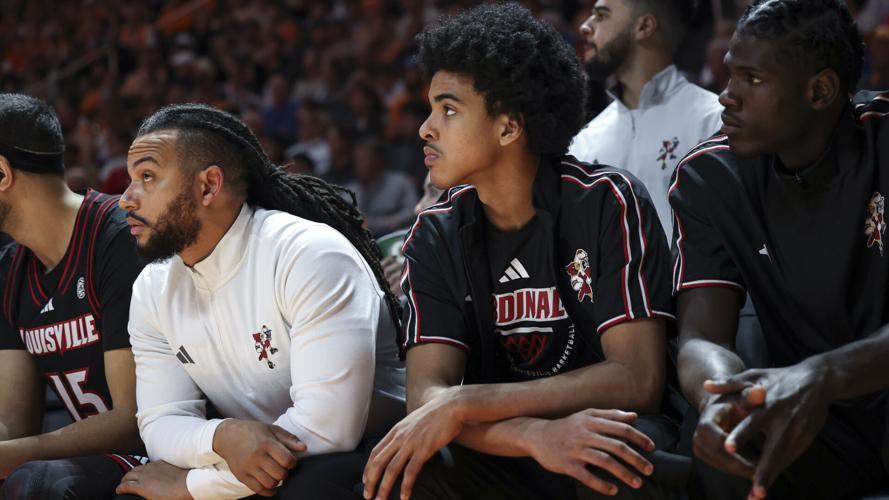
Louisville freshman guard Mikel Brown watches from the bench during Louisville's loss at Tennessee.
They play fast until someone makes them play slow. They shoot well until someone crowds the arc. They move the ball until someone bodies them off their spots. And, once again, against Tennessee — a team built to do all three — Louisville unraveled.
Kelsey looked for bright spots. And this might've been a situation where he didn't feel like letting his own team have it after a tough game from top to bottom.
"They're the No. 1 rebounding team in the country for a reason," he said. "I thought we were getting hurt. And then I thought, if you look for any silver lining in the second half, I felt like our guys did a better job of limiting their second opportunities and second shots, and showed a lot more fight and grit in the second half, you know, but credit them."
Here's the funny thing about limiting second-chance points: It doesn't matter much if they're scoring on the first try. Before missing their last four shots, Tennessee was shooting 70% in the half. The Vols missed only 10 shots after halftime and rebounded six of them.
Tennessee rebounded 10 of its 24 missed shots. It scored on nearly 60% of its possessions. Louisville scored on just 42% and turned it over on nearly a quarter of them. You can do that math. No need to belabor it.
At this point in the season, you're not going to change your team's physical makeup. You're not going to put 20 pounds on anyone or change who your team is too fundamentally. Nor is this about effort, on its own. It's about options.
It's about having somewhere to turn when the game becomes a slugfest.
Louisville shot 38% on Tuesday night. It made just seven of 34 from three. The No. 5 assist team in the country finished with eight. And in the second half, Tennessee scored at a rate of 1.45 points per possession, the kind of efficiency that turns tight games into walkovers.
Yes, Mikel Brown Jr. was missed. He changes the geometry of the court. He can get into the lane against anyone. And his length causes opponents problems on both ends. But his absence didn't create this loss. It exposed the lack of a backup plan when flow breaks down.

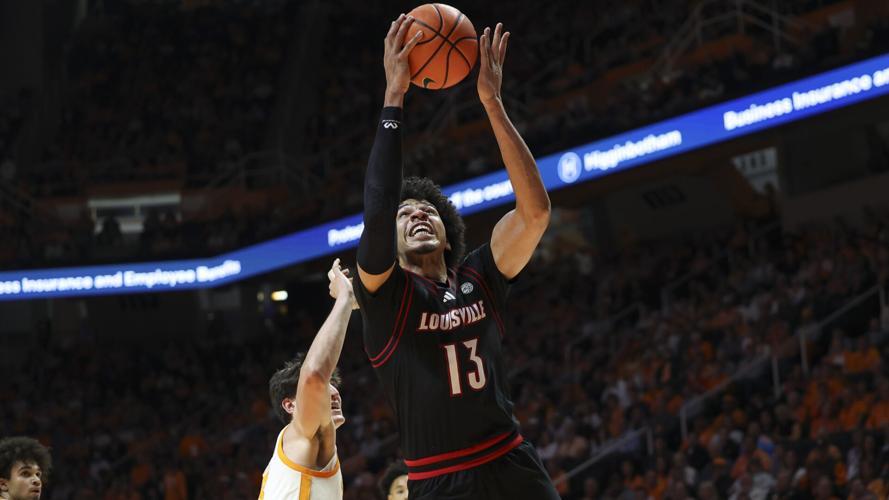
Louisville center Sananda Fru scores in the post during a loss to Tennessee.
Ryan Conwell is capable at point. He scored 22. He led. But Tennessee's defense isn't about taking away one player. It's about shrinking the entire floor. Louisville didn't have an offensive counterpunch once its spacing disappeared.
It's not time to blow up the blueprint. But it may be time to tweak the toolkit.
Kelsey has some time between Saturday's game against Montana and the ACC opener at Cal on Dec. 30 – itself a tough game against a team that is 10-1 to this point with a win over UCLA. Louisville doesn't so much need a new identity as a few contingency plans.
What happens when the offense stalls? Are there more sets to reorient the defense from inside-out to outside-in? Sananda Fru is capable of going to work in the post, especially with so many shooters drawing attention. But Tuesday, he got only three shots.
Could it mean switching defenses more fluidly against longer opponents? Louisville does have some length of its own and will throw full-court pressure or half-court traps at opponents to change up the rhythm. Is the z-word (zone) and option for this group?
A year ago, with J'Vonne Hadley, Terrence Edwards and even Chucky Hepburn, Louisville could invert the floor at times to get those guys scoring opportunities around the rim. Hadley can still do that – and had nine points at Tennessee.
As alarming as any number Tuesday was Tennessee outscoring Louisville 34–3 off the bench. Yes, Wooley's points typically come off the bench. But that total still reflects a lack of scoring production from players Louisville needs: Khani Rooths (0-for-2, no two-point attempts) and Kasean Pryor (0-2, only one two-point try).
Pryor has attempted half his shots from three as a Louisville player, and is shooting 20 percent beyond the arc – though he has been better this season. Rooths, similarly, has taken just under half of his career shots from three-point range, but is shooting just 22.4 percent from outside.
Eric Crawford talk's Tennessee's 83-62 win over Louisville, with some takeaways
Both may be more important to Louisville if they can deliver interior offense, particularly in situations when the outside shot is being taken away.
This isn't theory. It's necessary if Louisville wants to beat teams like Duke or Tennessee (or even Creighton), teams with size and strength that specialize in disruption. Teams you'll meet in March.
Tennessee is elite defensively. That's not in doubt. But the Vols exposed something that's been brewing since Arkansas, and showed up last year against physical high-majors, too.
The tempo team needs to survive when the tempo gets taken away.
There is, too, a notion that the program, now back in the Top 25, is "beyond" being blown out. Nobody is beyond being blown out. Gonzaga has a 40-point loss this year. Purdue lost by 23 -- at home. Alabama, a final four hopeful, lost by 21 to Arizona. It happens.
Kelsey knows all of this. You could hear it between the lines in Knoxville. The tone wasn't panic. But it wasn't comfort, either.
He's built a team with good pieces, particularly in the backcourt. The next step is figuring out how to win when the game turns into a crawl, when the only way out is grit, angles, and execution.
It's not about going back to the drawing board. Just about drawing a few more lines on it.
Copyright 2025 WDRB Media. All Rights Reserved.


