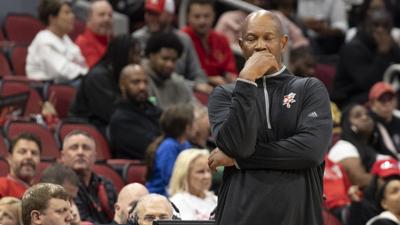

LOUISVILLE, Ky. (WDRB) – This is not exactly breaking news -- but this isn’t working.
Kenny Payne’s second Louisville team, the one that hoped to show progress with an improved eye-test and a new cast of characters, fell 75-68 on Saturday to a DePaul team that was 1-7 on the season and had lost its past five games.
It was a DePaul team that was the second-lowest rated power conference team in college basketball coming into the game in the NCAA’s NET ratings.
Louisville was the lowest. That’s not likely to change. Not after what we saw on Saturday. It was a game between teams from beleaguered programs trying to re-start themselves. One of the teams played as if it saw a chance to accomplish just that against a comparable opponent. The other team was Louisville.
Payne is now 0-13 in road games as Louisville coach, 0-19 in all games outside of Louisville and 8-33 overall. The eight wins have come against WKU, Florida A&M, Georgia Tech, Clemson, UMBC, Coppin State, New Mexico State and Bellarmine.
Like many, I want to see Payne succeed as Louisville coach. But if you can’t win that game against that team, at this point into your second season, it’s tough to see anything resembling useful progress against the conference competition ahead for Louisville in the season to come.
Louisville did not open the game with intensity. At least, it didn’t sound like it. The broadcast on FS1 didn’t join the game until two overtimes from the previous game were complete. And apparently, Fox Sports didn’t have a channel number low enough to boot the game to.
DePaul has historically been a get-well game for Louisville. But now, for a second straight meeting, it’s tough to come away from a Louisville loss to DePaul feeling anything but sick.
“To me, it felt like we played for ourselves and not for each other,” Payne said after the game. “That’s a problem. And nothing against DePaul. They played a really good game. They do what they typically do. And we didn’t handle it.”
Payne is right about a couple of things. First, it is a problem. Second, DePaul was DePaul on Saturday. Nothing more or less. But Louisville was not Louisville. And it hasn’t been for an awfully long time.
When things are really bad – and it’s not just at Louisville, it’s pretty much a universal in sports – coaches and players will start to talk about how great practices have been, or how hard they’re working on certain things. And all of that is important.
But in the end, the guy getting paid the most to get guys to play for each other and to care about the front of the jersey – in games and in practices -- is the guy in Payne’s chair.
Payne was asked what momentum for his team would look like from this point. Here’s what he said.
“Play hard every second that you’re on the floor,” he said. “Play together. Make people walk out of the game and say, ‘Wow, Louisville is connected. They’re not disconnected. They play for each other. They love each other. They fight for each other.’ And that’s hard. It’s the last piece of the puzzle. For me, I know we’re capable of beating anybody we play. But I also know we’re capable of losing to anybody we play. They have to know that as well. And they have to know what makes us good. And play that way.”
I guess, in the end, my problem is that the last piece of Payne’s puzzle actually feels like the first piece of the puzzle. You know, the corner pieces and edge pieces that you lay down first. The playing for each other and all that.
At some point, the answer has to be more than “fight.” I could pull five guys off the intramural court who know precisely what it means to put on the Louisville jersey. Don’t know if that would’ve helped against DePaul on Saturday (though it could have, you never know).
Payne is still talking about checkers. His teams have not progressed to chess. And maybe, given the scars in the program and the instability of the last several years, that’s to be expected.
But in this day and age, and given what this program has experienced over its history – a history, I might add, of which Payne is a proud part – this status quo cannot exist for much longer. It just can’t.
It's worth noting, Hall of Famer Rick Pitino lost back-to-back games to DePaul early in his U of L tenure. He also had been to Final Fours and had coached a national champion. Heck, in March of 2005, he barely squeaked by DePaul in a four-point win. Then went to the Final Four a month later.
There is no such confidence here. There was a modest hope that Payne could have a bit more success early this season and perhaps fan confidence from that into a better season of some kind. But at some point, you have to take advantage of the opportunities to build confidence, and Louisville has not. This game was a step back from a loss a week ago at Virginia Tech, which both were considerably less promising than losses to Texas and Indiana last month.
The ugly details from Saturday. A poor rebounding DePaul team outrebounded Louisville 36-32, a discouraging development even if Louisville was playing without forward JJ Traynor, who suffered an injury in pregame warmups. “He said he couldn’t go,” Payne said afterward.
Chico Carter, a transfer from South Carolina who began his college career at Murray State, finished with 14 points and eight assists (more assists than Louisville’s entire starting backcourt). Jeremiah Oden had a game-high 22 points.
Louisville made a couple of mild threats in the second half, cutting its deficit to single-digits, but DePaul responded each time. Payne, after the game, spent some time trying to make the case that DePaul was much better than its record, and maybe it is. But DePaul really shouldn’t matter in this discussion. Not if Louisville is playing like Louisville.
One of the big problems Louisville basketball has to overcome is instability. And nothing destabilizes the overall picture of a program like jettisoning a coach during the season. Payne took over an unstable program, that is true. And shouldn’t be overlooked. Perhaps, if you’re looking at the program now from the inside, you might think he has brought some stability. That’s possible. But from the outside, that’s not how it looks. And that’s where most of us reside. So that’s the eye test we have to apply.
Losing brings its own kind of instability. And I believe that Payne is a first-rate person, that he cares about his players and is doing what is best personally for every, single one of them. But the reality of the situation is that a coach has to do all those things, and win his share of games.
At some point, the leadership at Louisville is going to have to look at the big picture, look at the home attendance, look at the body language on the court, look at the basketball product and ask whether it is better to continue on its current trajectory or make a change.
It's going to have to do that whether it wants to or not. With each loss of the kind we saw Saturday, half-measures become less effective. My feeling on this season is that we’d have a good idea by New Year’s whether this thing was working out for Payne, and my hope is that it would be.
But hope is not a strategy. And Payne’s chances to build support are crumbling behind him. And though the big ball hasn’t dropped on New Year’s Eve yet, most of us feel as if we can see which direction this thing is heading. It’s the wrong kind of collision course. The only variable is time.
Copyright 2023 WDRB Media. All Rights Reserved.


