
LOUISVILLE, Ky. (WDRB) — The Kentucky Derby didn't begin as the Run for the Roses.
It began, like many great American traditions, as a party that got a little out of hand.
Or, more precisely, as a party where somebody handed out flowers.
Back in 1883, at a fashionable Louisville gathering hosted by New York socialite E. Berry Wall — a man who treated excess not as a vice but as a civic contribution — the ladies were given red roses. Not trophies. Not symbols. Just flowers. Decorative. Disposable. The kind of thing you might tuck behind your ear and forget by morning.
Except they didn't forget.
The roses made an impression, the kind that lingers longer than the bourbon. So much so that Meriwether Lewis Clark Jr., the founder of the Derby and a man with a promoter's instinct for spectacle, saw what happened and did what all good architects of tradition do:
He stole it.
By 1884, the rose was the official flower of the Kentucky Derby. Not because of symbolism. Not because of mythology. Because it looked good and people liked it.
That's how most traditions start — not as meaning, but as mood.
At first, the roses didn't behave like they do now. They wandered.
In 1896, when Ben Brush won the Derby in a stumble-and-surge finish that nearly threw his jockey into history, he was greeted not with the now-famous blanket, but with a collar of white and pink roses tied with ribbon.
Other years, the flowers changed entirely, carnations one year, elaborate arrangements the next, sometimes nothing standardized at all. The Derby was still figuring out what it wanted to be.

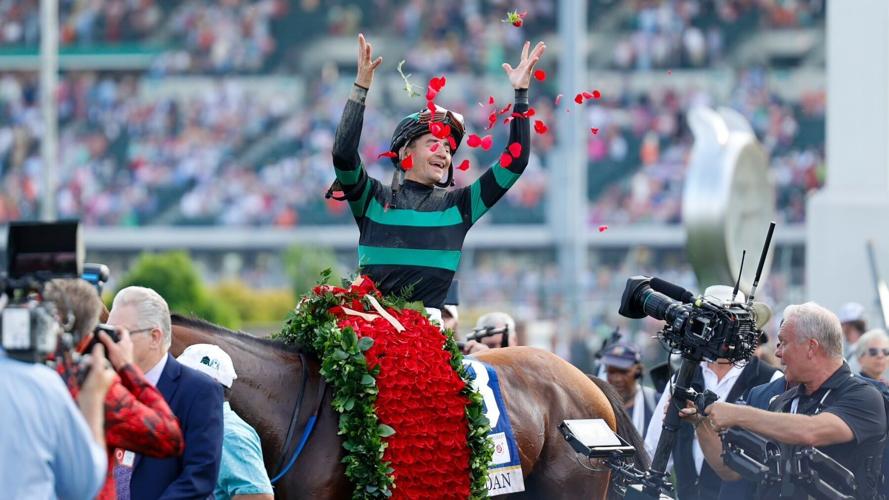
Mystik Dan and jockey Brian Hernandez in the winner's circle after the 150th running of the Kentucky Derby at Churchill Downs in Louisville on Saturday, May 4, 2024. Jockey's today often throw rose petals into the air after the garland is placed.
The roses were, too.
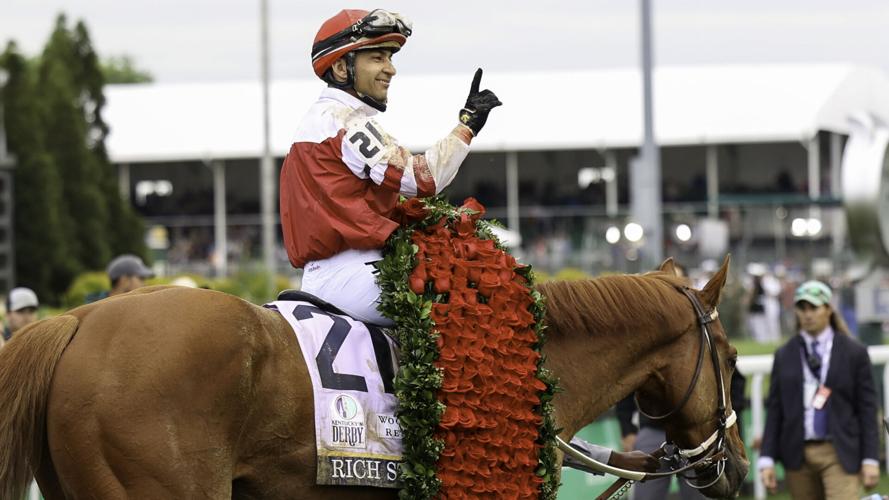
By 1932, a Louisville florist named Grace Walker finally pinned the thing down — literally — stitching more than 500 red roses into a cloth-backed garland and draping it over Burgoo King.
That was the moment the roses stopped being decoration and became identity.
The Derby had found its costume.
But the name — the poetry — came from somewhere else.
From a newspaperman.
In 1925, a New York sports columnist named Bill Corum looked at the cascade of roses and did what great columnists do: He gave the moment a line it didn't know it needed.
"The Run for the Roses."
No committee. No branding exercise. No marketing rollout. Just a phrase that fit so perfectly it refused to leave.
Corum would go on to become president of Churchill Downs, which tells you something about what the right sentence can do to a room.
And now, of course, the roses are no longer wandering.
They are regimented. Measured. Engineered.
More than 400 red "Freedom" roses, each hand-stitched into place, each stem fitted with its own hidden water vial, each bloom chosen for durability and color and the ability to hold up under the weight of everything the moment demands.
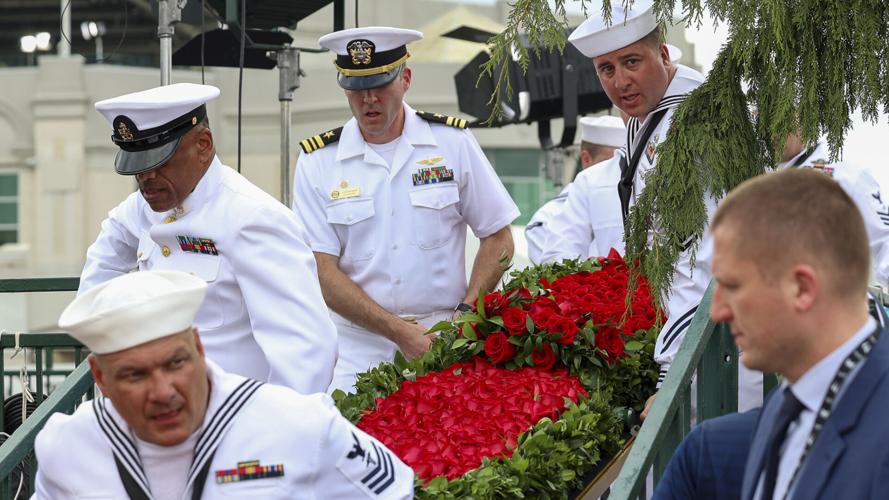
The garland stretches more than two yards. It weighs roughly 40 pounds. It arrives under police escort. It is assembled overnight in front of a crowd like a sacred rite.

U.S. Navy personnel carry the Kentucky Derby garland of roses toward the winner's circle in 2023.
Imagine that. A flower that needs security.
There is even a crown in the center, one rose for each horse, and one more for the idea that getting there cost something.
This is what happens when a party favor becomes a symbol.
And yet, for all that ceremony, the truth remains: The roses are still a little accidental. They are still the result of a moment when someone noticed something beautiful and decided to keep it.
That's the secret of the Kentucky Derby — and maybe of the country that built it. We pretend these traditions were inevitable. That they were always waiting for us, fully formed, like the horse in the gate.
They weren't.
They were chosen.
A flower handed to a woman at a party. A promoter paying attention. A columnist finding the right words.
Then, suddenly, a ritual.
And at the Kentucky Derby, rituals make the race.
Copyright 2026 WDRB Media. All Rights Reserved.


