

LOUISVILLE, Ky. (WDRB) -- The biggest issues facing college football all circle back to one thing.
“Right now, there is nobody — without a conflict of interest in the NCAA — who’s looking out for these young men’s rights in particular,” said Alicia Jessop, a law professor at Pepperdine University.
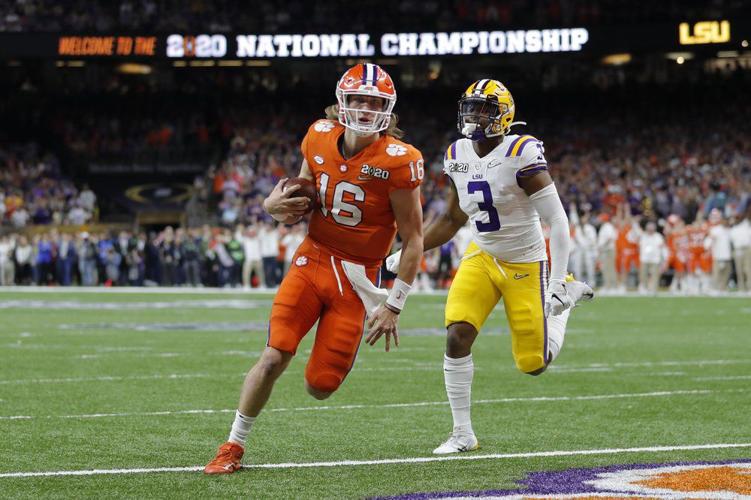
Clemson quarterback Trevor Lawrence tweeted out his solution: a players’ union, one of the most powerful tools for professional athletes in every major sports league that hasn’t made its way to college sports.
“The NCAA has a lot of rules, right?” said Ariana Levinson, a law professor at the University of Louisville.. “How (athletes) can be compensated, whether their likeness can be licensed — all of these rules look like the type of control employers have over employees.”
There are several routes college football players can take to form a union.
The simplest would be for the NCAA to voluntarily allow players to unionize. That would require players in favor to sign union-authorization cards as a sort of petition.
“(The NCAA and players) agree on a neutral person who will look at all the cards to determine whether actually 51% of the people signed the cards or not,“ Levinson said.
It's not likely that the NCAA, or its member institutions, will make it that easy.
“Employers disfavor unions because it slows down business, and it tends to drive up the cost of doing business,” Jessop said.
The second route is more complicated and involves an administrative agency known as the National Labor Relations Board.
Players would begin by filing a petition at the regional level. In it, they’d have to argue two things:
1. Players are employees.
“There have been times in the past that legal entities have deemed college athletes employees,” Jessop said. ”A great example would be in 2014 with the Northwestern football players on scholarship petitioned to unionize. We do have some precedent that that could happen, but it’s not guaranteed. It’s not certain.”
2. Players are working for a private employer.
“You have to be an employee of a private sector employer,” Jessop said. “Northwestern University was a private university, thus a private sector employer. A lot of member institutions in the NCAA are public schools, not private sector employers. “
This is why players would have to use what’s called a Joint Employer Argument.
“Joint employer argument says my employer is not only the University of Louisville, but it’s our conference, and it is also the NCAA, the conferences and NCAA being private sector employers,” Jessop said.
If the regional board rules in favor of players, then the petition goes to the NLRB in Washington. If the players do not like the board’s decision, they could appeal to the federal courts.
It’s a long and exhausting process that would surpass Lawrence’s time at the college level.
“You have to have the people who are currently playing, who are currently subject to the control of the school and by the NCAA,” Levinson said.
Other options include forming a co-operative or trade association. Neither provide the full protections of a union but are an easier path to some sort of athlete advocacy.
Whatever the players choose, the time to act is now.
“It’s very rare that there’s one singular issue that is ever uniting every college football player, even on the issue of compensation,” Jessop said. “You see, over time, vastly different opinions from college football players themselves on the issue of compensation beyond a scholarship. The reason why this is the time is the coronavirus is the uniting issue.”
“I think its important to not think of the athletes as somebody separate but kind of our whole country, where there’s a lot of people concerned about their working conditions and a lot of people taking more collective action,” Levinson said.
Copyright 2020 WDRB Media. All Rights Reserved.


