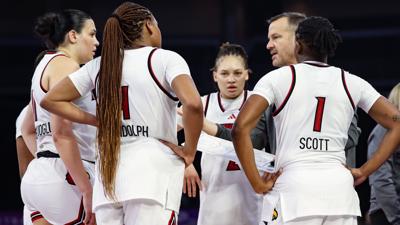

LOUISVILLE, Ky. (WDRB) — Louisville's women's basketball season ended Saturday with a clear sense of the difference between arrival and advancement.
They walked out of Fort Worth with a clearer understanding not of what they were this season, but of what it takes to stay here — to turn arrival into something more permanent.
Louisville's 71-52 loss to Michigan in the Sweet 16 was not complicated. It was, as Jeff Walz said, their worst performance of the year, delivered on the sport's biggest stage.
They missed open shots. They lost 50-50 balls. They grew passive against pressure. They missed free throws. And in March, those things don't linger quietly. They decide everything.
"You've got to win the 50-50 balls," Walz said. "At this time of year, you have to."
Louisville | Kentucky | Indiana | Eric Crawford
That was the requirement. But it wasn't the only one.
Because what Louisville built this season — and what it carried into Fort Worth — was something real, and something a little uncommon in a sport increasingly shaped by star power and roster churn.
This was a team without a singular center of gravity. No one player to build a broadcast around, no obvious headline name. Just five players on the floor who could score, pass, and shoot, and a roster that learned, over time, to lean into that.
"We always have five people on the court that can score," forward Laura Ziegler said. "I would hate to scout us."
It showed up in the numbers: six different players with 20-point games over the course of the season. It showed up in the way they played, the willingness to move the ball, to find the matchup, to let the game decide whose night it would be.
"If I don't have it going," guard Tajianna Roberts said, "my job is to get it to somebody who does."
It's also why the ending lands the way it does.
Because what Michigan exposed wasn't a flaw in the idea. It was the distance between understanding it and executing it when everything tightens.
There were moments early — a first quarter where Louisville defended with energy and found good shots — when the game looked like it might bend their way. Walz thought it should have been 20-9 instead of 15-9.
But shots didn't fall. And when they didn't, something else slipped.
"Instead of attacking," Walz said, "we pulled it out and tried to run offense."
That's the part this time of year exposes. Not just whether you can play your game, but whether you can hold onto it when it starts to fray.
Roberts, Mackenly Randolph, and Imari Berry reached the NCAA's second weekend for the first time. They felt, probably for the first time, how thin the margin is between playing well and playing well enough — how quickly a good possession can turn into a lost one, how a missed free throw carries into the next trip, how a game can tilt without ever quite breaking.
"You've got to stay present and trust the work," Roberts said. "And focus on what you can control."
That sounds like something learned over time. On Saturday, it was something learned in real time.
And that's where this season begins to look less like an ending and more like a beginning.
Because the most significant thing Walz said after the game wasn't about the shots Louisville missed or the rebounds it didn't get.
It was this:
"They've all signed to come back."
In a sport now defined by movement, that matters. Continuity is no longer assumed. It's chosen. And Louisville's young core — Roberts, Randolph, Berry, and a group behind them, including center Grace Mbugua — is choosing it.
What they do with that choice is the next question.
Walz pointed to Elif Istanbulluoglu as the example. A year ago, she was still finding her place. This year, she was Louisville's best player on the floor in its biggest game: 8-for-12 shooting, seven rebounds, and a presence that held even when everything else wavered.
"If one or two of you make the jump she made," Walz said, "we're going to be in business."
That's the path forward. Not reinvention. Not rescue. Growth.
Randolph put it more simply.
"This is going to be fuel," she said.
It should be.
Because Louisville didn't stumble into this season. It built something — a style, a trust, a way of playing that carried it through the ACC and into the second weekend of the NCAA Tournament.
What it found here was the next layer. The part that doesn't show up until the games are tighter, the possessions heavier, the mistakes more expensive.
They didn't solve that on Saturday.
But they saw it clearly. For a young team, that may be the most important experience of all.
Copyright 2026 WDRB Media. All Rights Reserved.


