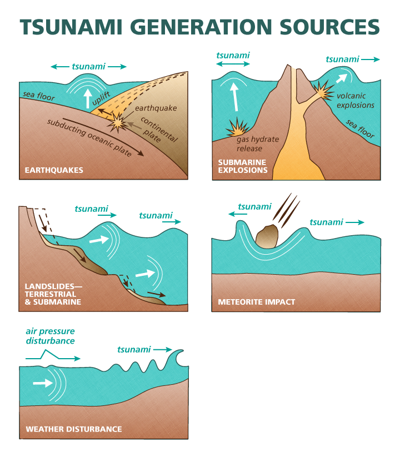

A tsunami is a series of waves generated by a large and sudden displacement of the ocean. Large earthquakes below or near the ocean floor are the most common cause, but landslides, volcanic activity, certain types of weather and meteorites can also cause tsunamis.
Tsunamis radiate outward in all directions from their source and can move across entire ocean basins, around islands and into bays, sounds and up rivers. When they reach the coast, they can cause dangerous coastal flooding and powerful currents that impact marine operation and navigation, and can last for several hours or days.

Tsunami generation sources. (Image credit: NOAA)
Tsunamis are infrequent but can pose a serious threat to life and property when they occur. Tsunamis have claimed hundreds of thousands of lives and caused hundreds of billions of dollars in damage around the world.
In deep ocean water, tsunami waves may go unnoticed. But as the waves travel closer to the shore, they build in height as the water becomes more shallow. The speed of tsunami waves depends on ocean depth: The deeper the water, the faster the wave travels. Tsunami waves may travel as fast as jet planes through deep waters, only slowing down when reaching shallow waters. While tsunamis are often referred to as tidal waves, this name is discouraged by oceanographers because tides have little to do with these destructive waves — though a tsunami at high tide may cause more damage and flooding.
What causes a tsunami?
About 80% of all known tsunamis are triggered by earthquakes. These seismic events move Earth's surface, displacing the water above and generating waves that rapidly travel in all directions across the ocean or body of water.
Not all earthquakes create tsunamis. An earthquake must be big enough and close enough to the ocean floor to cause the vertical movement of the ocean floor that typically sets a tsunami in motion. As the ocean floor rises or drops, so does the water above it. As the water moves up and down, seeking to regain its balance, the tsunami radiates in all directions. The amount of movement of the ocean floor, the size of the area over which it occurs (which may be reflected in how long the earthquake lasts) and the depth of the water at its source are all critical factors in the size of a resulting tsunami. Earthquakes can also cause landslides that generate tsunamis.
How landslides generate tsunamis
Tsunamis can be generated when a landslide enters the water and displaces it from above (subaerial) or when water is displaced ahead of and behind an underwater (submarine) landslide. Tsunami generation depends on the amount of landslide material that displaces the water, the speed it is moving and the depth it moves to. Landslide-generated tsunamis may be larger than seismic tsunamis near their source and can impact coastlines within minutes with little to no warning, but they usually lose energy quickly and rarely affect distant coastlines.
Most landslides that generate tsunamis are caused by earthquakes, but other forces (like gravity, wind and increased precipitation) can cause overly steep and otherwise unstable slopes to suddenly fail. Earthquakes that are not large enough to directly generate a tsunami may be large enough to cause a landslide, which can in turn generate a tsunami. A landslide-generated tsunami may occur independently or along with a tsunami directly generated by an earthquake, which can complicate the warning process and compound the losses.
What is a meteotsunami?
Large storms over the ocean or large water bodies can cause meteotsunamis, which, like tsunamis, can also be destructive.
Meteotsunamis are driven by air-pressure disturbances often associated with fast-moving weather events, such as severe thunderstorms, squalls and other storm fronts. The storm generates a wave that moves towards the shore, and is amplified by a shallow continental shelf and inlet, bay or other coastal feature.
Meteotsunamis have been observed to reach heights of 6 feet (1.82 meters) or more. They occur in many places around the world, including the Great Lakes, Gulf of Mexico, Atlantic Coast and the Mediterranean and Adriatic Seas.
Identifying a meteotsunami is a challenge because its characteristics are almost indistinguishable from a seismic tsunami. Meteotsunamis can also be confused with wind-driven storm surge or a seiche. These uncertainties make it difficult to predict a meteotsunami and warn the public of a potential event. However, NOAA scientists have identified atmospheric conditions that are likely to generate meteotsunamis and continue to research them.
Where do tsunamis occur?
Although tsunamis occur relatively infrequently, they can be a serious threat to life and property. Tsunamis have claimed hundreds of thousands of lives and caused hundreds of billions of dollars in damage around the world.
A tsunami can strike any coast (ocean, lake or even river) at any time. There is no season for tsunamis. This is quite evident when we look at records of past tsunamis. Tsunamis typically happen where there are large faults that can generate large earthquakes. Most of these large faults are around the Pacific Ring of Fire. However, any active fault that crosses water may be capable of generating a tsunami. As mentioned above, other causes of tsunamis include landslides and volcanic eruptions which can happen far away from any ocean coastline.
Tsunamis are sometimes referred to as "tidal waves," but this is very misleading as they are not related to tides.