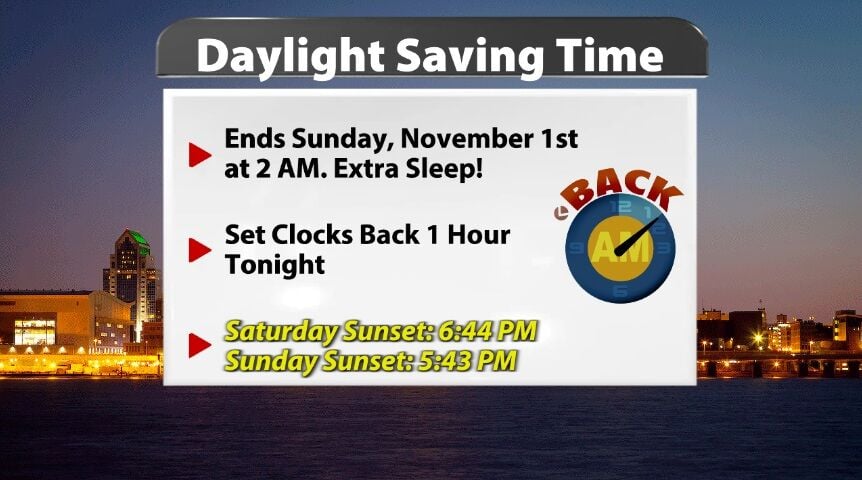
It's time to change your clocks - Daylight Saving Time is ending. This is the time change where you get an extra hour of sleep - YAY! Use this reminder to change the batteries in your smoke detector, carbon monoxide monitor, and weather radio as you set your analog clocks back an hour tonight.
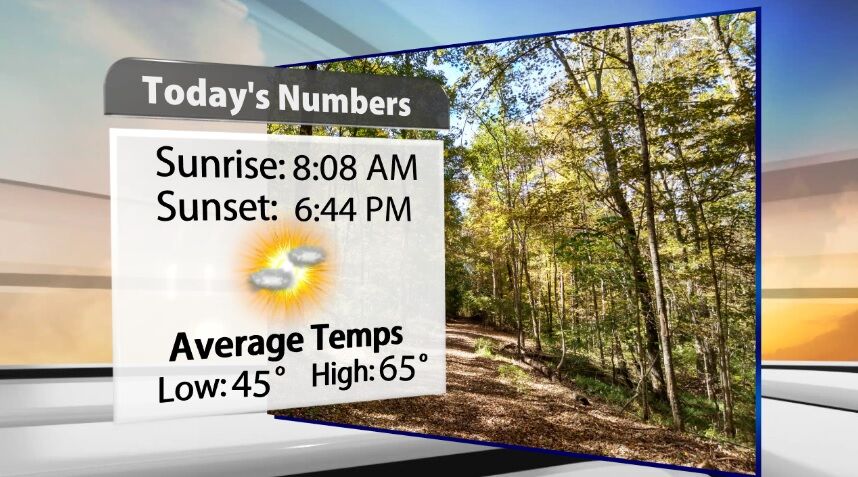
On Saturday official sunrise time was 8:08 AM in Louisville and sunset was 6:44 PM. On Sunday the sun will rise at 7:10 AM and set at 5:43 PM.
So WHY do we fall back?
The idea of daylight saving time was first conceived by Benjamin Franklin in 1784 during his stay in Paris. He published an essay that proposed to economize the use of candles by rising earlier to make use of the morning sunlight. The basic idea is to make the best use of daylight hours by shifting the clock forward in the Spring and backward in the Fall to save energy and electricity usage by extending daylight hours. However, it wasn't put into effect until WWI. The Standard Time Act was established in 1918, but was repealed a year later. During World War I much of the United States, Canada and Euorpe observed DLS, but individual states could exempt themselves.
By resetting all clocks one hour ahead of Standard Time, individuals who follow a year-round schedule will effectively wake an hour earlier than they would have otherwise; they will begin and complete daily work routines an hour earlier, and they will experience an extra hour of daylight following their workday activities during the evening hours.
A Brief History of Daylight Saving Time
In 1966, President Lyndon Johnson signed an The Uniform Time Act into law whereby Daylight Saving Time begins on the last Sunday of April and ends on the last Sunday of October each year. However, any State can opt out of Daylight Saving Time by passing a State law. Hawaii does not observe Daylight Saving Time and neither does much of Arizona (although the Navajo Nation, in northeastern Arizona, does). For many years, most of Indiana did not observe Daylight Saving Time with the exception of 10 counties. Beginning in 2006, all of Indiana now observes Daylight Saving Time. However, the state remains divided in two time zones. Seventy-four counties (including state capital Indianapolis) are in the Eastern Time Zone. The 18 remaining counties are in the Central Time Zone. American Samoa, Guam, Puerto Rico, and the U.S. Virgin Islands also do not observe Daylight Saving Time.
In 1986, US Federal law was amended to begin Daylight Saving Time on the first Sunday in April and end on the last Sunday of October. In 2005, President Bush signed into law a new energy policy bill that would extend Daylight Saving Time by 4 weeks beginning in 2007. Now DST begins on the second Sunday of March and ends the first Sunday of November.
The corresponding time zones in Canada also switch to Daylight Saving Time on the same dates. However, some regions of in British Columbia and Saskatchewan do not use Daylight Saving Time. They include: Charlie Lake, Creston (East Kootenays), Dawson Creek, Fort St. John, and Taylor (all in British Columbia), and most of Saskatchewan (except Creighton and Denare Beach). In Europe, Daylight Saving Time is referred to as Summer Time. About 70 countries world wide adjust their clocks for DLS. *Notice: it is "Daylight Saving Time" not "Daylight Savings Time."
So . . . Does it work?
Technically, there is no way to save daylight, but by taking advantage of the daylight that is available each day you can save energy by not having to use as much artificial light and thus it saves money. This is the main rationale for the change in time. By every individual using one hour less of artificial light during DST, a period of more than 200 days, it equates to an enormous amount of savings as a nation.
However. . . The idea of Daylight Saving is not without debate
Opponents argue that actual energy savings are inconclusive, that DST can disrupt morning activities, and that the act of changing clocks twice a year is economically, socially and even physically disruptive and cancels out any benefit. Groups that have tended to oppose DST are farmers, transportation companies, and the indoor (or darkness reliant) entertainment business.
DST is not observed during late fall and winter, because the mornings are darker; workers may have no sunlit leisure time and children may need to leave for school in the dark. According to a poll last year by The Associated Press-NORC Center for Public Affairs Research, 7 in 10 Americans preferred not to switch back and forth, but there was no agreement on which time clocks ought to follow. A bill was prefilled in July 2019 in the Kentucky General Assembly proposing to not change the clocks anymore, but no action was ever taken on it.
Daylight saving time returns at 2 a.m. local time on Sunday, March 14.