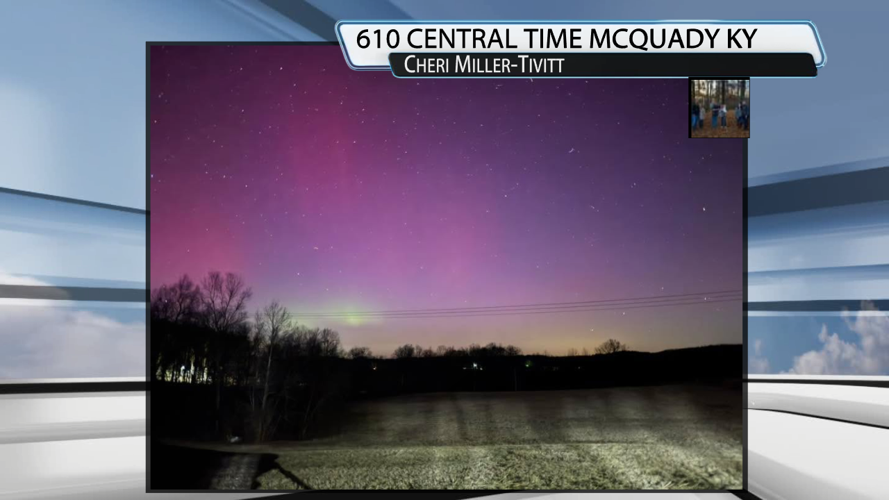
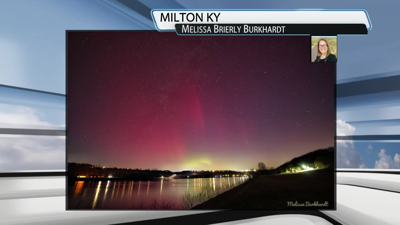

A handful of people in the northern part of our area saw the auroras just after 7 PM Monday, January 19th. The Kp index spiked to 8.67 so after the news I jumped in the car with Marc Weinberg to take a look. We drove about 30 minutes outside Louisville, let our eyes adjust to the dark, then used our phones in night mode hoping to catch some color. Long story short, we froze and saw nothing. What a bummer! Anyways, we got a lot of questions about why we've had so many sightings the last couple of years and it has to do with the solar cycle being at the solar maximum. We are transitioning from the peak into the declining phase, meaning fewer sunspots but still potential for strong flares and coronal mass ejections.

What is a solar cycle?
Our Sun is a huge ball of electrically-charged hot gas. This charged gas moves, generating a powerful magnetic field. The Sun's magnetic field goes through a cycle, called the solar cycle.
Every 11 years or so, the Sun's magnetic field completely flips. This means that the Sun's north and south poles switch places. Then it takes about another 11 years for the Sun’s north and south poles to flip back again.
The solar cycle affects activity on the surface of the Sun, such as sunspots which are caused by the Sun's magnetic fields. As the magnetic fields change, so does the amount of activity on the Sun's surface.
One way to track the solar cycle is by counting the number of sunspots. The beginning of a solar cycle is a solar minimum, or when the Sun has the least sunspots. Over time, solar activity—and the number of sunspots—increases.
The middle of the solar cycle is the solar maximum, or when the Sun has the most sunspots. As the cycle ends, it fades back to the solar minimum and then a new cycle begins.
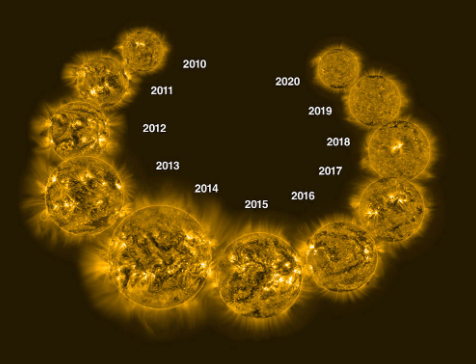
Evolution of the Sun in extreme ultraviolet light from 2010 through 2020, as seen from the telescope aboard Europe's PROBA2 spacecraft. Credit: Dan Seaton/European Space Agency (Collage by NOAA/JPL-Caltech)
Giant eruptions on the Sun, such as solar flares and coronal mass ejections, also increase during the solar cycle. These eruptions send powerful bursts of energy and material into space.
This activity can have effects on Earth. For example, eruptions can cause lights in the sky, called aurora, or impact radio communications. Extreme eruptions can even affect electricity grids on Earth.
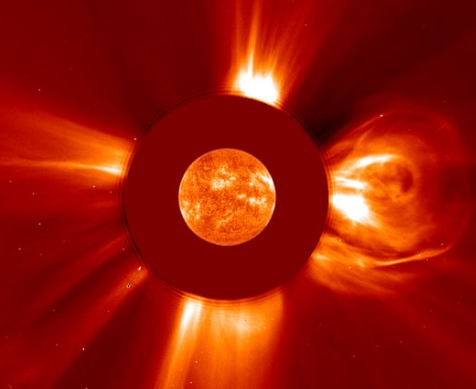
An image of a coronal mass ejection observed by NASA’s Solar and Heliospheric Observatory, or SOHO, satellite in 2001. Credit: ESA/NASA/SOHO
Some cycles have maximums with lots of sunspots and activity. Other cycles can have very few sunspots and little activity. Scientists work hard to improve our ability to predict the strength and duration of solar cycles. These predictions can help them forecast these solar conditions, called space weather.
Forecasting of the solar cycle can help scientists protect our radio communications on Earth, and help keep NASA satellites and astronauts safe, too.
Solar activity can affect satellite electronics and limit their lifetime. Radiation can be dangerous for astronauts who do work on the outside of the International Space Station. If scientists predict an active time in the solar cycle, satellites can be put into safe mode and astronauts can delay their spacewalks.


