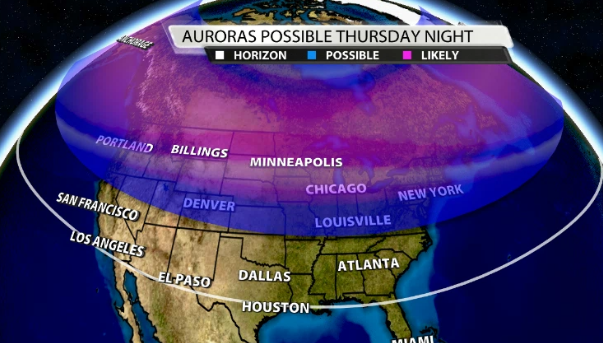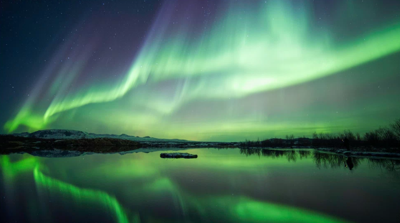

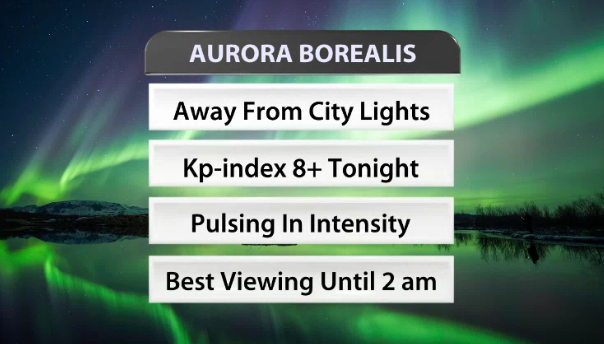
You might be able to check off a bucket list item with auroras being visible in our area tonight! These arcs or ribbons of light begin to twist and sway, just as if a breeze were blowing on curtains. At some point, the arcs may expand to fill the whole sky, moving rapidly and becoming very bright. These pulses of intensity mean you need to be very patient. We are expecting a G4 storm for northern lights. It could possibly get up to G5 levels, which would rival the magnificent display we saw back in May. The best way to see the northern lights will be with a long-exposure camera, but view to the naked eye is certainly possible! I would dedicate a minimum of one hour. It usually takes 30 minutes for your eyes to adjust and then you may have to wait for the flashes of green and pink! The most important thing is to get away from city lights and do so after sunset, but well before 2 am because after that the Kp-index will drop. It's at an 8+ tonight which gives us a really good chance!
The Aurora Borealis, also known as the Northern Lights, are the result of electrons colliding with the upper reaches of Earth’s atmosphere. The electrons are energized through acceleration processes in the downwind tail of the magnetosphere and at lower altitudes along auroral field lines. The accelerated electrons follow the magnetic field of Earth down to the Polar Regions where they collide with oxygen and nitrogen atoms and molecules in Earth’s upper atmosphere. In these collisions, the electrons transfer their energy to the atmosphere thus exciting the atoms and molecules to higher energy states. When they relax back down to lower energy states, they release their energy in the form of light. This is similar to how a neon light works. During major geomagnetic storms these ovals expand away from the poles such that aurora can be seen over most of the United States. Good luck!