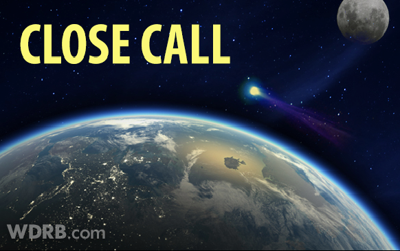
On Sunday an asteroid made the closest known pass by Earth without making impact with the planet! No asteroid has ever been detected flying this close to Earth. 2020 QG is the asteroid, and it passed by our planet about 1830 miles above the southern Indian Ocean Sunday morning, August 16. 2020 QG is 10-20 feet across, or about the length of a truck or SUV. Because of the orientation between the Earth, this asteroid, and the sun, it wasn't detected until after it passed by Earth. Unless the sun helps illuminate these asteroids, it's nearly impossible to see something the size of an SUV that's nearly 2000 miles away. NASA put together this animation so you can see how close it came to the Earth!

Image credit: NASA/JPL-Caltech
2020 QG is small enough that if it had come toward Earth, it would have burned up in the atmosphere before being able to make contact with the surface of the planet. If you think you're hearing more about these "close calls" lately, you're not wrong. Congress tasked NASA in 2005 with finding 90% of these near-Earth asteroids that are 460 feet or larger. NASA is detecting more of these, and we have access to a constant stream of information on the internet and social media, so you are hearing about more of these close calls. That doesn't necessarily mean there are more close calls happening than there were 50 years ago. We're just seeing them now instead of being blissfully ignorant. You will probably see some headlines in the coming months about another asteroid that's headed for Earth right around the time of the November election. It's called Asteroid 2018VP1, and here's what NASA has to say about it:
Asteroid 2018VP1 is very small, approx. 6.5 feet, and poses no threat to Earth! It currently has a 0.41% chance of entering our planet’s atmosphere, but if it did, it would disintegrate due to its extremely small size.
— NASA Asteroid Watch (@AsteroidWatch) August 23, 2020
When you see those headlines in the next few days, just remember how small this asteroid is. IF it makes it into our atmosphere it will break apart/burn up high up like so much space debris does that enters our atmosphere.


