



A collage of weather systems including thunderstorms, rain, heat waves, and fair weather. (Image credit: iStock)
NOAA has launched a groundbreaking new suite of operational, artificial intelligence (AI)-driven global weather prediction models, marking a significant advancement in forecast speed, efficiency, and accuracy. The models will provide forecasters with faster delivery of more accurate guidance, while using a fraction of computational resources.
“NOAA’s strategic application of AI is a significant leap forward in American weather model innovation,” said Neil Jacobs, Ph.D., NOAA administrator. “These AI models reflect a new paradigm for NOAA in providing improved accuracy for large-scale weather and tropical tracks, and faster delivery of forecast products to meteorologists and the public at a lower cost through drastically reduced computational expenses.”
The new suite of AI weather models includes three distinct applications:
- AIGFS (Artificial Intelligence Global Forecast System): A weather forecast model that implements AI to deliver improved weather forecasts more quickly and efficiently (using up to 99.7% less computing resources) than its traditional counterpart.
- AIGEFS (Artificial Intelligence Global Ensemble Forecast System): An AI-based ensemble system that provides a range of probable forecast outcomes to meteorologists and decision-makers. Early results show improved performance over the traditional GEFS, extending forecast skill by an additional 18 to 24 hours.
- HGEFS (Hybrid-GEFS): A pioneering, hybrid "grand ensemble" that combines the new AI-based AIGEFS (above) with NOAA’s flagship ensemble model, the Global Ensemble Forecast System. Initial testing shows that this model, a first-of-its kind approach for an operational weather center, consistently outperforms both the AI-only and physics-only ensemble systems.
More about the new AI operational models
AIGFS — a new AI-based system that uses a variety of data sources to generate weather forecasts comparable to those produced by traditional weather prediction systems, such as GFS.
- Performance: shows improved forecast skill over the traditional GFS for many large-scale features. Notably, it demonstrates a significant reduction in tropical cyclone track errors at longer lead times.
- Efficiency: AIGFS’s most transformative feature. A single 16-day forecast uses only 0.3% of the computing resources of the operational GFS and finishes in approximately 40 minutes. This reduced latency means forecasters get critical data more quickly than they do from the traditional GFS.
Area for future improvement: Though track forecasts are better, v1.0 shows a degradation in tropical cyclone intensity forecasts, which future versions will address.
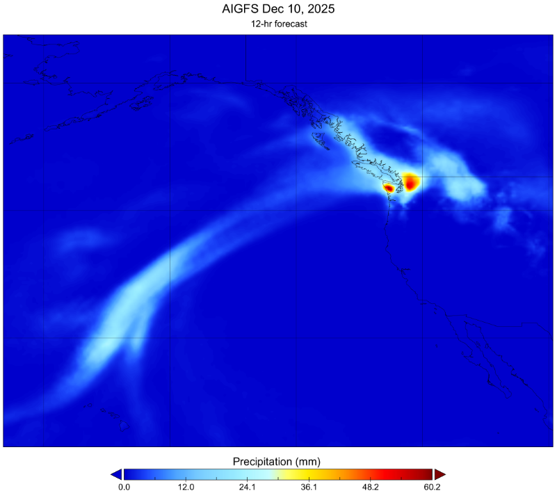
- This AIGFS forecast in the form of a map, for December 10, 2025, shows the heavy precipitation from an atmospheric river hitting the U.S. Pacific Northwest. AI weather models like this one will protect life and property by improving forecast accuracy and timeliness for events such as the catastrophic flooding that impacted the Northwest. (Image credit: NOAA National Weather Service)