The city of Phoenix, Arizona, is covering some of their roads with gray sealant to study whether it helps mitigate their urban heat island effect. This actually started with a pilot program a year ago, and in a meeting last month, the results from that first year were shared. Arizona State University is partnering with the city of Phoenix to study what's happening in the Cool Pavement Pilot Program.
The most significant finding: "Cool pavement had an average surface temperature 10.5 to 12 degrees Fahrenheit lower than traditional asphalt at noon and during the afternoon hours. Surface temperatures at sunrise averaged 2.4 degrees Fahrenheit lower." That's a huge difference! In the middle of the afternoon, the gray pavement is reflecting so much sunlight that the pavement itself is 10.5-12ºF cooler than normal black asphalt.
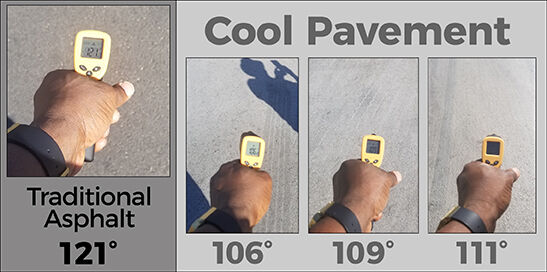
Cool Pavement Image Showing Traditional Asphalt side by side. Image Credit: City of Phoenix
What's causing the drop? Lighter colors reflect more sunlight while darker colors absorb it. Think about a snow-covered field - it reflects most of the incoming sunlight and solar radiation back into the air (you need your sunglasses). But dark colors (like black asphalt) absorb most of the light and solar radiation which makes it warm up faster. Then at night that heat in the pavement is released back out into the air keeping temperatures higher in the city at night than in surrounding communities. Even at sunrise after that full heat transfer has happened, the cool pavement was still 2.4ºF lower than the black asphalt.
Cool pavement is different than black asphalt because it's actually a treatment that goes on top of existing pavement. Instead of regularly applying sealant, Phoenix is applying this cool pavement treatment to one area in each of their city's districts. Cool pavement "is made with asphalt, water, an emulsifying agent (soap), mineral fillers, polymers and recycled materials. It contains no harmful chemicals and is compatible with traditional asphalt." "While the cool pavement material is more costly than the seal coating materials we usually use, results from other cities suggest the material is effective and longer lasting than traditional asphalt seal coats." The City of Phoenix says they participated in a workshop with the city of Los Angeles which "has been using cool pavement on neighborhood streets and has reported positive results in reducing roadway surface temperatures."

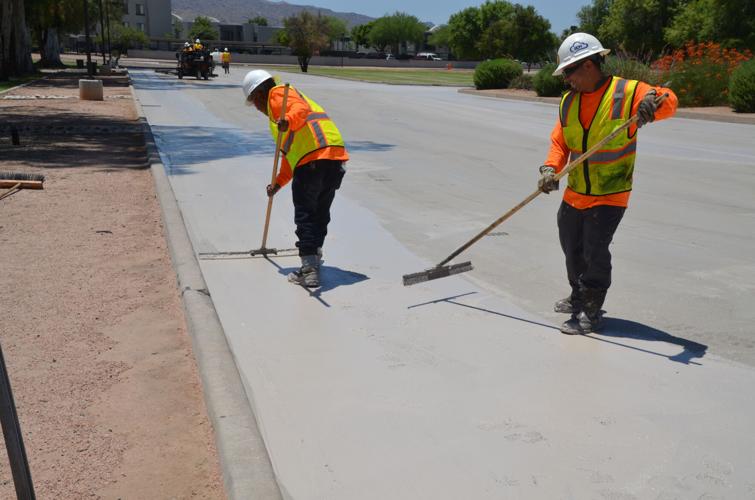
Cool Pavement Application. Image Credit: City of Phoenix
In studying the full impact of this sealant, ASU looked at more than just temperature differences between asphalt and the gray pavement. They took into account whether this changed how much heat a person would feel from the pavement when walking on or near it. They also looked at temperatures under the surface and six feet in the air. Tests were done to evaluate friction and skidding and to see if this extra reflectivity caused any visibility problems for drivers. The city of Phoenix says, "it meets or exceeds all skid safety requirements," and "staff found no safety concerns for people walking, driving or bicycling on streets coated with cool pavement," but they want to do more skid testing in the future. They add the cool pavement does not create a glare for drivers, walkers, or bicyclists, but we are curious if it would have any effect on air traffic.
Cautious optimism may be a good way to describe these results. ASU and Phoenix specifically mention the harsh environmental conditions in and around this city. Desert sand, monsoon rain, sunshine, high temperatures, and strong wind may wear down the cool pavement faster in Phoenix than in other cities which is why this study remains ongoing. It will be interesting to watch for more results because Louisville also deals with a significant urban heat island.