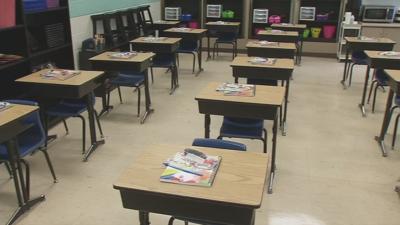
LOUISVILLE, Ky. (WDRB) – Attorney General Daniel Cameron and Danville Christian Academy have urged the U.S. Supreme Court to overturn a federal appeals court’s decision allowing Gov. Andy Beshear’s restrictions against in-person learning at religious schools to continue.
Attorneys for Cameron and the school, who requested the high court’s review, argued in a Tuesday filing that Beshear’s executive order closing K-12 classrooms throughout Kentucky in hopes of limiting the spread of COVID-19 should not apply to religious schools because of constitutional protections for religious exercise, which swayed U.S. District Judge Gregory Van Tatenhove to exclude such institutions from the governor’s mandate.
They also questioned the logic of Beshear’s Nov. 18 executive order to force schools into remote learning, claiming he has not offered data to show that K-12 schools prompt COVID-19 spread.
“If the locations ‘most associated’ with the risk of spread are indoor gatherings lasting longer than 15 minutes, then countless activities and businesses fall under that umbrella,” the attorneys wrote. “This would be especially true with respect to preschools and daycares, where children are in session for as long as, if not longer, than students at K-12 schools.”
“If daycares and preschools are relatively safe because the Governor has imposed maximum group sizes and limits on mixing classes, why can he not do the same for religious schools?” they wrote. “That, in fact, is all Danville Christian and the other religious schools in Kentucky are seeking.”
Beshear said Monday that he ultimately decided to close schools to in-person instruction because of high COVID-19 incidence rates and escalating testing positivity rates throughout Kentucky.
All but four of the state’s 120 counties are in the highest category of COVID-19 transmission as of Tuesday, according to Kentucky’s color-coded incidence rate map.
“It is unquestionably true that each of these categories of activity presents some public health risk, but the Governor and his expert advisors have concluded that each presents materially less risk than in-person K-12 schooling over the next five weeks,” Beshear’s attorneys wrote in their Friday filing, referring to questions raised by Cameron and Danville Christian Academy about shuttering school buildings and keeping other entities open.
Cameron and Danville Christian Academy also claimed Tuesday that the Sixth Circuit Court of Appeals erred in its decision to overturn the lower court’s ruling, including references from a recent Supreme Court opinion that struck down COVID-19 restrictions on religious services in New York.
That 5-4 ruling was the first rendered by the high court involving COVID-19 restrictions on religious services in its new makeup following the death of Justice Ruth Bader Ginsberg and confirmation of Justice Amy Coney Barrett. The U.S. Supreme Court had previously upheld coronavirus protocols involving religious institutions in California and Nevada.
“The court ignored the many indoor activities that are free to continue in Kentucky while religious schools are closed,” attorneys for Cameron and Danville Christian Academy wrote.
Attorneys for Beshear, whose broad executive authority during public health emergencies was affirmed by the Kentucky Supreme Court in November, have said in their filing before the U.S. Supreme Court that the governor’s “facially neutral” executive order did not discriminate against religious schools.
They’ve also noted that Beshear’s executive order is set to expire for schools on Jan. 4, when classroom instruction for middle and high schools can resume. Some elementary schools resumed in-person learning on Monday since their counties were not in the state’s “red zone” for COVID-19 transmission.
Attorneys for Cameron and Danville Christian Academy said in their filing that a similar time-sensitive claim failed in the New York case before the Supreme Court.
While 38 Republican senators, including Senate Majority Leader Mitch McConnell and Rand Paul, filed a brief supporting Cameron and Danville Christian, the American Medical Association and the Louisville Metro Department of Public Health and Wellness filed a brief before the high court endorsing Beshear’s executive order.
The two included excerpts of guidance from the National Academies of Science, Engineering and Medicine; American Academy of Pediatrics; and the U.S. Centers for Disease Control and Prevention that offer recommendations on when leaders should consider closing schools during the pandemic.
“One size does not fit all regarding K-12 school closures,” an attorney for the American Medical Association wrote in the brief. “… The science indicates that under certain circumstances, such as those described in Dr. (Steven) Stack’s declaration, temporary school closures in grades K-12 for in-person learning, including closure of religiously oriented schools, may be necessary public health measures.”
Stack is head of the Kentucky Department for Public Health.
Copyright 2020 WDRB Media. All Rights Reserved.


