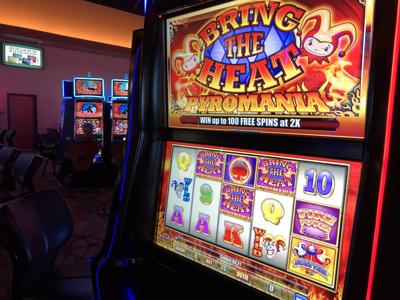

LOUISVILLE, Ky. (WDRB) – While casino gambling remains illegal in Kentucky, “historical horse racing” machines that mimic slots have grown to a $2 billion industry over the last decade, and racetracks like Churchill Downs are investing hundreds millions of dollars to bring more gaming venues to the state.
To hear the conservative Family Foundation of Kentucky tell it, this “massive gambling industry-driven expansion of slot gaming” has been predicated on a “nonsensical fiction” that players who sit at machines named Spin City, Pac-Man Wild or Treasures Atlantis and hit a button are actually making a pari-mutuel bet on an old horse race.
The Kentucky Supreme Court today takes up the Family Foundation’s nine-year battle with racetracks and the Kentucky Horse Racing Commission over the legality of historical horse racing.
It’s the second time the case has reached the state’s high court.
PODCAST:
The racetracks hope the court finally removes any doubt about the legal status of the growing industry. The Family Foundation says the racetracks “have had their run” and the court should shut the gaming venues down.
“If not reversed, this Court will have presided over the greatest expansion of gaming in the history of Kentucky without a vote of the people or the General Assembly,” the foundation says in its Supreme Court brief.
The industry has blossomed in the last five years, with $2.2 billion bet in state’s four gaming venues in fiscal year ended June 30. That’s an 11% increase from the prior year even though the venues were closed for three months amid the pandemic.

Churchill Downs alone plans three additional gaming venues in coming years, in Oak Grove near the Tennessee border, at Turfway Park in northern Kentucky and at its historic Louisville racetrack in a $300 million expansion that will also include a hotel.
Some horse industry proponents have long seen the legal battle as effectively settled, if not formally.
Sen. Maj. Floor Leader Damon Thayer, R-Georgetown, who helped clear the way for historical racing in 2010, told WDRB in May 2019 that the case was “over.”
“These people can continue to exhaust their appeals, but it’s not going to go anywhere,” he said.
Gov. Andy Beshear, a proponent of casino gambling, said Wednesday that historical horse racing has generated money to prop up the live-racing industry through bigger purses, tax revenue for the state’s general use and “allowed us to be competitive with some other states” that have full-fledged gambling.
“I think as a state, we need it to be ruled constitutional,” Beshear said.
RELATED: Is Kentucky being ‘shortchanged’ on its ‘slots’?
Back after six years
The court last took up the case in 2014, finding that the racing commission had the authority to license and regulate historical horse racing.
But the justices stopped short of delivering a complete victory to the racetracks. Instead, they said evidence needs to be collected to determine whether the games in use at the Kentucky venues actually are “an authorized form of pari-mutuel wagering.”
The high court will finally revisit that question on Friday.
The term “pari-mutuel wagering” is finely parsed in the case. In general, it refers to bets players make against each other (as in live horse racing), as opposed to bets made against the house (as in casino gambling).
While the machines are designed to look and feel like slots, the idea behind historical horse racing is that players are betting on the results of old horse races – which are randomly selected by the machine and invisible to the person making the bet.
In 2018, Franklin Circuit Judge Thomas Wingate sided with the racetracks, saying Kentucky’s definition of “pari-mutuel wagering” doesn’t require that players bet on the same races on the same day, nor that payouts be based on how other players bet, as in live horse-racing when odds are determined in real time.
The fact that forfeited money from losing bets funds payouts for future prizes -- even if one player’s loss was on a different race than the next player’s win -- satisfies the requirement that wagers be placed into “designated pools,” Wingate found.
The racetracks argue that historical racing is akin to exotic wagers in live racing, like the Pick 6, that span races over multiple days, and that adopting the Family Foundation’s view would invalidate those longstanding exotic bets. The Family Foundation rejects the equivalence.
Wingate acknowledged in his decision that the devices are designed to look like “Vegas style slot machines,” saying “a casual observer would be hard pressed to discern the difference.”
But “the design of the device is merely for entertainment purposes,” the judge said.
The Supreme Court last year agreed to directly take up the Family Foundation’s appeal of Wingate’s decision, skipping the Kentucky Court of Appeals.
The Family Foundation challenges the legality of the racing machines at all four of the state’s gaming venues, Churchill Downs’ Derby City Gaming, Keeneland Association’s The Red Mile, Kentucky Downs and Ellis Park.
But Wingate narrowed his review and decision to only the gaming system in use at Kentucky Downs and Ellis Park, which is made by Boynton Beach, Florida-based Exacta Systems.
Wingate didn’t examine or rule on the gaming systems behind the machines at the Red Mile or at Derby City Gaming, which hadn’t opened when Wingate conducted his 2018 trial.
Churchill Downs argues it would be “patently untenable” for the Supreme Court to shut down all historic racing venues, saying systems other than the one at Kentucky Downs and Ellis Park are “beyond this scope of this appeal.”
The case started in 2010 when the racetracks and the commission went to court to ask a judge for a “declaratory judgment” confirming the commission’s authority to approve and regulate what were then called “instant racing” machines. The Family Foundation intervened in the case to oppose that request.


